

Why Spherical Plain Bearing Selection Needs Surface and Model Checks?

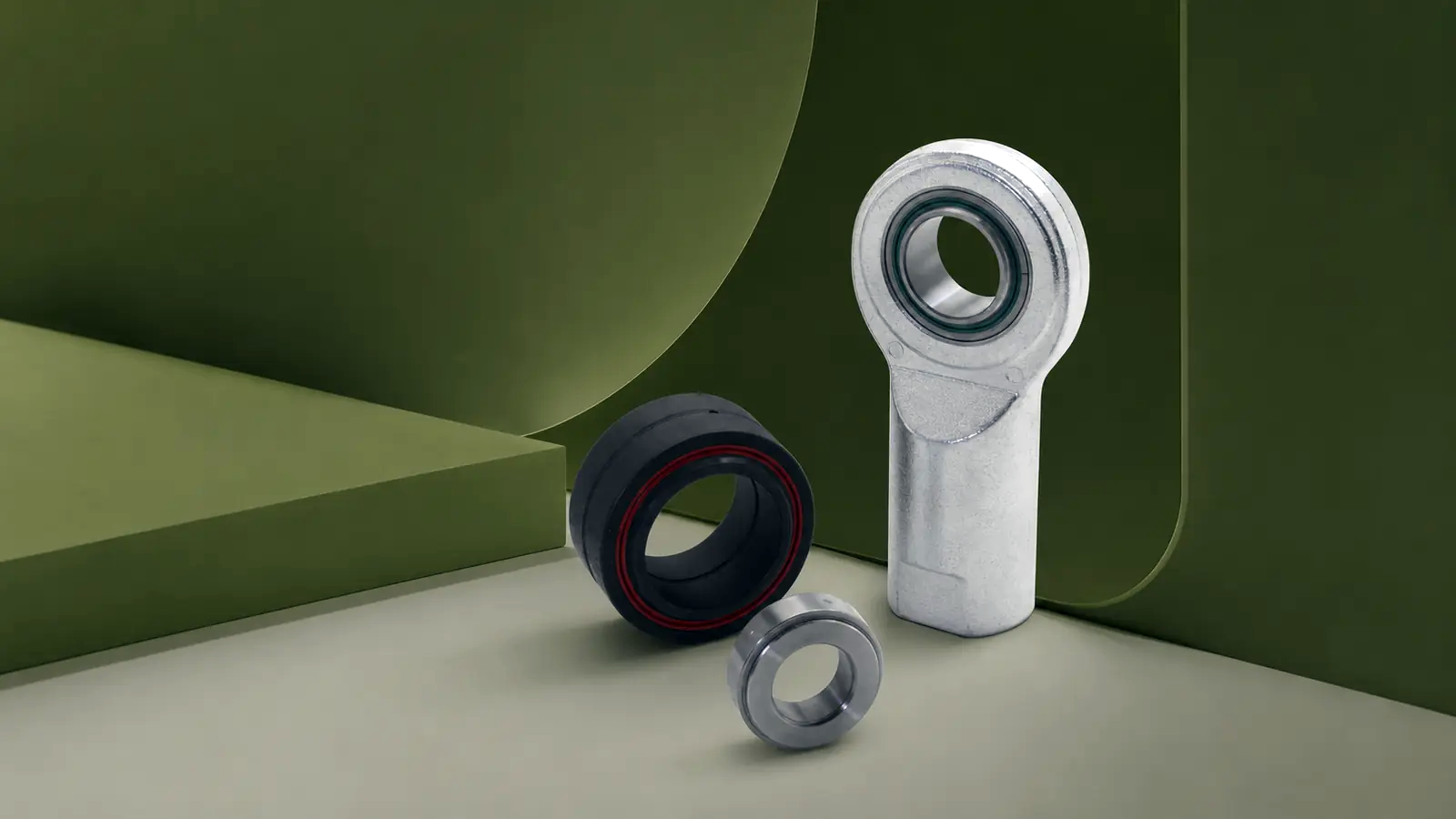
A spherical plain bearing supports oscillating or tilting movement through sliding contact rather than rolling elements. Its inner ring has a convex spherical outside surface, while the outer ring has a matching concave surface. This geometry accommodates misalignment within the model’s stated limit.
However, spherical plain bearings differ in load direction, sliding material, sealing and lubrication. A buyer must therefore confirm the full code instead of relying only on bore and outside diameter.
Table of contents
- What Defines the Structure of a Spherical Plain Bearing?
- Which Radial, Angular Contact and Thrust Types Are Available?
- How Do Sliding Surfaces Change Maintenance Requirements?
- Where Are Spherical Plain Bearings Commonly Used?
- What Must Buyers Check Before Selection?
- What Should Buyers Know About Installation and Removal?
- Which Brand Series and Complete Models Should Buyers Know?
- How Do Buyers Read a Spherical Plain Bearing Code?
- How Can HSN Support Spherical Plain Bearing Orders?
- FAQ
What Defines the Structure of a Spherical Plain Bearing?
The spherical sliding surfaces allow angular movement between the shaft and housing. This makes the bearing useful where deflection, mounting error or articulation cannot be avoided. The bearing can carry high static and alternating loads, but its speed range is normally lower than that of a rolling bearing.
The inner and outer rings may use steel/steel sliding contact or a maintenance-free sliding layer. Some products are split or fractured at the outer ring for assembly. Others use one-piece outer rings, seals or extended inner rings.
Permissible misalignment depends on ring geometry, shaft shoulders, housing clearance and seals. Surrounding parts must not restrict the intended movement.
Which Radial, Angular Contact and Thrust Types Are Available?
Radial spherical plain bearings mainly support radial load and can also carry a limited axial component. They are commonly identified by GE-related series. Extended-inner-ring versions can help where adjacent components need additional spacing.
Angular contact spherical plain bearings carry combined loads with a defined axial direction. They are often mounted in pairs when axial force can reverse. Thrust spherical plain bearings primarily carry axial load and can accept only a limited radial component.
Select the basic type from the actual load direction:
- Radial type for mainly radial and permitted combined loads
- Angular contact type for combined load with a significant axial component
- Thrust type for mainly axial load
- Rod end for integration with a threaded shank
The same bore size can exist in several families. Their ring widths, contact geometry and permissible loads are not identical.
How Do Sliding Surfaces Change Maintenance Requirements?
Steel/steel bearings generally require lubrication. Grease separates the sliding surfaces, reduces wear and helps protect against corrosion. Lubrication holes and grooves must align with the supply path.
Maintenance-free designs use PTFE-based fabric, composite or fibre-reinforced polymer sliding layers. They suit positions where relubrication is difficult. However, load, temperature, moisture, edge stress and oscillation angle still affect service behavior.
Sealed versions help retain lubricant and exclude contaminants. Nevertheless, seal material and lip position must suit the movement and temperature. A suffix that identifies seals should not be omitted from the purchase order.
Where Are Spherical Plain Bearings Commonly Used?
Typical applications include hydraulic cylinder eyes, construction equipment joints, agricultural linkages, material-handling systems, lifting equipment, dam gates and heavy-machinery articulation points.
These positions often combine slow oscillation, shock and misalignment. Therefore, selection should consider load direction, frequency of movement, contamination and access for lubrication.
For a hydraulic cylinder, the bearing must fit the pin, eye and retaining arrangement. In structural joints, corrosion protection and inspection access also matter.




What Must Buyers Check Before Selection?
Start with radial and axial loads, including peak and alternating forces. Then confirm oscillation angle, frequency, sliding speed and expected misalignment. A bearing that is suitable for static articulation may not suit continuous rotation.
Also check:
- Sliding contact material combination
- Required lubrication and grease compatibility
- Seal type and environmental exposure
- Bore, outside diameter, width and ring extension
- Housing fit, shaft or pin fit and axial retention
- Temperature and corrosion conditions
- Clearance or preload requirements for the arrangement
Similar GE numbers can share nominal dimensions while differing in sliding layer, seal design or maintenance requirements.
What Should Buyers Know About Installation and Removal?
Measure the shaft or pin and housing bore before mounting. Press on the ring with the interference fit, and do not transmit force through the sliding contact surface. Installation tools should support the ring evenly.
Protect seals and sliding layers from sharp shoulders. If temperature-assisted mounting is used, follow the manufacturer’s limits. After mounting, confirm that the joint reaches its required angle without interference.
For removal, support the housing and press the bearing out squarely. Inspect fretting, corrosion, polished edge zones and damaged seals. These marks can identify poor fit, restricted misalignment or inadequate lubrication.
Which Brand Series and Complete Models Should Buyers Know?
The following examples use different brand designation systems.
| Brand | Main spherical plain bearing range | Complete model example |
|---|---|---|
| SKF | GE and GEH radial series; GAC angular contact; GX thrust series | GE 20 ES-2RS |
| Schaeffler | GE..-DO maintenance-required and GE..-FW maintenance-free series | GE20-DO-2RS |
| RBC Bearings | MB metric radial series and B-series inch products | MB20SS |
SKF GE 20 ES-2RS is a sealed, maintenance-required radial spherical plain bearing. Schaeffler GE20-DO-2RS also identifies a sealed steel/steel radial design, but its suffix system belongs to Schaeffler. RBC MB20SS is an RBC metric sealed spherical plain bearing reference.
These model examples are not automatic interchanges. Dimensions, misalignment, sliding surfaces, seals, lubrication and load ratings must be compared before ordering.
How Do Buyers Read a Spherical Plain Bearing Code?
SKF GE 20 ES-2RS provides a practical code example.
| Code | Code section | Meaning |
|---|---|---|
| GE | BProduct prefix | Metric radial spherical plain bearing family |
| 20 | Size code | Nominal 20 mm bore group |
| ES | Sliding design | Steel/steel design requiring maintenance |
| 2RS | Seal suffix | Seals on both sides |
| GEH | Alternative prefix | Wider radial series in selected sizes |
| GAC | Alternative prefix | Angular contact spherical plain bearing family |
| GX | Alternative prefix | Thrust spherical plain bearing family |
Other SKF suffixes identify different sliding layers, ring designs or seal types. Buyers should never remove an unfamiliar suffix to make a quotation easier. The suffix may define the feature that makes the bearing suitable for the joint.
How Can HSN Support Spherical Plain Bearing Orders?
HSN Bearing Group supports model confirmation, sourcing, inspection, and custom supply discussions. Buyers should provide the complete reference, design type, dimensions, and load direction. HSN can review movement angle, misalignment, sliding surfaces, seals, lubrication, temperature, and mounting position. Quantity and working conditions should also be included. Supply checks focus on the exact execution.
For older or difficult models, HSN can review drawings, samples, fits, and application data. Replacement or custom supply can follow technical confirmation. Before shipment, agreed checks may cover dimensions, hardness, clearance, coating, seals, and appearance. A shared GE size code does not confirm identical performance. Load capacity, maintenance needs, internal design, and fit must be reviewed separately.
FAQ
Can a spherical plain bearing handle misalignment?
Yes, within its design limits. It cannot correct severe housing error, poor fits or unsuitable surrounding geometry.
Are maintenance-free designs free of all checks?
No. They may not need relubrication, but load, angle, temperature, contamination and installation still require review.
Can radial and thrust designs be interchanged?
No. Their load directions, ring geometry and mounting arrangements differ and must be checked separately.
Why does the sliding surface combination matter?
It controls lubrication needs, friction, wear, temperature limits and suitability for oscillating movement.
Remarks
For detailed spherical plain bearing models not listed above, please contact HSN for model confirmation and supply discussion. When checking spherical plain bearing references, you can also send the complete model number, photos, dimensions, quantity, and working conditions for review.
This article is based on independent analysis of publicly available technical information and industry understanding for knowledge sharing. All brand names and trademarks mentioned belong to their respective owners. HSN Bearing Group is an independent bearing supplier and technical service provider.
Tel: +86 156 6578 7336 Email: service@hsnindustrial.com Website: www.rollingparts.com www.hsnbearing.com
Need Help Confirming a Spherical Plain Bearing?
If you urgently need a hard-to-find spherical plain bearing from stock in China, contact HSN. We can also discuss an alternative solution after technical confirmation.