

Why Ceramic Ball Bearings Need Material and Model Checks?

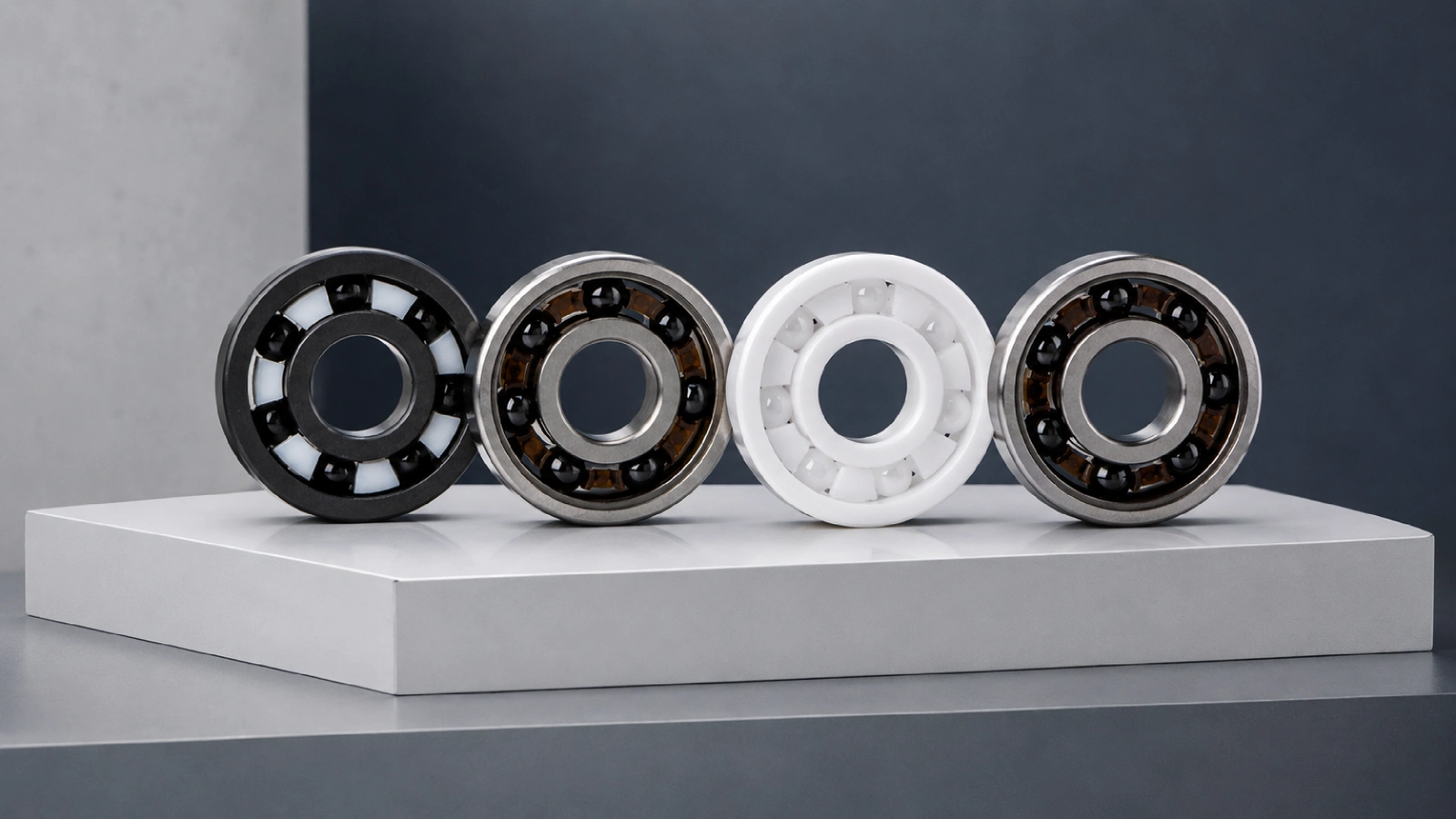
The term ceramic ball bearings can describe more than one construction. Hybrid bearings use steel rings with ceramic balls, while full-ceramic bearings use ceramic rings and rolling elements. Their load behavior, fits, temperature limits and handling requirements are different.
SKF standard industrial ceramic-bearing offer is mainly based on hybrid designs with bearing-steel rings and bearing-grade silicon nitride balls. Buyers should confirm this construction, along with the complete designation, before comparing products.
Table of contents
- How Do Hybrid and Full-Ceramic Ball Bearings Differ?
- Which Ceramic Materials and Bearing Structures Are Used?
- Where Are Ceramic Ball Bearings Commonly Used?
- What Must Buyers Check Before Selection?
- What Should Buyers Know About Installation and Removal?
- Which SKF Hybrid Bearing Series Should Buyers Know?
- How Do Buyers Read an SKF Ceramic Bearing Code?
- How Can HSN Support Ceramic Ball Bearing Orders?
- FAQ
How Do Hybrid and Full-Ceramic Ball Bearings Differ?
A hybrid ball bearing combines steel raceways with silicon nitride balls. The ceramic balls are electrically insulating, lighter than steel balls and resistant to adhesive wear. These properties can support high-speed or electrically exposed applications when the rest of the design is suitable.
A full-ceramic bearing uses ceramic rings as well as ceramic rolling elements. It may be selected for corrosion, temperature or electrical requirements, but its ring material and fit behavior differ substantially from steel-ring bearings.
The two constructions should not be grouped under one generic specification. Buyers must state ring material, ball material, cage, seals, lubricant and required clearance. A request for “6205 ceramic bearing” is incomplete without these details.
Which Ceramic Materials and Bearing Structures Are Used?
Silicon nitride is widely used for balls in industrial hybrid bearings. It provides electrical insulation and low rolling-element mass. Other ceramic materials can appear in specialized full-ceramic bearings, but their chemical, thermal and mechanical characteristics vary.
Hybrid ball-bearing structures include:
- Deep groove ball bearings for radial load and moderate axial load
- Angular contact ball bearings for combined load and axial location
- Super-precision angular contact bearings for high-speed spindles
- Sealed or shielded variants with selected grease and cage designs
Material alone does not define performance. Ring heat treatment, internal geometry, precision, preload, cage and lubrication remain important.
Where Are Ceramic Ball Bearings Commonly Used?
Hybrid deep groove ball bearings are used in electric motors and generators where shaft voltage can damage conventional steel rolling contacts. They can also be considered for variable-frequency-drive motor positions after the complete electrical and mechanical arrangement is reviewed.
Hybrid super-precision angular contact bearings are used in machine-tool spindles, turbomolecular pumps and other high-speed systems. Their lower ball mass can reduce centrifugal effects, but precision, preload and lubrication must be controlled carefully.
Other possible applications include compressors, pumps and industrial equipment exposed to poor lubrication or contamination. Nevertheless, the required advantage should be identified first. A hybrid bearing should not be selected only because “ceramic” sounds more advanced.



What Must Buyers Check Before Selection?
First identify the main requirement: electrical insulation, speed, low friction, contamination resistance, precision or lubricant life. Then compare radial and axial loads, temperature, duty cycle and required reliability.
Buyers should also confirm:
- Steel-ring hybrid or full-ceramic construction
- Silicon nitride ball specification
- Bearing type and complete size designation
- Internal clearance or preload
- Precision class and matching arrangement
- Cage, seals, shields and grease
- Shaft and housing fits
- Electrical grounding and insulation strategy
For a motor, one hybrid bearing may change the current path through the machine. Electrical design should therefore be reviewed with the equipment specialist. For a spindle, preload and lubrication can be more important than the material label alone.
What Should Buyers Know About Installation and Removal?
Keep the bearing sealed in clean packaging until mounting. Ceramic balls can resist rolling contact well, but impact or improper mounting can still damage rolling elements, raceways or cages. Do not strike the bearing or transmit installation force through the balls.
Apply force to the ring with the interference fit. If a steel-ring hybrid bearing is heated for mounting, follow the manufacturer’s temperature limit for the cage, seals and lubricant. Do not assume that ceramic balls allow unlimited heating.
After installation, check rotation, noise and temperature during controlled start-up. For a precision pair, retain the marked mounting order and direction. During removal, record electrical damage, lubrication condition and raceway marks before cleaning or discarding the bearing.
Which SKF Hybrid Bearing Series Should Buyers Know?
SKF supplies hybrid variants in several ball-bearing families. The examples below show how the ceramic feature is integrated with other design codes.
| SKF hybrid series | Main bearing design | Complete model example |
|---|---|---|
| 60 series | Hybrid deep groove ball bearing; sealed executions are available | 6004-2RSLTN9/HC5C3WT |
| 62 series | Hybrid deep groove ball bearing; open or sealed executions are available | 6205-2RSLTN9/HC5C3WT |
| 63 series | Hybrid deep groove ball bearing | 6305 TN9/HC5C3 |
| 719 series | Super-precision hybrid angular contact ball bearing | 71905 ACDGA/HCP4A |
| 70 series | Super-precision hybrid angular contact ball bearing | 7005 CEGA/HCP4A |
SKF lists hybrid deep groove ball bearings in the 60, 62, and 63 series, including configurations with low-friction seals, polymer cages, ceramic balls, increased clearance, and specified grease. The 719 and 70 examples belong to SKF super-precision angular contact range and serve different accuracy, speed, and load requirements.
Therefore, buyers should not compare these bearings only because they all contain ceramic rolling elements. The bearing series, dimensions, internal design, seals, cage, clearance, lubrication, precision requirements, and application conditions should be checked together.
How Do Buyers Read an SKF Ceramic Bearing Code?
The example 6205-2RSLTN9/HC5C3WT shows how a sealed hybrid deep groove ball bearing reference can be read section by section.
| Code | Code section | Meaning |
|---|---|---|
| 6205 | Basic designation | 62-series single-row deep groove ball bearing with a 25 mm bore |
| 2RSL | Seal suffix | seals on both sides |
| TN9 | Cage suffix | Glass-fibre-reinforced PA66 cage, ball centred |
| HC5 | Rolling-element material suffix | Balls made of bearing-grade silicon nitride |
| C3 | Clearance suffix | Radial internal clearance greater than Normal |
| WT | Lubrication suffix | Wide-temperature grease execution |
The complete 6205-2RSLTN9/HC5C3WT designation is important because the basic 6205 number alone does not identify the seals, cage, ceramic rolling elements, internal clearance, or lubrication execution.
A similar basic size does not confirm that two ceramic ball bearings have the same design or operating capability. Before approving a model or replacement, buyers should check the bearing type, rolling-element material, dimensions, seals, cage, internal clearance, lubrication, precision requirements, speed, and operating conditions.
How Can HSN Support Ceramic Ball Bearing Orders?
HSN Bearing Group first confirms whether the request involves a hybrid or full-ceramic bearing. Buyers should provide the complete model, dimensions, quantity, and operating environment. HSN can review ring material, ball material, precision, clearance, cage, seals, and lubricant. Load, speed, temperature, and electrical requirements also matter. Supply checks use the exact construction rather than the base number.
For special requirements, HSN can review drawings, samples, fits, and working conditions. Replacement or custom supply can follow technical confirmation. Before shipment, agreed checks may cover dimensions, clearance, markings, appearance, and rotation. Buyers may also request material, accuracy, vibration, noise, or other performance checks. Similar references do not automatically confirm equivalent materials or performance.
FAQ
How do hybrid and full-ceramic bearings differ?
Hybrid bearings use ceramic balls with metal rings. Full-ceramic designs use ceramic rolling elements and rings.
Are ceramic bearings always electrically insulating?
No. Electrical behavior depends on all materials and current paths in the assembly, so the requirement must be verified.
Can ceramic bearings withstand any temperature?
No. Cage, seals, lubricant, fits, load and thermal expansion can limit the usable operating range.
Can similar base codes confirm ceramic equivalence?
No. Confirm the complete suffix, ceramic material, ring material, precision, clearance, cage and lubrication.
Remarks
For detailed ceramic ball bearing models not listed above, please contact HSN for model confirmation and supply discussion. When checking ceramic ball bearing references, you can also send the complete model number, photos, dimensions, quantity, and working conditions for review.
This article is based on independent analysis of publicly available technical information and industry understanding for knowledge sharing. All brand names and trademarks mentioned belong to their respective owners. HSN Bearing Group is an independent bearing supplier and technical service provider.
Tel: +86 156 6578 7336 Email: service@hsnindustrial.com Website: www.rollingparts.com www.hsnbearing.com
Need Help Confirming a Ceramic Ball Bearing?
If you urgently need a hard-to-find ceramic ball bearing from stock in China, contact HSN. We can also discuss an alternative solution after technical confirmation.