

Why Bushings Need Material, Fit and Lubrication Checks?

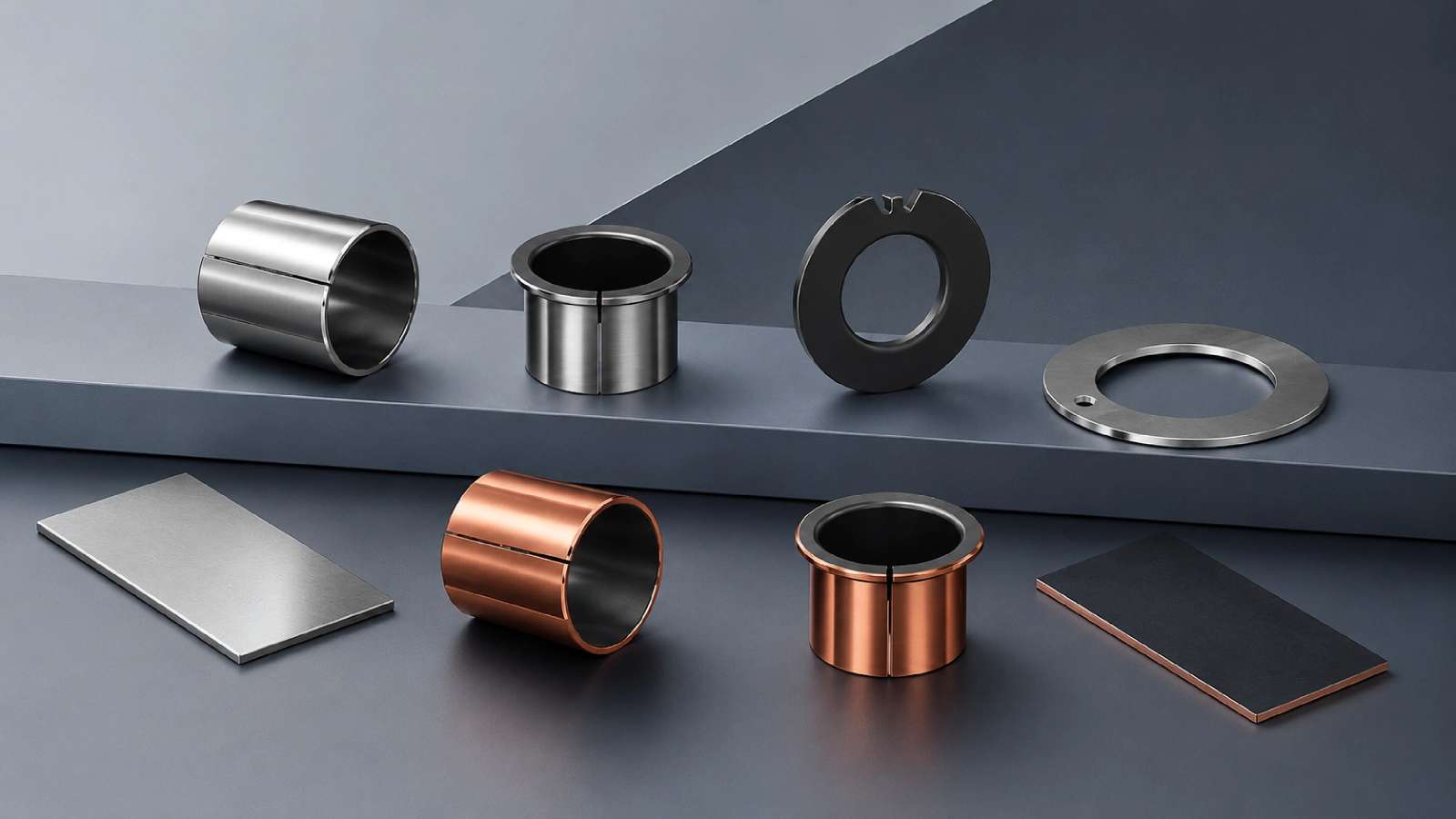
Bushings support a shaft, pin or sliding member through direct sliding contact. Without rolling elements, their material, surface finish, running clearance and lubrication determine joint behavior. Correct dimensions alone do not ensure suitability.
Buyers should identify the bushing form, backing material, sliding layer and complete model code. For branded products, the series name is part of the technical specification rather than a general quality label.
Table of contents
- What Is a Bushing and How Does It Support Motion?
- Which Bushing Materials and Structures Should Buyers Compare?
- How Do the Main GGB Bushing Series Differ?
- Where Are Bushings Commonly Used?
- What Fit and Operating Data Must Buyers Confirm?
- What Should Buyers Know About Installation and Removal?
- Which GGB Product Families and Model Examples Should Buyers Know?
- How Do Buyers Read a GGB Bushing Code?
- How Can HSN Support Bushing Orders?
- FAQ
What Is a Bushing and How Does It Support Motion?
A cylindrical bushing is installed between a housing and a moving shaft or pin. It can support rotating, oscillating or linear motion, depending on its material and design. Flanged bushings also provide an axial locating surface, while thrust washers carry axial sliding load.
Wrapped metal-polymer bushings use a metal backing for strength and a low-friction sliding layer. Fibre-reinforced composite bearings use a structural composite backing with a wear-resistant liner. Other categories include bimetal, sintered-metal and engineered-polymer bushings.
The bushing, shaft and housing form one sliding system. Shaft finish, hardness, lubricant and housing fit all change the contact conditions.
Which Bushing Materials and Structures Should Buyers Compare?
Metal-polymer bushings can work dry, greased or lubricated according to the material. Their thin wrapped construction is compact, but installation determines the final bore size.
Self-lubricating bearings use a sliding layer that reduces dependence on external grease. However, “self-lubricating” does not mean every series can run dry under every load, speed or temperature.
Fibre reinforced composite bearings combine a wound-fibre structure with a low-friction liner. Selected grades suit high-load, corrosive or shock-loaded joints, while machinable grades allow final sizing.
Before comparing materials, confirm:
- Rotating, oscillating or linear motion
- Load, speed, duty cycle and edge loading
- Dry, greased, oil-lubricated or water-lubricated service
- Shaft material, hardness and surface finish
- Temperature, chemicals, moisture and contamination
- Required wall thickness, flange and axial support
How Do the Main GGB Bushing Series Differ?
GGB DU is a metal-polymer, self-lubricating bearing material used in dry and lubricated applications. Standard forms include cylindrical bushings, flanged bushings, thrust washers and strip.
GGB DP4 is a lead-free metal-polymer material for dry, greased or lubricated movement. DP4-B uses a bronze backing where corrosion resistance or non-magnetic behavior is important. GGB DX is intended mainly for grease-lubricated applications.
GGB’s fibre reinforced composite range includes GAR-MAX, HPMB, HSG and GAR-FIL. GAR-MAX covers cylindrical and customized forms, while HPMB is a precision, machinable composite bearing. Select each family by operating conditions.
Where Are Bushings Commonly Used?
Bushings are used in hydraulic cylinder pivots, construction equipment, agricultural linkages, pumps, valves, automotive systems, packaging machinery and material-handling equipment.
Dry-running metal-polymer bushings can be useful where regular greasing is difficult. Grease-lubricated materials suit joints with an established maintenance system. Fibre composite designs can support corrosive, contaminated or high-load pivot applications when shaft and housing conditions are suitable.
A lightly loaded linkage has different requirements from a hydraulic pivot or continuously rotating pump.




What Fit and Operating Data Must Buyers Confirm?
Start with the installed bore, housing diameter and bushing width. A wrapped bushing may close to its final bore only after it is pressed into the specified housing. Measuring the free bushing alone does not confirm the operating clearance.
Also review shaft diameter, surface roughness, hardness and coating. Excessive roughness can wear the liner. Housing material and wall thickness influence interference and heat transfer.
For design review, provide load direction, motion type, speed, oscillation angle, temperature, contamination and lubricant. If the joint carries axial load, confirm whether a flange or separate thrust washer is needed.
What Should Buyers Know About Installation and Removal?
Use a clean, chamfered housing and a flat-ended installation mandrel. Align the split correctly and press the bushing in squarely. Do not hammer directly on the thin edge or scrape the sliding layer across a sharp housing corner.
After installation, verify the bore and running clearance. Do not ream or machine a finished metal-polymer liner unless the manufacturer permits that process. For flanged bushings, support the flange and confirm that it seats without distortion.
During removal, support the full circumference. Inspect the shaft for scoring, transfer material and corrosion before installing a new bushing.
Which GGB Product Families and Model Examples Should Buyers Know?
GGB offers several metal-polymer bearing families with different backing materials and sliding-layer designs. Buyers should identify both the product family and the complete part number before comparing dimensions or replacement options.
| GGB product family | Main construction or form | Complete model example |
|---|---|---|
| DU | Steel-backed metal-polymer cylindrical bushing | 2020DU |
| DU | Steel-backed metal-polymer flanged bushing | BB0808DU |
| DP4 | Lead-free, steel-backed metal-polymer cylindrical bushing | 2020DP4 |
| DP4-B | Lead-free, bronze-backed metal-polymer cylindrical bushing | 2020DP4B |
| DU | Steel-backed metal-polymer thrust washer | WC18DU |
These examples show that GGB references can combine a product-family designation with size or form codes. The coding pattern is not identical for cylindrical bushings, flanged bushings, and thrust washers, so buyers should retain the complete reference when checking dimensions or replacements.
Other GGB families, such as GAR-MAX and HPMB, use different product references. Buyers should check the relevant dimensional table or drawing rather than applying the DU coding pattern to other families.
How Do Buyers Read a GGB Bushing Code?
The complete 2020DU reference is important because the size code and product-family suffix must be checked together when confirming the correct bushing.
| Code | Code section | Meaning |
|---|---|---|
| 20 | Bore size section | Nominal 20 mm bore diameter |
| 20 | Width section | Nominal 20 mm bushing width |
| DU | Product-family suffix | GGB DU metal-polymer bearing family |
Other GGB references follow different coding patterns. For example, BB0808DU identifies a DU flanged-bushing reference, while WC18DU identifies a DU thrust washer. DP4 and DP4B refer to different metal-polymer product families. Buyers should therefore check each complete reference against the corresponding GGB dimensional table rather than applying the 2020DU format to every product.
A similar size code does not confirm that DU, DP4, and DP4-B products are interchangeable. Buyers should also check backing material, sliding-layer design, shaft and housing fit, lubrication conditions, temperature, load, and operating environment before selecting a replacement.
How Can HSN Support Bushing Orders?
HSN Bearing Group supports reference confirmation, sourcing, inspection, and custom supply discussions. Buyers should provide the complete part number, dimensions, quantity, and product form. HSN can review wall thickness, sliding material, backing material, and lubrication method. Shaft, housing, load, speed, temperature, motion, and environment also guide selection. Supply is evaluated against the full construction.
For difficult or non-standard bushings, HSN can review drawings, samples, fits, and working conditions. Production or replacement supply can follow technical confirmation. Before shipment, agreed checks may cover dimensions, wall thickness, material, flange geometry, and surface condition. The same nominal size does not prove interchangeability. Material behavior, installed clearance, lubrication, and housing fit may differ.
FAQ
Do all bushings require grease?
No. Some are designed for dry running, while others need grease or oil. Follow the material and series requirements.
How is bushing running clearance established?
It depends on the installed bore, shaft size, housing fit, wall thickness, temperature and material behavior.
Can a bushing be installed with direct hammer blows?
No. Use a suitable arbor or mandrel to press it evenly and avoid damaging the edge or sliding surface.
Which conditions guide bushing material selection?
Check load, speed, motion, temperature, lubrication, contamination, corrosion, shaft and housing conditions., wear, temperature limits and suitability for oscillating movement.
Remarks
For detailed bushing models not listed above, please contact HSN for model confirmation and supply discussion. When checking bushing references, you can also send the complete model number, photos, dimensions, quantity, and working conditions for review.
This article is based on independent analysis of publicly available technical information and industry understanding for knowledge sharing. All brand names and trademarks mentioned belong to their respective owners. HSN Bearing Group is an independent bearing supplier and technical service provider.
Tel: +86 156 6578 7336 Email: service@hsnindustrial.com Website: www.rollingparts.com www.hsnbearing.com
Need Help Confirming a Bushing?
If you urgently need a hard-to-find bushing from stock in China, contact HSN. We can also discuss an alternative or improved solution after technical confirmation.