

Why Cross Roller Slewing Bearing Selection Needs Structure Checks?

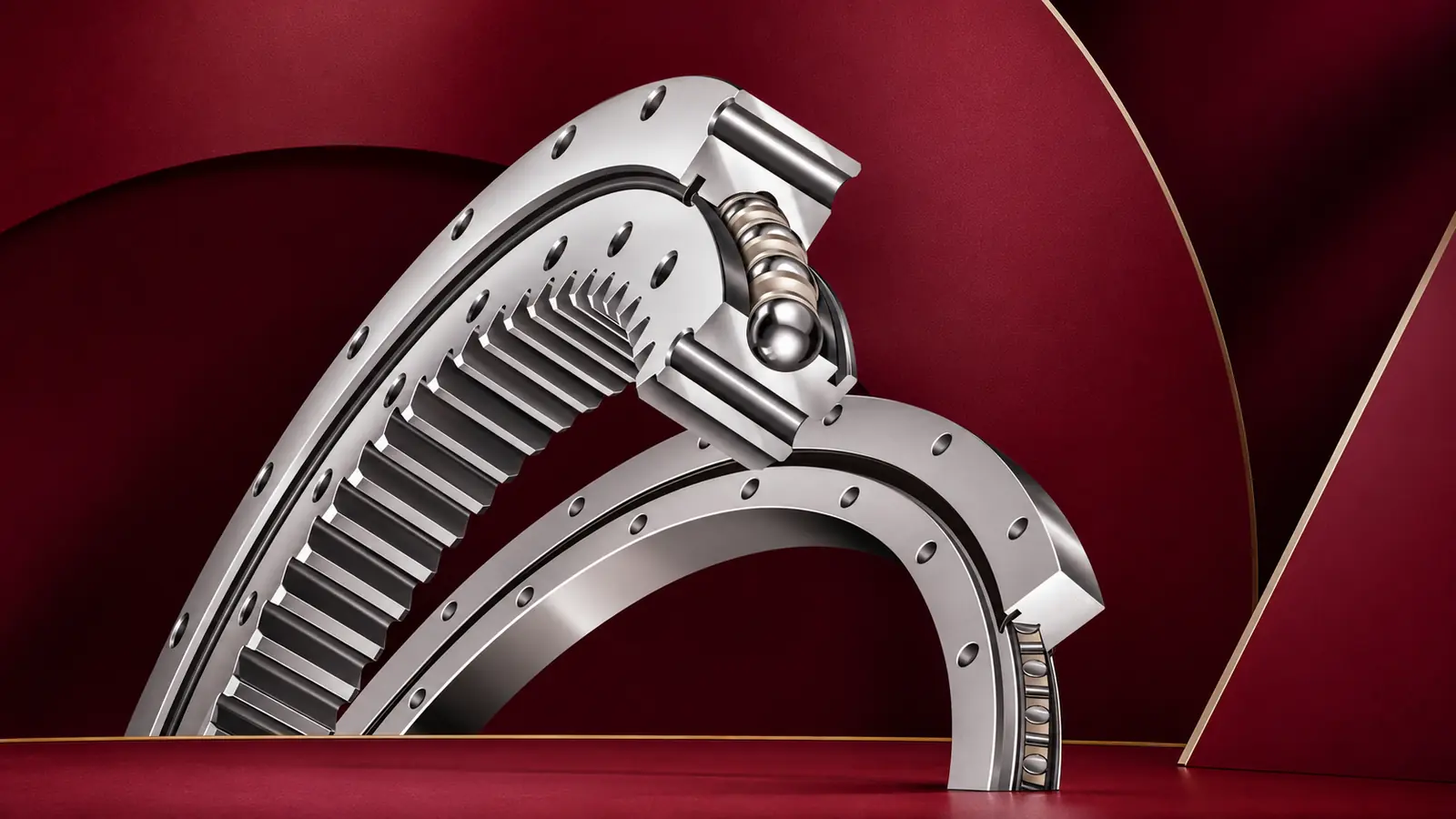
A cross roller slewing bearing uses cylindrical rollers arranged with alternating axes. This layout allows one bearing position to support radial load, axial load, and tilting moment. It also provides the stiffness and uniform rotational resistance needed in many slow-turning precision systems.
However, the product name alone is not enough for purchasing. Buyers must confirm the gear arrangement, mounting holes, preload, accuracy, sealing, lubrication, and load direction. Two bearings with similar boundary dimensions can have different bolt patterns or ring functions. Therefore, the complete designation and drawing should guide every inquiry.
Table of contents
- Which Cross Roller Slewing Bearing Types Are Available?
- Where Are Crossed Roller Slewing Bearings Used?
- What Operating Data Must Buyers Confirm?
- What Should Buyers Check During Installation and Removal?
- Which Brand Series and Complete Models Should Buyers Know?
- How Do Buyers Read an INA Slewing Bearing Code?
- How Can HSN Support Slewing Bearing Orders?
- FAQ
Which Cross Roller Slewing Bearing Types Are Available?
The main components are an inner ring, an outer ring, cylindrical rollers, spacers, seals, and lubrication points. Adjacent rollers cross at right angles, so their load directions alternate around the raceway. Many designs also use preload to remove operating clearance and improve rigidity.
The rings usually contain through holes or threaded holes for direct mounting. Depending on the design, gear teeth may be machined on the outer ring, on the inner ring, or omitted. This creates three practical groups:
| Type | Structural feature | Main ordering check |
|---|---|---|
| External gear | Gear teeth on the outer ring | Gear module, tooth count, drive position, and ring rotation |
| Internal gear | Gear teeth on the inner ring | Internal gear dimensions, pinion access, and mounting space |
| No gear | Plain inner and outer rings | Separate drive method, hole pattern, and centring features |
Preload and accuracy also matter. A preloaded unit can provide stable rotation, but it places stricter demands on support stiffness and mounting-face flatness. Buyers should not assume that every crossed roller slewing bearing has the same preload or running accuracy.
Where Are Crossed Roller Slewing Bearings Used?
These bearings suit equipment that combines limited installation space with moment load and rotational accuracy. Common applications include industrial robots, rotary tables, machine tools, handling systems, radar mechanisms, excavators, and tunnel-boring equipment.
The selection reason differs by application. A machine-tool table may prioritize stiffness and runout. A handling system may place more emphasis on moment load, duty cycle, and sealing. Meanwhile, a geared slewing position also requires tooth capacity and backlash checks. Application data must therefore accompany the model number.




What Operating Data Must Buyers Confirm?
Start with the maximum axial load, radial load, and tilting moment. Also identify whether these loads act separately or at the same time. The operating cycle, rotation angle, speed, acceleration, shock, and expected positioning accuracy affect the final choice.
In addition, confirm these points before ordering:
- Preload or operating-clearance requirement
- Required rotational accuracy and stiffness
- Continuous or intermittent motion
- Operating temperature and contamination level
- Grease or oil lubrication method
- Seal arrangement and relubrication access
- Gear type, module, tooth count, pressure angle, and backlash
- Mounting-hole pattern, bolt grade, and adjacent structure
A complete load case is more useful than a single maximum value. It helps determine whether the raceway, bolts, and gear all meet the same operating requirement.
What Should Buyers Check During Installation and Removal?
The mounting faces must support both rings across their full width and circumference. Poor flatness or an elastic support frame can distort the raceway. Before assembly, clean the seating surfaces and remove burrs, paint deposits, welding residue, and raised edges.
Place the bearing in the specified orientation. The hardness gap and loading plug area should not sit in the main load zone. Insert the fasteners without forcing misaligned holes, then tighten them in a crosswise sequence to the approved torque. For a geared design, check tooth backlash at the position with the tightest gear mesh.
After mounting, rotate the unit and check resistance before applying the full load. Lubricate the raceway and gear according to the operating plan. During removal, support the bearing evenly and record its orientation. Avoid hammering the rings, rollers, seals, or gear teeth.
Which Brand Series and Complete Models Should Buyers Know?
International manufacturers use different designation systems. The examples below show how series and gear arrangements can differ. They are identification references, not proof of interchangeability.
| Brand | Main series or arrangement | Complete model example |
|---|---|---|
| INA / Schaeffler | XSA 14 external gear; XSI 14 internal gear; XSU 14 without gear | XSA 14 0544 N |
| SKF | RKS.161 external gear; RKS.162 internal gear; RKS.160 without gear | RKS.162.14.1094 |
| Kaydon | MB metric radial series and B-series inch XR cross roller series with no gear, internal gear, or external gear | 16328001 |
The Kaydon XR series uses product numbers and includes application-specific configurations. Therefore, buyers should request the associated drawing. Likewise, similar INA and SKF size sections do not establish a direct interchange. Ring dimensions, hole patterns, gear data, preload, and accuracy still require comparison.
How Do Buyers Read an INA Slewing Bearing Code?
INA model XSA 14 0544 N provides a useful code example. Each section describes a structural or dimensional feature.
| Code | Code section | Meaning |
|---|---|---|
| X | Bearing type | Crossed roller bearing |
| S | Series group | Standard series designation |
| A | Gear arrangement | External gear teeth |
| 14 | Roller-size section | 14 mm rolling-element diameter group |
| 0544 | Size section | 544 mm rolling-element pitch-circle diameter group |
| N | Gear treatment suffix | Normalized gear teeth |
This reading method applies to this designation system only. Other brands can use different prefixes, punctuation, and dimension logic. Retain spaces, dots, and suffixes when sending an inquiry.
How Can HSN Support Slewing Bearing Orders?
HSN Bearing Group supports model confirmation, sourcing, inspection, and custom production discussions. Buyers should provide the complete reference, drawing, quantity, and mounting orientation. HSN can review boundary dimensions, hole pattern, gear data, seals, lubrication, clearance, and preload. Radial, axial, and moment loads also require confirmation. Speed, duty cycle, and working conditions guide the supply review.
For obsolete or difficult models, HSN can review photos, samples, drawings, and application data. Replacement or custom design can follow technical confirmation. Before shipment, checks may cover dimensions, hardness, gear accuracy, clearance, preload, and surface condition. Material, rotational, or flaw-detection checks can also be discussed. A similar diameter or gear form does not prove interchangeability.
FAQ
Can one slewing bearing carry combined loads?
Yes, if its design and rating suit the radial, axial and moment loads, mounting stiffness and operating cycle.
Do geared and gearless types mount the same way?
They share basic mounting checks, but geared types also require tooth alignment, backlash and drive inspection.
Where should the hardness gap be positioned?
Keep it outside the main load zone and follow the bearing maker’s orientation and loading-plug instructions.
What data is needed for a replacement review?
Send the full code, drawing, dimensions, hole and gear data, loads, accuracy, speed, lubrication and quantity.
Remarks
For detailed cross roller slewing bearing models not listed above, please contact HSN for model confirmation and supply discussion. When checking cross roller slewing bearing references, you can also send the complete model number, photos, dimensions, quantity, and working conditions for review.
This article is based on independent analysis of publicly available technical information and industry understanding for knowledge sharing. All brand names and trademarks mentioned belong to their respective owners. HSN Bearing Group is an independent bearing supplier and technical service provider.
Tel: +86 156 6578 7336 Email: service@hsnindustrial.com Website: www.rollingparts.com www.hsnbearing.com
Need Help Finding a Crossed Roller Slewing Bearing?
If you need a difficult cross roller slewing bearing reference, contact HSN with the full model, drawing, loads, gear data, quantity and inspection requirements.