

How Should Buyers Compare Tapered Bearings Before Ordering?

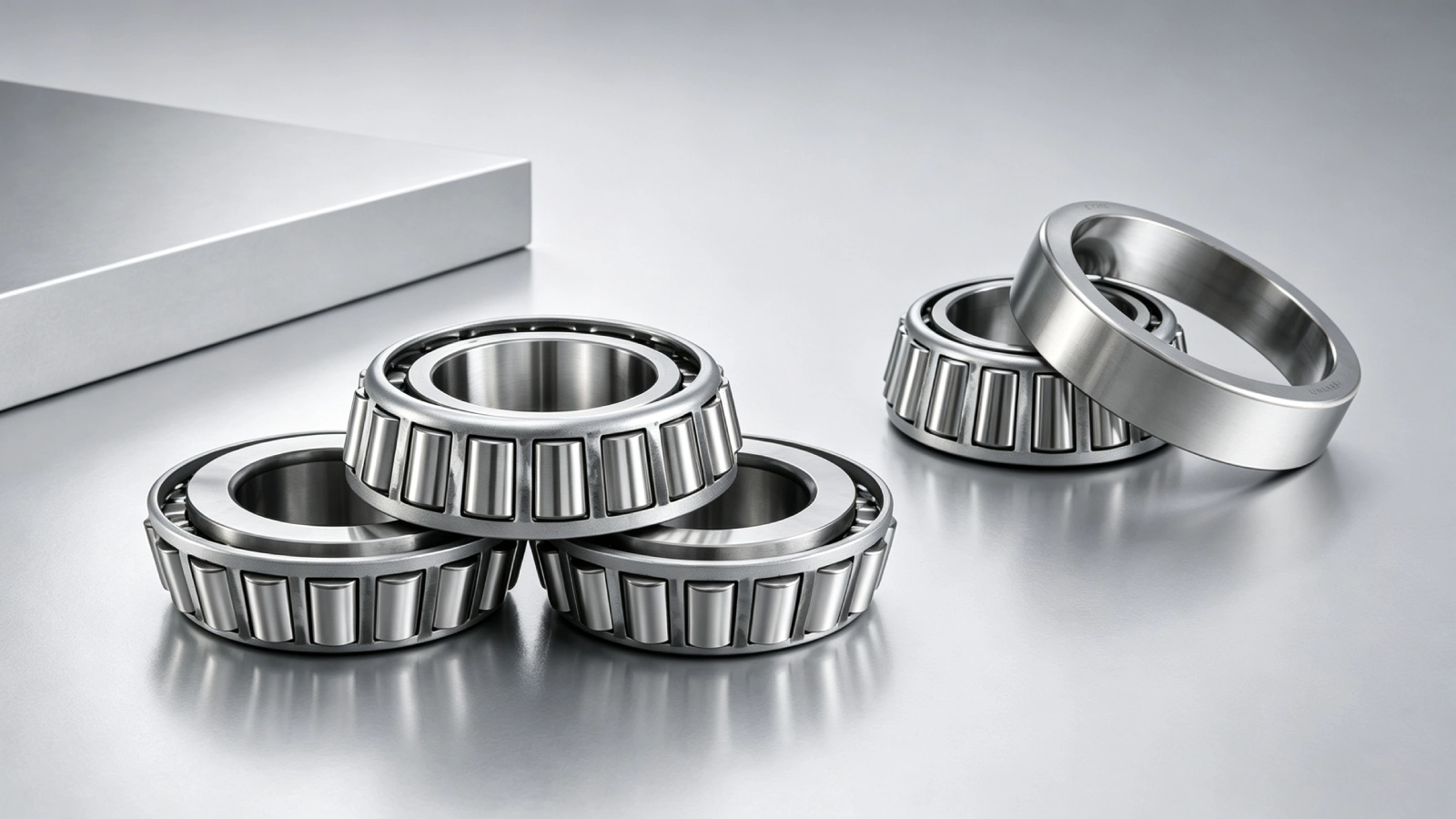
Industrial buyers often use the phrase tapered bearings for bearings with tapered rollers and matching raceways. This geometry carries combined radial and axial load, but row arrangement, contact angle, setting, cup and cone dimensions, and suffixes control the result. Therefore, a bore-only request cannot define a safe purchase.
Table of contents
- What Structure and Classifications Should Buyers Check?
- Where Are Tapered Bearings Used?
- What Should Buyers Verify Before Ordering?
- Which Brand Series and Complete Models Should Buyers Know?
- How Do Buyers Read a Metric Tapered Bearing Code?
- What Installation and Removal Practices Matter?
- How Can HSN Support Tapered Bearing Orders?
- FAQ
What Structure and Classifications Should Buyers Check?
A radial tapered roller bearing contains a cone assembly and a separate cup. The cone assembly includes the inner ring, tapered rollers, and cage. Because the roller and raceway extensions meet at a common point on the bearing axis, the bearing can roll under combined load with controlled sliding.
Timken uses several design classifications for tapered roller bearings, including:
- TS single-row designs, normally used alone against another bearing.
- TSF single-row designs with a flanged cup for axial location.
- TDO double-row designs with one double cup and two cones.
- TDI designs with one double cone and two cups.
- TNA non-adjustable double-row designs with a built-in setting.
- Four-row designs for applications such as rolling-mill roll necks.
Single-row units support axial load primarily in one direction. Therefore, designers often install them in direct or indirect pairs. Double-row and four-row arrangements can support loads in both axial directions. Where the design uses matched spacers, preset components, or factory-controlled clearances, buyers should keep those parts with the original bearing assembly.
Where Are Tapered Bearings Used?
Typical applications include automotive wheel ends, transmissions, gearboxes, differentials, construction machinery, agricultural equipment, rail systems, pumps, mining equipment, and rolling mills. Each application creates a different balance of radial load, thrust load, moment, shock, speed, and stiffness.
Before ordering, provide the load direction and magnitude, speed, duty cycle, required life, temperature, lubrication, contamination, and shaft arrangement. Also state whether the application uses a single bearing, an opposed pair, or a preset multi-row assembly.
Setting deserves special attention. Too much endplay can reduce guidance and stiffness, while excessive preload can increase heat and torque. Consequently, buyers should request the approved endplay or preload target and the measurement method used during assembly.





What Should Buyers Verify Before Ordering?
First, confirm the complete cone and cup identification. Some metric products use one assembly designation, while other systems mark the cone and cup separately. Then verify bore, outside diameter, total width, individual ring widths, contact angle, chamfers, shoulders, and effective load centre.
Next, compare dynamic and static load ratings, speed limits, cage, accuracy class, internal geometry, lubricant, and operating setting. A suffix can identify a modified angle, tolerance, surface, or internal arrangement. Therefore, removing it can change performance even when the main dimensions match.
Finally, check whether the product is supplied as components, a matched set, or a preset assembly. Keep spacers and matched rings together. Also, confirm whether the drawing uses metric or inch dimensions before accepting a similar-looking number.
Which Brand Series and Complete Models Should Buyers Know?
The examples below show three international designation formats. Similar numbers can share nominal dimensions, but they do not automatically share ratings, internal geometry, tolerances, or suffix meaning.
| Brand | Series examples | Complete model example |
|---|---|---|
| Timken | TS; TSF; TDO; TDI; TNA; original metric 32000 series | 32005X; XAA32005X / YAA32005X |
| SKF | 302; 303; 320; 322; 323 single-row series | 32005 X/Q |
| NSK | HR metric single-row tapered roller series | HR32005XJ |
Timken also offers separate cone and cup codes and preset multi-row types. Meanwhile, SKF and NSK add brand-specific suffixes to their base numbers. Buyers should compare the current drawings and application data rather than treating the common `32005` stem as proof of equivalence.
How Do Buyers Read a Metric Tapered Bearing Code?
Timken model 32005X is a metric tapered roller bearing. Its main code sections can be read as follows.
| Code | Code section | Meaning |
|---|---|---|
| 3 | Bearing type | Tapered roller bearing in the original metric system |
| 2 | Width series | Width-series classification |
| 0 | Diameter series | Outside-diameter series classification |
| 05 | Bore code | 25 mm nominal bore under the five-times rule |
| X | Modification suffix | Manufacturer-defined dimensional or design modification; retain in full |
The base code does not state pair arrangement, preload, grease, accuracy, or every internal feature. For this Timken reference, XAA32005X identifies the cone and YAA32005X identifies the matching cup. Therefore, buyers should use the complete component or assembly reference shown on the approved drawing.
What Installation and Removal Practices Matter?
Clean the shaft, housing, shoulders, and tools before mounting. Apply force only through the ring being fitted, and never transmit mounting force through the rollers. Then seat each ring fully against its approved shoulder without damaging the cage or raceways.
For an opposed pair, set endplay or preload with the specified nut, spacer, shim, or housing adjustment. Rotate the assembly while adjusting so rollers seat correctly. Afterward, check torque, temperature response, lubricant quantity, seal contact, and axial movement.
During removal, use a puller, press, or hydraulic method that acts on the correct ring. Keep matched parts and spacers together. Finally, inspect the raceways, rollers, cage, fits, lubricant, and contact pattern for evidence of contamination, misalignment, incorrect setting, or overload.
How Can HSN Support Tapered Bearing Orders?
HSN can review the complete brand and bearing model, cone and cup references, row arrangement, dimensions, load, speed, setting, cage, accuracy, lubrication, seals, quantity, and operating conditions before sourcing begins. When an installed unit has incomplete markings, photos and measurements can support an initial identification review, but the final order still requires a technical comparison.
Agreed checks can cover markings, dimensions, component matching, hardness, clearance or endplay, rotational condition, visible surface quality, and packaging. HSN can arrange material, geometry, or additional testing when specified. Before discussing an alternative, HSN compares drawings, ratings, contact geometry, suffixes, fits, setting method, and acceptance criteria rather than relying on the base series alone.
FAQ
Is a cup included with every tapered bearing cone?
Not always. Confirm whether the order is for a cone, cup, matched set, or complete preset assembly.
Can two single-row bearings run without setting?
No. The arrangement needs an approved endplay or preload target and a controlled assembly method.
Does the same 32005 stem confirm interchangeability?
No. Compare dimensions, ratings, angle, tolerances, suffixes, lubricant, and complete manufacturer data.
What should buyers include in an inquiry?
Send complete codes, drawings, load, speed, setting, fits, lubrication, quantity, and working conditions.
Remarks
For detailed tapered bearing models not listed above, or for other bearing types, contact HSN with the reference, photos or drawing, dimensions, quantity, application, and working conditions.
This article is based on independent analysis of publicly available technical information and industry understanding for knowledge sharing. All brand names and trademarks belong to their respective owners. HSN Bearing Group is an independent bearing supplier and technical service provider.
Tel: +86 156 6578 7336 Email: service@hsnindustrial.com Website: www.rollingparts.com www.hsnbearing.com
Need Help Finding Tapered Bearings?
Contact HSN to confirm a hard-to-find model or discuss a replacement after technical review.