

Why Rod End Bearings Need Thread and Model Checks?

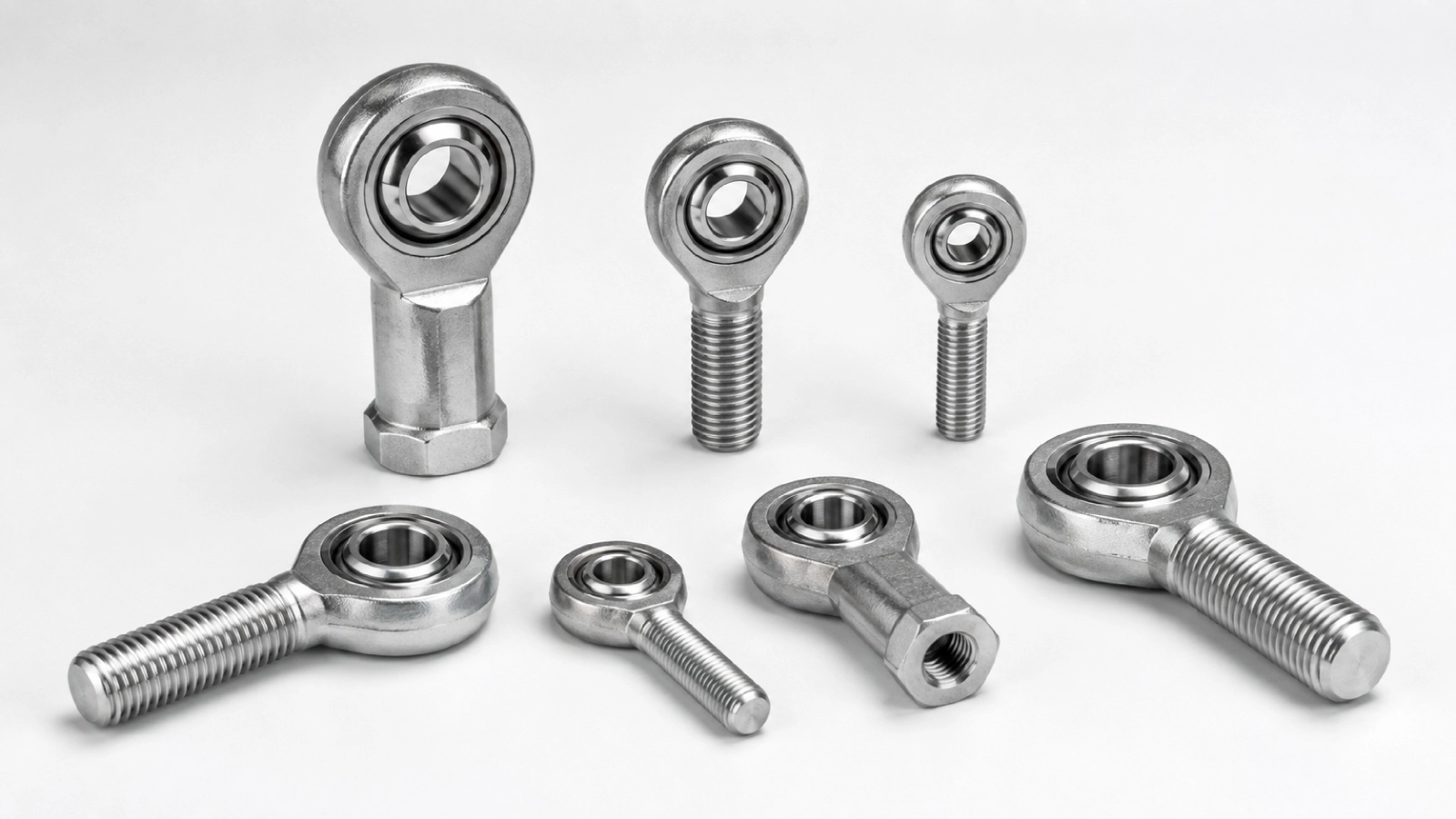
Rod end bearings combine a spherical plain bearing with a head-shaped housing and a threaded or weldable connection. The assembly supports linkage movement while allowing angular misalignment. However, the bore alone cannot identify the correct product.
For buyers, the thread form, pitch, direction, housing geometry, sliding pair, sealing, and maintenance design all matter. A code that resembles an existing part may still describe a different connection or internal bearing execution.
Table of contents
- What Is Included in a Rod End Bearing?
- Which Rod End Structures and Classifications Are Available?
- Where Are Rod End Bearings Used?
- How Should Buyers Select Thread and Sliding Design?
- Which Brand Series and Complete Models Should Buyers Know?
- How Do Buyers Read a Rod End Bearing Code?
- What Installation, Lubrication, and Removal Checks Matter?
- How Can HSN Support Rod End Bearing Orders?
- FAQ
What Is Included in a Rod End Bearing?
A rod end normally contains a body or housing, a permanently installed spherical plain bearing, and a shank or threaded connection. The spherical insert provides the angular movement, while the body connects the bearing to a control rod, cylinder, linkage, or machine frame.
This distinction matters during purchasing. A GE 30 C spherical plain bearing is an internal bearing type, while an SI 30 C rod end is the complete connection component. Ordering the insert when the assembly is required will not provide the threaded body or the same installation dimensions.
Which Rod End Structures and Classifications Are Available?
Rod ends may have female internal threads, male external threads, or a weldable body. Threaded versions can use right-hand or left-hand threads. Paired right- and left-hand rod ends allow linkage length to be adjusted by rotating the connecting rod without removing both ends.
The selected sliding system determines the maintenance plan. Lubricated types need a suitable grease path and relubrication interval, whereas maintenance-free types use a low-friction liner. In addition, buyers must distinguish open and sealed executions. Hydraulic rod ends form a separate group, so compare their body and connection dimensions with the drawing rather than with a standard threaded model.
| Classification | Typical Feature | Ordering Check |
|---|---|---|
| Female thread | Internal thread in the shank | Thread diameter, pitch, depth, and direction |
| Male thread | External threaded shank | Thread diameter, pitch, length, and direction |
| Maintenance-required | Lubricated sliding contact | Grease path and relubrication plan |
| Maintenance-free | Low-friction sliding layer | Liner material, environment, and duty |
Where Are Rod End Bearings Used?
Common applications include agricultural machinery, gardening equipment, pneumatic and hydraulic systems, fitness machines, lifting equipment, and general industrial linkages. In these positions, the component transfers force while accommodating small alignment changes between connected parts.
First, review tension and compression loads, shock, oscillation angle, movement frequency, corrosion, contamination, and inspection access. For rod ends installed near personnel or in lifting equipment, the equipment designer must also define the safety factors and maintenance procedures. A general model example does not approve a component for a safety-critical position.




How Should Buyers Select Thread and Sliding Design?
Begin with the bearing bore and load, then verify the entire connection. Thread diameter alone is insufficient because coarse and fine pitches, right- and left-hand directions, thread classes, and engagement lengths can differ.
Before ordering, check:
- bore diameter and inner-ring width;
- female, male, or weldable body design;
- metric or inch thread, diameter, pitch, and direction;
- center height, housing width, and available installation space;
- required misalignment and surrounding-component clearance;
- sliding pair, seals, lubrication, and maintenance interval;
- static, alternating, impact, tension, and compression loads.
If the old marking is incomplete, measure the part and provide clear photographs. Do not identify a left-hand thread from appearance alone; confirm it using the drawing, mating component, or manufacturer’s designation.
Which Brand Series and Complete Models Should Buyers Know?
The following examples show common international rod end bearing series. Similar bore references do not confirm the same body, thread, sliding pair, seals, or installation dimensions.
| Brand | Series examples | Complete model example |
|---|---|---|
| ISB | SI..C and SI..E/ES female; SA..E/ES male; 2RS sealed options | SI 30 C |
| SKF | SI..ES-2RS female; SA..ES-2RS male | SI 20 ES-2RS |
| INA | GIR/GIL internal thread; GAR/GAL external thread; DO-2RS sealed options | GIR20-DO-2RS |
| Timken/Aurora | MW-M right-hand and MG-M left-hand metric female series | MW-M20 |
ISB relates the complete SI 30 C rod end to a GE 30 C spherical plain bearing inserted in the body. Preserve the body and insert designations in an inquiry. Before treating another brand as an alternative, compare the drawing, bore, thread diameter and pitch, direction, center height, housing width, sliding system, seals, load requirements, and articulation.
How Do Buyers Read a Rod End Bearing Code?
ISB model SI 30 C shows how a compact code can identify the rod end family, bore section, and inserted bearing execution.
| Code | Code section | Meaning |
|---|---|---|
| SI | Series prefix | Rod end type with an internal threaded body |
| 30 | Bore section | 30 mm nominal bore of the inserted bearing |
| C | Sliding-contact suffix | Execution linked to the inserted spherical plain bearing |
The code does not state every connection detail. Buyers must still confirm thread diameter, pitch, direction, class, engagement length, housing geometry, and the complete inserted-bearing reference. Ordering GE 30 C alone does not include the SI rod-end body.
What Installation, Lubrication, and Removal Checks Matter?
Inspect the mating thread and remove burrs, dirt, and corrosion. Engage the thread to the required depth, use the specified locking method, and confirm that right- and left-hand components are installed in their intended positions. After adjustment, the housing must not contact adjacent parts through the required movement range.
Do not use the spherical insert as a lever for tightening the body. Lubricate maintenance-required versions through the correct path, but do not add grease to a maintenance-free liner unless the manufacturer allows it. During removal, mark the position and thread direction, support the linkage, and avoid twisting the insert beyond its permissible angle.
How Can HSN Support Rod End Bearing Orders?
HSN can review the complete model, brand reference, bore, female or male thread, thread diameter, pitch, direction, center height, sliding pair, seals, quantity, load, movement, and working conditions. Dimensional tolerance, hardness, and clearance are key pre-shipment checks. Material verification or other inspections can be discussed according to the order requirements.
For incomplete or discontinued markings, HSN can use photos, drawings, measurements, and a physical sample to support model confirmation. HSN discusses replacement or customized options only after completing the required technical review.
FAQ
What is the difference between SI and SA rod ends?
They commonly distinguish female and male thread families, but the relevant brand’s designation must be checked.
How do left- and right-hand threads differ?
They tighten in opposite directions and must match the mating part, adjustment method, and complete model code.
Do all rod end bearings need grease?
No. Maintenance depends on the sliding pair; follow the requirements of the selected series.
Can a rod end code identify thread size?
Not always. Confirm thread diameter, pitch, direction, class, and engagement length from the drawing or product data.
Remarks
For detailed rod end bearing models not listed above, other bearing types, model confirmation, and supply discussion, contact HSN. Send the complete model, photos, dimensions, quantity, and working conditions.
This article is an independent analysis for knowledge sharing. All brand names and trademarks belong to their respective owners. HSN Bearing Group is an independent bearing supplier and technical service provider.
Tel: +86 156 6578 7336 Email: service@hsnindustrial.com Website: www.rollingparts.com www.hsnbearing.com
Need Help Confirming Rod End Bearings?
Contact HSN to confirm a hard-to-find model or discuss a cost-effective replacement or improvement option after technical review.