

How Should Buyers Select a Thrust Roller Bearing?


A thrust roller bearing supports axial force through rolling contact between rollers and raceways. For buyer, the main purchasing risk is assuming that every thrust roller design carries load in the same way. Roller shape, load direction, alignment capability, washer arrangement, cage, speed, and lubrication must all match the machine.
Model letters matter as much as the basic number. A suffix can identify a cage or another execution detail, while separate prefixes may identify a roller-and-cage assembly rather than a complete bearing. Buyers should therefore retain the full manufacturer designation and confirm the surrounding arrangement before ordering.
Table of contents
- What Defines a Thrust Roller Bearing?
- Which Structures and Classifications Are Available?
- Where Are Thrust Roller Bearings Used?
- How Should Buyers Check Load, Speed, and Alignment?
- Which Brand Series and Complete Models Should Buyers Know?
- How Do Buyers Read the Designation Code?
- What Installation and Removal Checks Matter?
- How Can HSN Support Thrust Roller Bearing Orders?
- FAQ
What Defines a Thrust Roller Bearing?
Axial force acts mainly parallel to the shaft. Rollers provide more contact area than balls, so designers often choose thrust roller arrangements when the application needs greater axial capacity or rigidity. However, no single roller geometry suits every duty.
For example, a complete axial cylindrical roller bearing normally consists of a shaft washer, a housing washer, and a roller-and-cage assembly. Schaeffler describes this design as rigid and capable of carrying axial load in one direction. Suppliers may also provide the washers and assembly separately. In that case, the adjacent raceways and centering arrangement require additional engineering checks.
Which Structures and Classifications Are Available?
Classification starts with roller geometry and the direction of force. The correct family should be chosen before comparing a bore code or brand reference.
| Design | Main capability | Main ordering check |
|---|---|---|
| Cylindrical roller thrust bearing | High axial load and rigidity, commonly one direction | Complete bearing or separate washers and cage assembly |
| Needle roller thrust bearing | Compact axial section with needle rollers | Raceway hardness, finish, and washer requirement |
| Tapered roller thrust bearing | Axial load with application-specific combined-load capability | Arrangement, preload or endplay, and matched components |
| Spherical roller thrust bearing | Axial load with self-aligning capability and a permitted radial component | Load ratio, direction, alignment, and lubrication |
Single-direction and double-direction arrangements must not be confused. A double-direction requirement may use a dedicated design or two bearings in a validated arrangement. Confirm which ring rotates, where the load enters, and whether the machine needs axial location in one or both directions.
Where Are Thrust Roller Bearings Used?
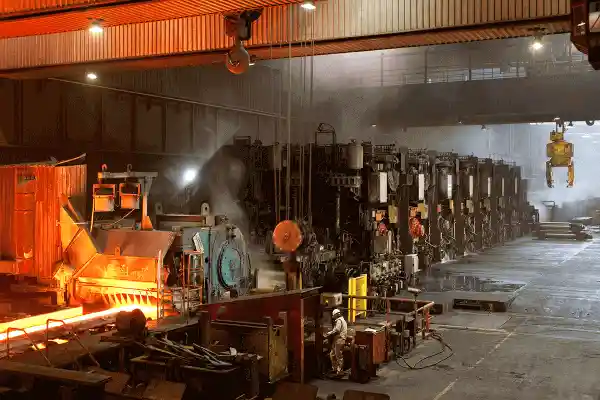
Typical positions include industrial gearboxes, presses, extruders, crane mechanisms, machine tools, pumps, and heavy process equipment. However, the same industry may use different thrust designs at different positions. A compact needle thrust assembly in an auxiliary mechanism does not follow the same selection criteria as a self-aligning spherical thrust design in a heavily loaded shaft line.
Record steady and peak axial loads, any radial component, speed, duty cycle, shock, temperature, contamination, and shaft orientation. Also check whether the position receives circulating oil, grease, or splash lubrication. Vertical shafts and frequent starts can change lubricant distribution and heat behavior.




How Should Buyers Check Load, Speed, and Alignment?
First, determine whether the selected design supports pure axial load or combined load. Do not assign radial load to an axial cylindrical design. By contrast, a spherical thrust design can carry a radial component only within the manufacturer’s stated limits.
Then compare dynamic and static ratings, reference or limiting speed, minimum load guidance, cage execution, and permissible temperature. Light load at high speed can allow rolling elements to slide rather than roll correctly. Misalignment also needs separate review: most cylindrical and needle thrust designs require accurately aligned support surfaces, while spherical designs provide a defined self-aligning function.
Which Brand Series and Complete Models Should Buyers Know?
The following examples show complete manufacturer references for cylindrical roller thrust bearings. A shared basic number does not prove identical cage material, load data, speed limits, tolerances, or supplied components.
| Brand | Series examples | Complete model example |
|---|---|---|
| FAG | 811..-TV single-direction axial cylindrical roller series | 81120-TV |
| SKF | 811.. TN complete bearings; K 811.. TN cage assemblies | 81120 TN |
| NTN | 81100 and 81200/81300 thrust cylindrical roller ranges | 81120 |
FAG, SKF, and NTN each list an 81120 reference, but buyers must compare the current manufacturer data and the complete execution. Do not remove a cage suffix or assume that a separately listed assembly includes both washers.
How Do Buyers Read the Designation Code?
FAG model 81120-TV is a useful example because the basic designation and cage suffix are both visible.
| Code | Code section | Meaning |
|---|---|---|
| 811 | Series section | Single-direction axial cylindrical roller bearing series |
| 20 | Bore section | Bore code corresponding to a 100 mm nominal bore |
| TV | Cage suffix | Plastic cage made from PA66 in this FAG execution |
The code identifies the product family and execution, but not every application limit. The buyer should still confirm dimensions, dynamic and static ratings, speed, minimum load, operating temperature, lubricant, and whether the ordered item is a complete bearing.
What Installation and Removal Checks Matter?
Thrust bearing washers need flat, clean, and adequately supported abutments. Identify the shaft and housing washers before assembly; similar-looking rings are not automatically interchangeable. Keep rollers and raceways free from contamination, apply mounting force to the correctly fitted part, and use manufacturer-approved heating or hydraulic methods where required.
After assembly, confirm axial location, free rotation, lubrication delivery, and operating temperature during commissioning. During removal, support the fitted ring or washer and avoid transmitting puller force through the rollers. Photograph the orientation and retain every model marking for the replacement inquiry.
How Can HSN Support Thrust Roller Bearing Orders?
HSN reviews the complete model, brand reference, dimensions, photos or drawing, quantity, load direction, speed, lubrication, application, and working conditions. It confirms availability for the exact model before discussing sourcing or customization.
Before shipment, HSN focuses on dimensional tolerances, hardness, and clearance where applicable. According to the order requirements, the inspection plan can also include material verification, rotation accuracy, vibration, noise, or flaw detection. HSN discusses a brand alternative only after technical comparison and customer confirmation.
FAQ
Can a cylindrical roller thrust bearing carry radial load?
No. It is designed for axial force; use a separately engineered radial bearing arrangement where radial load exists.
Is an 81120 number the same across all brands?
The boundary convention may be similar, but cage, ratings, speed, tolerances, and complete supply scope must be checked.
Why does minimum load matter?
Insufficient load, especially at speed, can prevent stable rolling contact and increase sliding risk.
What should an inquiry include?
Send the full model, brand, dimensions, photos or drawing, quantity, load, speed, lubrication, application, and working conditions.
Remarks
For detailed thrust roller bearing models beyond those listed above, or for other bearing types, contact HSN with the complete reference and technical requirements.
This article is based on independent analysis of publicly available technical information and industry understanding for knowledge sharing. All brand names and trademarks belong to their respective owners. HSN Bearing Group is an independent bearing supplier and technical service provider.
Tel: +86 156 6578 7336 Email: service@hsnindustrial.com Website: www.rollingparts.com www.hsnbearing.com
Need Help Finding a Roller Thrust Bearing?
Contact HSN to confirm a hard-to-find model or discuss a cost-effective replacement or improvement option after technical review.