

Why Bearings for Wind Turbines Need Main-Shaft Load-Path Checks?

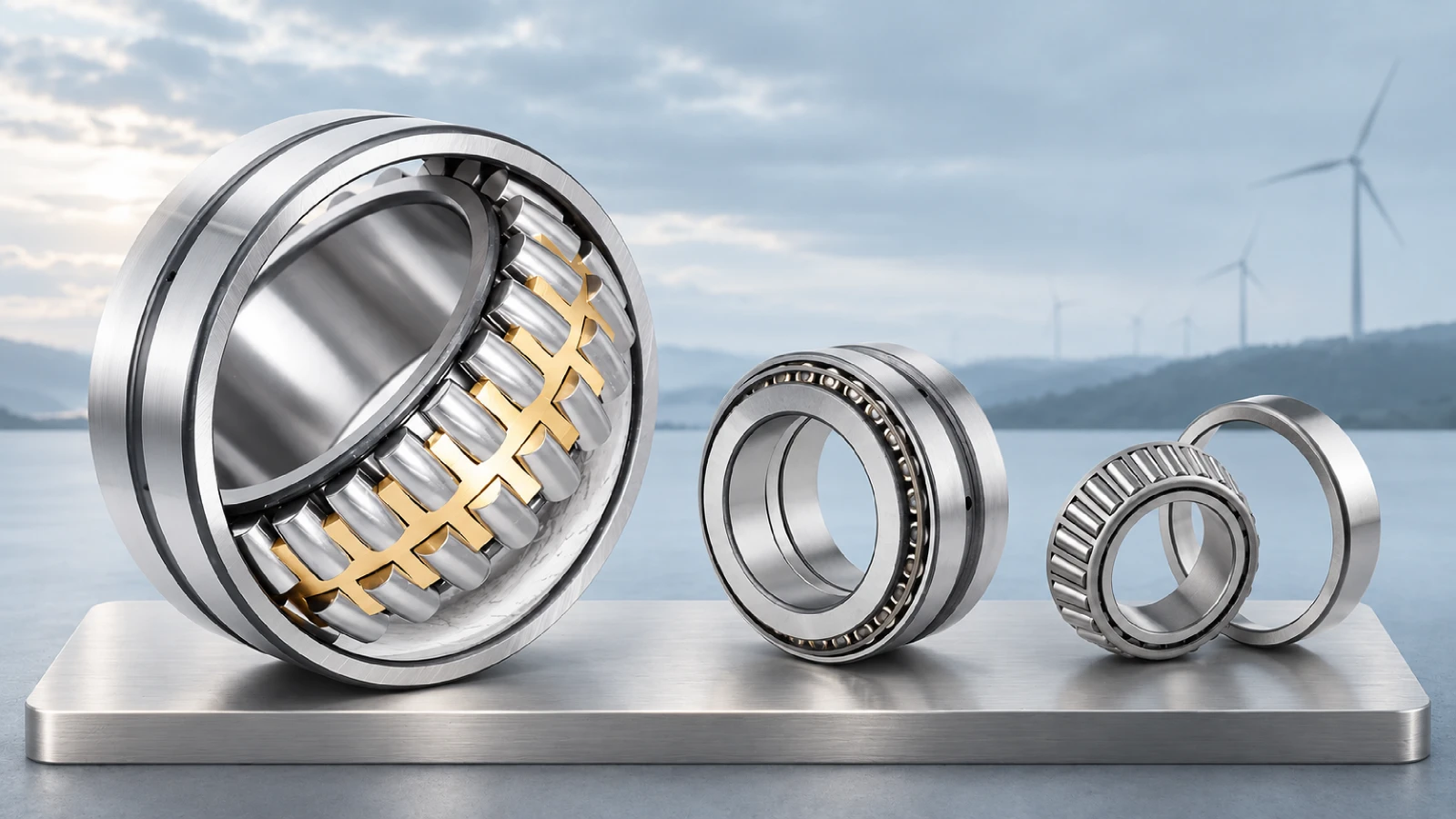
Bearings for wind turbines serve several critical positions, including the main shaft, gearbox, generator, blade pitch, and nacelle yaw systems. These positions carry different loads and use different bearing arrangements, so turbine power or a general machine description cannot define the correct bearing. For main-shaft sourcing, buyers should first understand how rotor thrust, radial load, and bending are transferred through the bearing arrangement.
The main-shaft design may use a spherical roller bearing with a separate support, paired tapered roller bearings, or an integrated bearing unit with matched housing, seals, and lubrication features. These arrangements do not distribute axial load or shaft movement in the same way. Buyers should therefore confirm the drivetrain layout, complete assembly drawing, bearing scope, fits, lubrication, and approval requirements before comparing stock or a replacement.
Where Does the Main-Shaft Bearing Sit?
The rotor hub drives a low-speed shaft or an integrated drivetrain support. Wind thrust acts along the rotor axis, while blade weight and changing wind produce radial forces and bending moments. The bearing arrangement transfers these reactions into the bedplate or housing. Its location also influences movement at the gearbox input in a geared turbine.
Different machines distribute the work differently. One layout may use a locating bearing with another support that accommodates shaft displacement. Another may use a compact, integrated bearing unit. A direct-drive turbine removes the gearbox but still requires rotor support. Consequently, the same general turbine class can call for different main-bearing constructions.
Before sourcing a part, identify whether the order is for a bearing alone, a bearing with seals, or a preassembled unit that includes housing and monitoring provisions. The complete assembly number and section drawing prevent a supplier from quoting a loose component when the repair plan expects an integrated package.
How Can an Integrated Arrangement Carry Thrust?
The phrase integrated bearing solutions that handle high axial loads in wind turbines usually refers to a main-shaft system, not a universal bearing size. Paired single-row or double-row tapered rollers can carry combined radial and axial loads when their row geometry, setting and housing are designed together. Timken describes its UltraWind mainshaft system as a tapered-roller arrangement with associated sealing and lubrication options; UltraWind is a product family, not a complete bearing model for a given turbine.
Opposed tapered rows locate the shaft in both thrust directions; row spacing also affects moment stiffness. Preload or endplay governs contact and heat. The designer must verify these features against the shaft, bedplate and gearbox interface, even if a new unit has a comparable envelope or published load rating.
Some turbines instead use spherical roller bearings with a separate support that accommodates displacement. This architecture handles shaft movement differently from an integrated tapered unit. A conversion may change gearbox input forces, mounting interfaces and setting procedures, so the turbine designer must approve it.
Main-shaft arrangements can carry axial load in different ways, so buyers should compare the load path and assembly scope before treating two designs as equivalent.
| Main-shaft arrangement | Axial-load function | Buyer must verify |
|---|---|---|
| Spherical roller bearing with second support | One bearing locates the shaft while the support arrangement accommodates shaft displacement | Which bearing provides axial location and how displacement is accommodated |
| Paired tapered roller bearings | Opposed rows carry thrust in both directions and contribute to shaft location | Bearing orientation, row spacing, and setting |
| Integrated tapered bearing unit | Matched bearing rows, housing, seals, and related features work as one package | Complete assembly scope, mounting interface, and design approval |
Which Loads and Fits Govern the Choice?
Request the design load cases rather than a single peak force. The engineer needs radial load, thrust in both directions where applicable, bending moment, speed, temperature and transient events. A gust or emergency stop may change the contact pattern. The bearing supplier also needs the expected shaft and housing deflection, since a catalog capacity assumes particular support conditions.
Fits determine whether rings retain their intended position under load and thermal movement. Check shaft-seat dimensions and condition, housing bore, shoulders, retaining features and the method used to set the bearing. A worn seat can make an otherwise suitable bearing perform badly. If a replacement unit changes width or seal location, the adjoining spacers and lubrication route may also need review.
Low-speed operation does not remove fatigue or lubrication concerns. Changing loads can concentrate stress on a portion of a raceway; grease distribution and sealing matter over long service intervals. Define the lubricant and replenishment method from the turbine design, not from the bearing family name. For an integrated assembly, specify where monitoring sensors and grease connections must land.
When Is Replacement More Than a Parts Swap?
Monitoring trends guide an inspection; they do not choose an integrated upgrade. Examine the removed bearing, shaft seat, housing and seals. Record axial movement and contact patterns. A support or grease problem should be addressed in the repair scope before a different bearing architecture is considered.
For a like-design replacement, compare the full designation, internal geometry, clearance or setting, material specification, seals and mounting method against the approved drawing. A cross-reference remains a candidate until those details are reconciled. If the proposed part changes from a spherical to a tapered design, the approval scope expands to rotor and gearbox load transfer.
The maintenance plan should match the order scope. A preassembled unit may change lifting and mounting steps; a loose bearing may require separate seals, spacers and inspection of reused housing parts. Ask the repair team which components they will replace together. This prevents the bearing from arriving without a necessary mating part.
What Data Makes a Main-Bearing RFQ Usable?
Provide turbine maker, model and serial number, drivetrain configuration, bearing position, complete installed code and assembly drawing. Include measured shaft and housing seats, expected loads, speed, lubricant, seal arrangement, quantity and photos. If the old part is unavailable, supply the best available drawing and state which dimensions remain unverified.
For a U.S. maintenance window, identify the design-decision date and required receipt date. Specify the inspection records the repair facility will accept. HSN can review an unusual model or approved custom drawing and discuss stock, dimensional checks and lead time. The turbine owner and engineer approve any altered drivetrain load path.
FAQ
Do all wind turbines use the same main bearing?
No. Main-shaft arrangements vary with drivetrain, load path, housing and original design.
Can a tapered bearing replace a spherical one?
Only after engineering reviews fit, setting, thrust distribution and downstream drivetrain loads.
What should U.S. buyers verify before expedited shipment?
Confirm the complete designation, assembly scope, inspection status, packaging, and required receiving date.
Why ask HSN about an integrated unit?
HSN can review the assembly drawing, inspection criteria, sourcing route and lead time; turbine engineering approves any design change.
Remarks
For detailed wind turbine main shaft bearing models not listed above, please contact HSN for model confirmation and supply discussion. When checking other bearing references, you can also send the complete model, photos, dimensions, quantity, application, and working conditions.
This article is based on independent analysis of publicly available technical information and industry understanding for knowledge sharing. All brand names and trademarks mentioned belong to their respective owners. HSN Bearing Group is an independent bearing supplier and technical service provider.
Tel: +86 156 6578 7336 Email: service@hsnindustrial.com Website: www.rollingparts.com www.hsnbearing.com
Need Help Sourcing Bearings for Wind Turbines?
Contact HSN to confirm a hard-to-find model or discuss a replacement after technical review.