

What Are the Main Scheerer Bearing Types and Their Key Features?

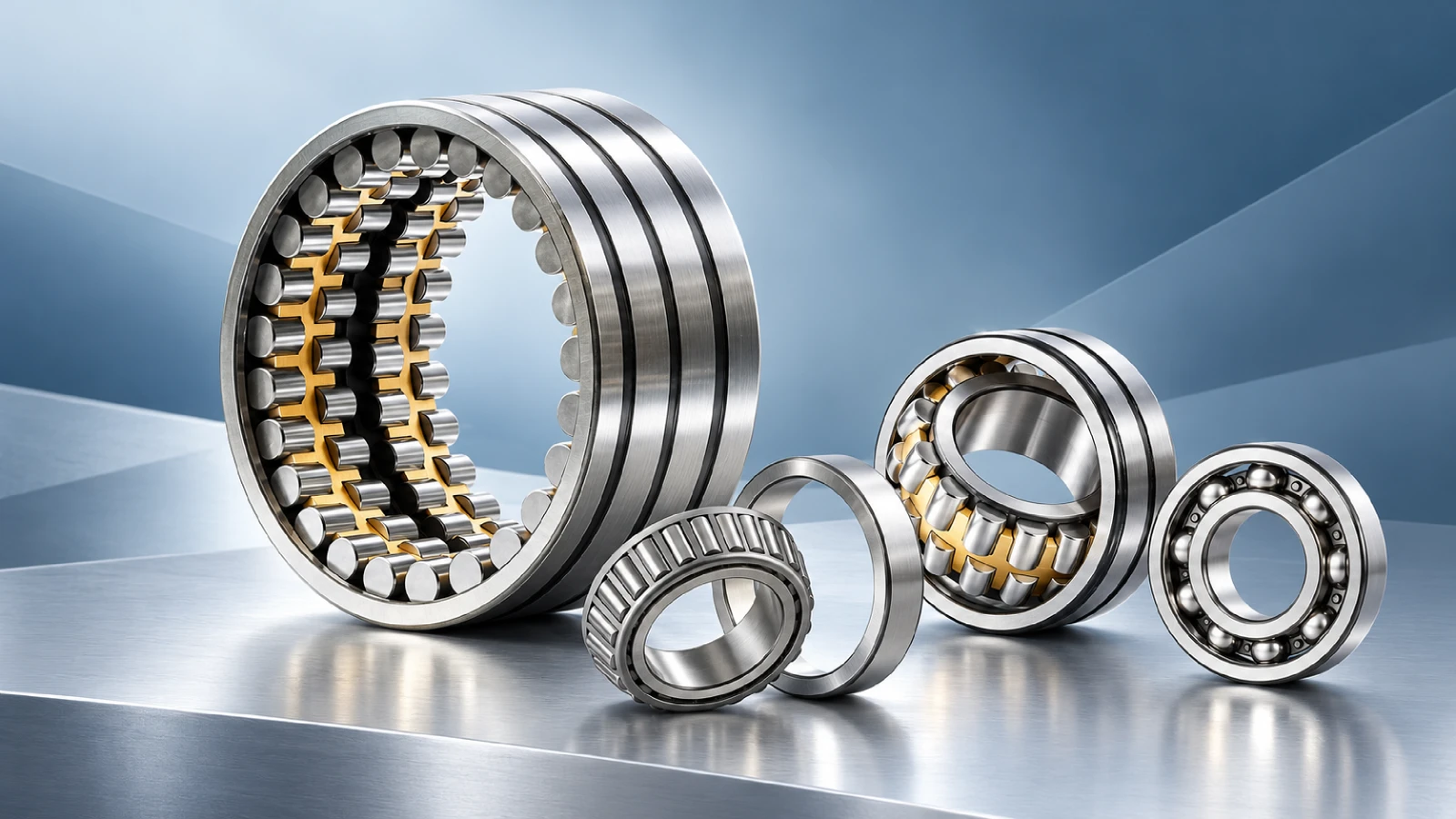
A Scheerer bearing catalog can help buyers distinguish bearing families that may share similar dimensions but serve different load paths and shaft-support functions. The catalog covers cylindrical roller, radial and angular-contact ball, thrust, split-inner-race, and other industrial bearing designs. Therefore, identification should begin with the bearing family, load direction, and complete designation rather than bore size alone.
The next step is to compare the construction that affects the installed application. Ring arrangement, row count, cage design, clearance, lubrication, fits, and thrust or radial function can all change how a bearing performs. This guide explains how Scheerer catalog families and drawings can be used to identify these differences and what specifications buyers should confirm before requesting stock or reviewing a replacement.
What Are the Main Scheerer Bearing Categories?
The Scheerer product catalog covers cylindrical roller bearings, including inch and metric styles; radial and angular-contact ball bearings; split-inner-race angular-contact ball bearings; and roller or ball thrust bearings. Its contents also distinguish slim-section ball configurations and multi-row roller designs. Download the official Scheerer bearing catalog below, then use its family heading and printed edition when citing an older machine number. Confirm current product details and availability with the manufacturer before placing an order.
Official catalog (PDF): Download the Scheerer bearing catalog
| Catalog family | Example listed in the Scheerer catalog | Primary selection issue |
|---|---|---|
| Radial cylindrical roller | RU-5220 | Ring style, axial freedom and radial load |
| Split-inner-race angular-contact ball | QJ-220 | Axial guidance in a defined arrangement |
| Cylindrical roller thrust | 81120 | Axial load and washer/assembly dimensions |
| Ball thrust | 51120 | Axial direction and mounting faces |
The catalog lists RU-5220 with a nominal 100 mm bore, 180 mm outside diameter, and 60.3 mm width. Its adjacent RN, RJ, RF, RT, RP, and RR columns share those boundary figures but specify different ring styles. Therefore, matching the three principal dimensions cannot settle the axial-location question. The other examples illustrate separate product families, not size-for-size alternatives.
The term “Scheerer bearing” can refer to a standard configuration or a special design. A drawing may specify an altered shoulder, cage, tolerance, or lubrication feature beyond a base row. Preserve any modification code and do not assume every catalog entry is in stock now. Catalog presence identifies a design for investigation; an availability inquiry is a separate step.
How Do Radial and Thrust Bearing Designs Differ?
A radial cylindrical roller bearing primarily carries force perpendicular to the shaft. The available axial guidance depends on which ring has ribs and whether the mating ring permits movement. In a gearbox with thermal growth, one support often needs to float while another locates the shaft. A wrong rib arrangement can restrain growth or leave the shaft poorly located.
Ball-bearing designs use a different internal geometry to manage radial and axial loads. A deep-groove ball bearing can support radial load together with limited axial load, while an angular-contact design depends on contact angle and orientation for combined loading and axial guidance. The Scheerer catalog lists QJ-220 as a split-inner-race angular-contact ball bearing. A similar bore size does not make it equivalent to a deep-groove bearing because the contact arrangement and axial function are different.
Thrust bearings instead address load along the shaft. The catalog’s 81120 cylindrical roller thrust entry and 51120 ball thrust entry both list 100 mm bore, 135 mm outside diameter, and 25 mm height. That shared envelope is a useful warning: roller and ball contacts offer different stiffness, capacity, speed, and operating behavior. The machine’s radial support and axial load path must be considered before selecting either.
Scheerer’s thrust-bearing overview also distinguishes ball, cylindrical, tapered, and spherical thrust constructions. The supplied catalog does not give permission to exchange one for another. Identify whether the order calls for a complete bearing, separate washers, or a specific arrangement shown on the equipment drawing.
How Do Row Count and Cage Design Affect Bearing Performance?
Row count changes load distribution, stiffness, assembly width, and support geometry. A single-row cylindrical roller bearing suits many radial positions; double-row or multi-row constructions serve other shaft and housing arrangements. Yet two rows do not simply double the permitted load. Internal geometry, fits, and actual load sharing determine the installed behavior.
Likewise, a cage separates and guides rolling elements. The Scheerer catalog notes bronze and phenolic cage options in its ball-bearing tables. It also describes machined bronze and phenolic retainer materials in the introductory material. These materials differ in mass, friction, and operating limits, so request the actual cage designation rather than substituting on appearance. A full-complement roller design, where specified, has a different roller count and speed envelope than a caged version.
For example, a buyer comparing a high-speed motor position with a heavily loaded mill position should not choose solely by bore. The motor’s speed and heat removal may make cage guidance important. The mill’s radial load, shock, and alignment may call for another structure. Compare the catalog drawing and rating methodology before treating a row-count change as an upgrade.
How Can Catalog Series and Drawings Help Identify a Bearing?
Use the catalog in two passes. First locate the broad family in its contents, such as cylindrical roller, radial ball, or thrust. Next use the diagram and dimensional table for the exact series. The Scheerer bearing catalog prints inch and metric dimensions together for many entries; label the units explicitly when copying values into a U.S. RFQ.
With the RU-5220 group, the “5220” portion identifies a dimensional row, while the preceding ring-style code distinguishes related constructions. Do not invent a universal meaning for every letter across unrelated series. Compare the drawing to photographs of the removed rings and note any missing separable part. In a thrust table, overall height and washer faces take priority over a radial bearing’s width convention.
The online Scheerer part lookup accepts number and dimension clues, but an older edition can still be useful for a legacy designation. Neither search result nor a visually similar row proves a direct interchange. Retain the original drawing revision, measured features, and machine position when requesting a technical comparison.
Which Specifications Should Match the Operating Conditions?
Start with boundary dimensions, tolerances, shaft and housing fits, and the shoulders that support each ring. Then compare load direction, dynamic and static ratings on the manufacturer’s basis, speed, radial clearance or preload, cage, lubrication, and thermal range. For a thrust assembly, confirm washer bores and outside diameters separately when the construction requires it. A dimensional table often omits the installed conditions that decide suitability.
When a U.S. plant has a scheduled shutdown, send the full marking, photographs, machine position, drawing, measured dimensions with units, quantity, and target delivery date. State whether the requirement is the Scheerer designation itself or an independently reviewed alternative. The maintenance engineer should confirm the substitute against fit and operating conditions before a purchase order treats it as approved.
HSN can screen potential stock in China or discuss a drawing-based custom option where feasible. Its inspection arrangements may check dimensions, hardness, and clearance against an agreed plan. Those checks serve solely as a reference for comparison; they do not imply that products with similar specifications in the catalog are automatically equivalent to “approved substitutes.”
FAQ
Do RU-5220 and RN-5220 perform the same axial role?
No. They share a listed envelope but have different ring arrangements; review the shaft support.
How do I order a separable bearing from the catalog?
Specify the full number and confirm which rings, washers, or rolling elements the quoted item includes.
What should a U.S. buyer send for a catalog inquiry?
Send the full marking, photos, position, dimensions with units, quantity and required date.
Can HSN help with a legacy Scheerer model?
HSN can check possible stock or review a drawing-based option after technical comparison.
Remarks
For detailed models beyond those listed above, or for other bearing types, please contact HSN. Send the complete model, photographs, dimensions, quantity, and working conditions so the inquiry starts with the right information.
This article is based on independent analysis of publicly available technical information and industry understanding, and aims to provide knowledge sharing. All brand names and trademarks mentioned in this article belong to their respective owners. HSN Bearing Group is an independent bearing supplier and technical service provider.
Tel: +86 156 6578 7336 Email: service@hsnindustrial.com Website: www.rollingparts.com www.hsnbearing.com
Need Help With a Scheerer Bearing Catalog Model?
Contact HSN to confirm a hard-to-find model or discuss a replacement after technical review.