

Why Does Excavator Swing Bearing Repair Start with Joint Diagnosis?

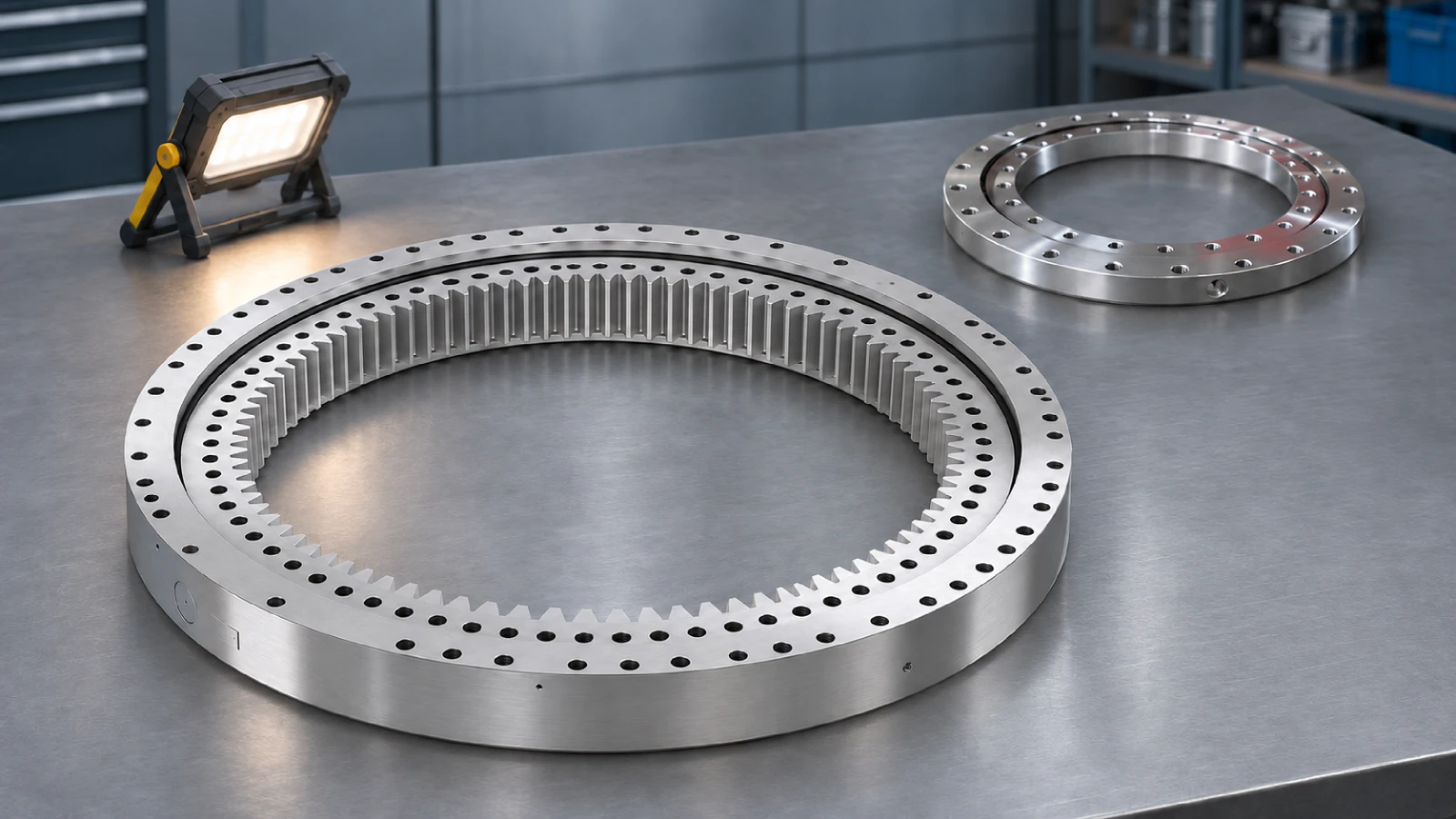
Excavator swing bearing repair begins with a diagnosis of the entire turntable joint. Rough slewing, noise or movement may come from a worn raceway, loose mounting bolts, damaged gear teeth or distorted supporting structure. Ordering a new ring before finding the source can leave the same fault in place. The maintenance team needs machine-specific limits and repeatable measurements to decide what to repair.
An excavator swing bearing failure can also affect the gear, drive pinion and mounting faces. Treat the ring as one part of the investigation. The repair plan then becomes a defined choice among servicing an external component, replacing the ring and rebuilding damaged supports.
Which Part of the Swing Joint Is at Fault?
The large bearing connects the rotating upper structure to the lower frame. Its two rings bolt to different supports, and a geared member may mesh with the swing drive pinion. First identify which race is fixed and where the gear sits on the exact machine. A complaint from the swing motor or gearbox can sound similar but does not prove that the large ring is damaged.
A swing-motor or gearbox complaint can resemble distress at the large ring. Identify whether the movement or noise occurs at the turntable interface, drive or supporting structure. Record when and where each symptom appears. Dark grease may justify checking the feed route and seals, but it cannot quantify raceway damage.
The load path changes as the boom and bucket move. Therefore, observations made unloaded may differ from those under a specified test condition. Avoid using another excavator’s play value as a rejection limit. The machine and bearing maker’s procedure determines whether a measurement is comparable.
How Do You Check the Bearing Before Teardown?
Technicians asking how to check the swing bearing on an excavator should start with the manufacturer’s method for supporting the machine and measuring relative movement. Establish the reference points, boom configuration and load condition stated in that method. Measure at specified positions around the circumference and retain earlier baseline readings when available.
A dial indicator can help distinguish movement between upper and lower structures from movement elsewhere in the boom or undercarriage. Yet the exact placement and loading sequence are machine-specific. Compare the result with the approved limit or previous measurements taken under the same conditions. Repeating an undocumented field test can create a false trend.
Check swing-drive backlash and gear contact separately. Excessive backlash may come from gear wear or drive adjustment without proving raceway damage. Conversely, a smooth-running pinion does not rule out mounting-bolt issues. When abnormal findings suggest a serious joint defect, the responsible technician should decide whether to stop operation and disassemble.
Keep the measurement sheet with the machine hours, temperature, attachment and test configuration. Photograph the indicator setup so the team can identify the measuring points later. If no baseline exists, use the approved service limit and a qualified assessment rather than an unsupported percentage change.
| Observation | Other component to examine | Next decision |
|---|---|---|
| Relative joint movement | Bolts and mounting faces | Measure by approved method |
| Rough or uneven slewing | Gear mesh, drive and raceway | Isolate source of resistance |
| Contaminated grease | Seals and grease route | Inspect damage and cause |
How Do Load, Shock and Sealing Affect Repair?
Digging and swinging produce changing radial, axial and moment loads at the turntable. Shock from a hard bucket impact may leave local damage, while a loose joint can concentrate load on a small part of the raceway. A different ring design needs the machine designer’s load review; its outside diameter cannot establish suitability.
Seals keep abrasive dirt and water out and help retain grease. A torn seal can be a repairable external issue before internal damage develops, but replacing it will not undo existing spalling. Trace all grease feed points and check that lubricant reaches the intended raceway. The exposed gear teeth may have a separate lubrication path and maintenance schedule.
Mounting support is just as important. If a face is uneven, tightening bolts can distort even a new ring. Fretting, cracks and damaged threads require evaluation under the equipment repair procedure. A quotation for “bearing repair” should say whether those structure and fastening tasks belong to the workshop, not the bearing supplier.
When Is Servicing Enough, and When Is Replacement Needed?
Cleaning a blocked grease line, restoring the specified lubricant or replacing a damaged external seal may address an early service issue after qualified inspection. Loose fasteners require the manufacturer’s joint inspection and tightening procedure; simply applying more torque is not a diagnosis. A worn pinion or tooth set needs separate mesh assessment.
Severe raceway distress, damage beyond the manufacturer’s wear criteria or a compromised ring can require replacement. Teardown may uncover additional problems at the upper and lower mounting faces. Preserve the removed ring’s orientation and markings, photograph raceway and gear evidence, and measure its seats. An attempted internal rebuild of a structural slewing ring needs an approved specialist process; routine field service is not equivalent to restoring its original capacity.
The workshop should document which findings close each repair option. For example, an intact ring with an isolated feed-line blockage calls for a different work order from a ring with measurable raceway distress and damaged mounting faces. This decision log prevents a parts quotation from being mistaken for the technical approval to operate.
A U.S. fleet can list parts before teardown. Ring, bolts, seals and drive parts have different lead times. Set an inspection hold point before the next job.
What Does a Repair or Replacement RFQ Need?
For a replacement inquiry, provide the following four groups of information:
- Machine and ring: Excavator maker, model, serial number, installed ring code and drawing revision.
- Measured movement: Play readings, indicator setup, test method and operating conditions.
- Joint condition: Photographs, gear and bolt details, lubrication records, damage locations and any supporting-structure damage. Distinguish worn-part measurements from original drawing dimensions.
- Order scope: Parts required, quantity and workshop receipt date. Mark any scope that still depends on teardown inspection.
HSN can review a bearing code or drawing for stock, a hard-to-find ring or a custom discussion with agreed inspection. The equipment owner and qualified repair team determine the fault, approve structural work and validate the completed joint. This division makes an urgent sourcing decision possible without treating a replacement quote as a repair procedure.
FAQ
Does swing noise prove bearing failure?
No. Gear mesh, drive components, bolts and mounting structure can also cause noise; inspect the joint.
Can a damaged ring be regreased back to service?
Grease cannot reverse raceway damage. Use machine-specific inspection and wear limits to decide the repair.
What should a U.S. repair buyer schedule?
Allow time for joint inspection, structural work, ring receipt, bolts and return-to-service checks.
Can I order just one custom bearing set?
MOQ: 1 set for medium/large bearings, 10–200 sets for small, and 50–10,000 sets for miniature. Confirm the requirement by model.
Remarks
For detailed excavator swing bearing models not listed above, please contact HSN for model confirmation and supply discussion. When checking other bearing references, you can also send the complete model, photos, dimensions, quantity, application, and working conditions.
This article is based on independent analysis of publicly available technical information and industry understanding for knowledge sharing. All brand names and trademarks mentioned belong to their respective owners. HSN Bearing Group is an independent bearing supplier and technical service provider.
Tel: +86 156 6578 7336 Email: service@hsnindustrial.com Website: www.rollingparts.com www.hsnbearing.com
Need Help with Excavator Swing Bearing Repair?
Contact HSN to confirm a hard-to-find model or discuss a replacement after technical review.