

Why Guide Wheel Selection Needs Track and Load Checks?

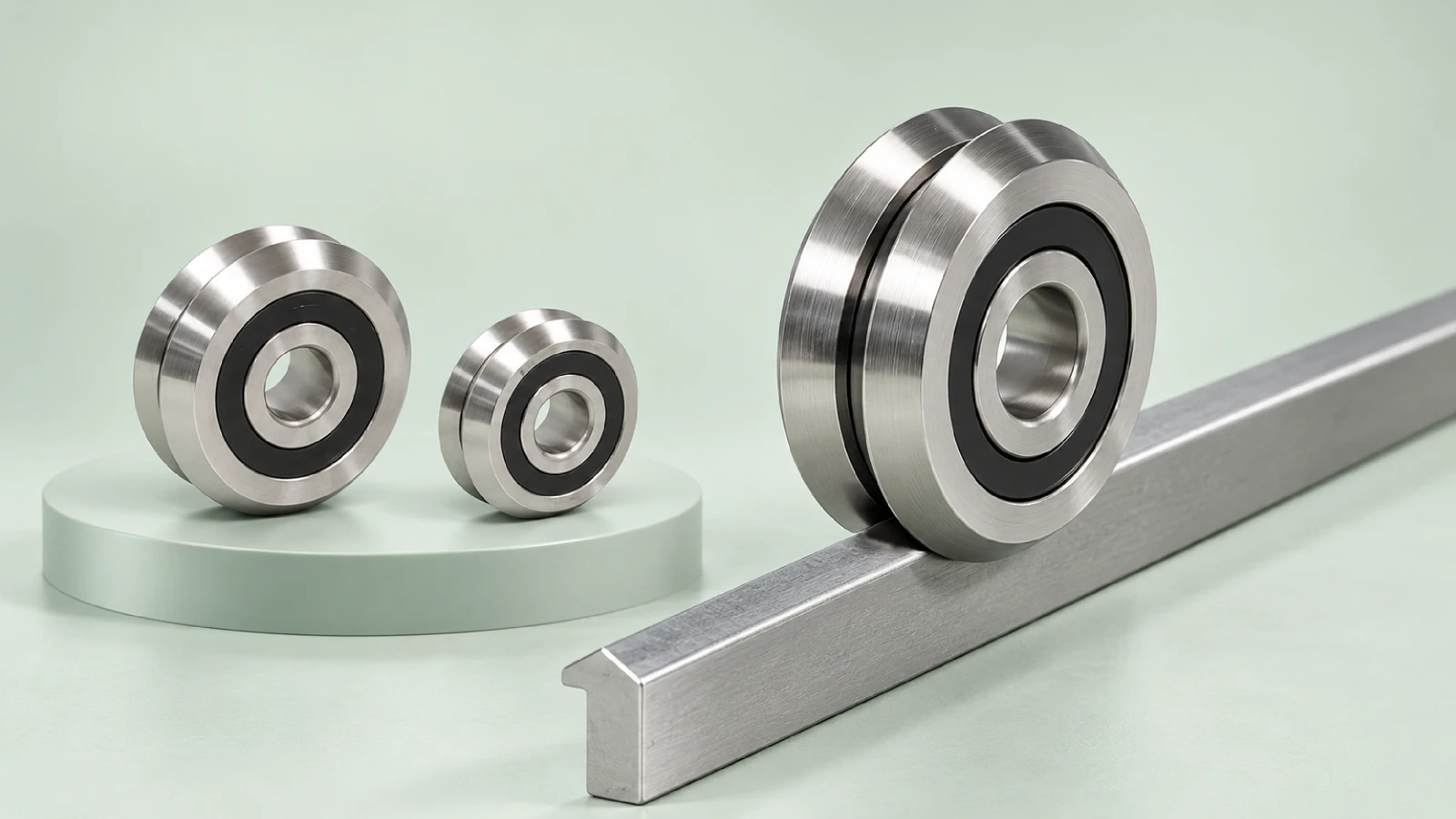
A guide wheel is one part of a complete linear-motion system. The wheel, track, mounting hardware, carriage geometry, preload, and supporting structure work together to guide movement. Selecting a wheel by outside diameter or appearance alone can result in poor fit, excessive play, high rolling resistance, or short service life.
For B2B buyers, the safest starting point is the complete original code. The next step is to confirm the track and the loads acting at each wheel under real operating conditions.
What Is a Guide Wheel and How Does It Support Linear Motion?
In a vee-guide arrangement, the wheel runs along a matching track and locates the moving carriage. BWC DualVee wheels use opposing vee contact surfaces and an internal double-row angular-contact bearing arrangement. This structure can react to load components in more than one direction while the external wheel profile follows the track.
The system typically uses several wheels around a carriage. Their spacing influences moment capacity and load distribution. Concentric mounting elements establish alignment, while eccentric elements allow the installer to remove play and set the wheel-to-track fit.
The track is equally important. Its profile, hardness, material, straightness, mounting surface, and joint condition affect running accuracy and wear. Therefore, a replacement review should treat the wheel and track as a matched motion system rather than separate catalog parts.
Which BWC Guide Wheel Designs Should Buyers Compare?
BWC offers several wheel constructions for different environments. The examples below show how code characters can change material, protection, or operating purpose. They are identification examples, not automatic substitutes.
| Model example | General construction | Main selection point |
|---|---|---|
| W1 | Size 1 carbon-steel wheel with shields | General environment, external lubrication, speed and load |
| W1X | Size 1 carbon-steel wheel with seals | Contamination protection and added seal drag |
| W1SSX | Size 1 stainless-steel wheel with seals | Corrosion exposure, cleaning method and material requirement |
| W1SSVAC | Size 1 stainless-steel vacuum wheel with shields | Vacuum level, lubricant, materials and cleanliness |
| W1SS227 | Size 1 stainless-steel shielded wheel for high-temperature service | Maximum temperature, lubricant, duty cycle and track conditions |
| W1SS300 | Size 1 stainless-steel shielded wheel for low-temperature service | Minimum temperature, lubricant, condensation and material compatibility |
The number in these examples identifies wheel size, while other characters identify material or configuration. Additional families include washdown wheels and studded wheels. A studded design combines the wheel with a permanently attached threaded stud, which changes mounting dimensions and installation method.
Buyers should copy every character from the existing wheel, drawing, or quotation. For example, W1 and W1X share the same basic size but use different protection. Likewise, a stainless, vacuum, washdown, or temperature-specific version should not be reduced to the basic wheel number.
Why Do Track Geometry and Load Direction Affect Selection?
The vee contact creates force components at the wheel-to-track interface. Equipment weight, process force, acceleration, and gravity can generate radial and axial loads at each bearing element. An overhung payload also adds a moment, so the most heavily loaded wheel may carry far more than a simple total-load division suggests.
First, calculate the load at every wheel for the worst carriage position and motion stage. Include payload, tooling force, acceleration, emergency stops, and shock. Then compare the result with the applicable wheel rating and life method. Speed, cycle frequency, contamination, and lubrication can reduce practical life.
Preload needs similar care. A common arrangement uses concentric mounting points to establish alignment and eccentric mounting points to adjust fit. Enough adjustment removes unwanted play. However, excessive preload increases internal load, friction, and wear before the machine applies any external force. It also cannot correct a flexible beam or a badly aligned track.
Track installation controls accuracy. Check the mounting surface for flatness, straightness, and parallelism. Confirm track spacing and joint alignment over the full stroke. Hardened and soft tracks, as well as carbon-steel and stainless-steel versions, have different wear and installation considerations. The selected wheel, track, and support should therefore be reviewed together.
Where Are Guide Wheel Systems Commonly Applied?
Vee-wheel systems serve machines that need guided linear travel with accessible installation and adjustment. Common application groups include:
| Application group | Typical motion need | Main environmental check |
|---|---|---|
| Packaging and printing equipment | Repeated carriage or web-handling motion | Debris, cycle rate and lubrication |
| Automation and robotics | Positioning, transfer and guarding | Acceleration, moments and alignment |
| Material-handling equipment | Long travel and variable payload | Track joints, contamination and shock |
| Food and laboratory equipment | Washdown or corrosion resistance | Materials, seals, lubricant and cleaning agents |
| Welding, refrigeration or vacuum equipment | Motion outside normal ambient conditions | Temperature, pressure, lubricant and cleanliness |
Application names alone do not select the product. A food machine may need corrosion resistance without direct washdown, while another requires a dedicated washdown construction. A hot process can also expose the track, lubricant, seals, and mounting hardware to different temperatures. Buyers must define the conditions at the wheel location.
External lubrication at the wheel-to-track interface is another system decision. A suitable light oil or manufacturer-approved track lubricant can reduce wear, corrosion, and stick-slip. Track lubricators can also sweep debris and distribute lubricant along the contact path. Factory lubrication inside the wheel bearing does not lubricate the external wheel-to-track interface, so buyers must review both lubrication points separately.





What Should Buyers Confirm Before Ordering?
Send enough information to identify both the component and its system:
- Full wheel and track codes, including all suffixes.
- Photos, drawings, wheel dimensions, and track profile.
- Concentric or eccentric mounting details and stud dimensions.
- Number and spacing of wheels on the carriage.
- Load at each wheel, speed, stroke, acceleration, and duty cycle.
- Temperature, contamination, corrosion, vacuum, or washdown conditions.
- Lubrication method, required quantity, and inspection criteria.
HSN can review the original reference together with the track, dimensions, samples, drawings, and working conditions. During alternative discussions, HSN checks configuration, critical dimensions, material, sealing, load direction, and installation needs. Buyers should agree on dimensional, hardness, clearance, material, accuracy, vibration, noise, or flaw-detection checks where they apply. Final suitability depends on the complete guide system and operating duty.
FAQ
Can Wheel Diameter Alone Identify a Guide Wheel?
No. Confirm the full code, vee profile, width, bore or stud, material, shields or seals, and track.
Are W1 and W1X the Same BWC Wheel?
No. They share a basic size, but W1 is shielded and W1X is sealed. Protection and running behavior differ.
Why Does an Eccentric Mount Need Adjustment?
It sets wheel-to-track fit and removes play. Excessive adjustment creates preload, friction and premature wear.
What Should Buyers Send for a Wheel Review?
Send wheel and track codes, drawings, loads, carriage layout, speed, stroke, environment, quantity and photos.
Remarks
For detailed BWC guide wheel models not listed above, please contact HSN for model confirmation and supply discussion. For other bearing types, send the complete model, photos, dimensions, quantity, application, and working conditions.
This article is based on independent analysis of publicly available technical information and industry understanding and is intended for knowledge sharing. All brand names and trademarks belong to their respective owners. HSN Bearing Group is an independent bearing supplier and technical service provider.
Tel: +86 156 6578 7336 Email: service@hsnindustrial.com Website: www.rollingparts.com www.hsnbearing.com
Need Help Confirming a Guide Wheel System?
Contact HSN to confirm a hard-to-find guide wheel or discuss a technically reviewed alternative.