

Which Steam or Gas Turbine Main Bearing Needs Repair?

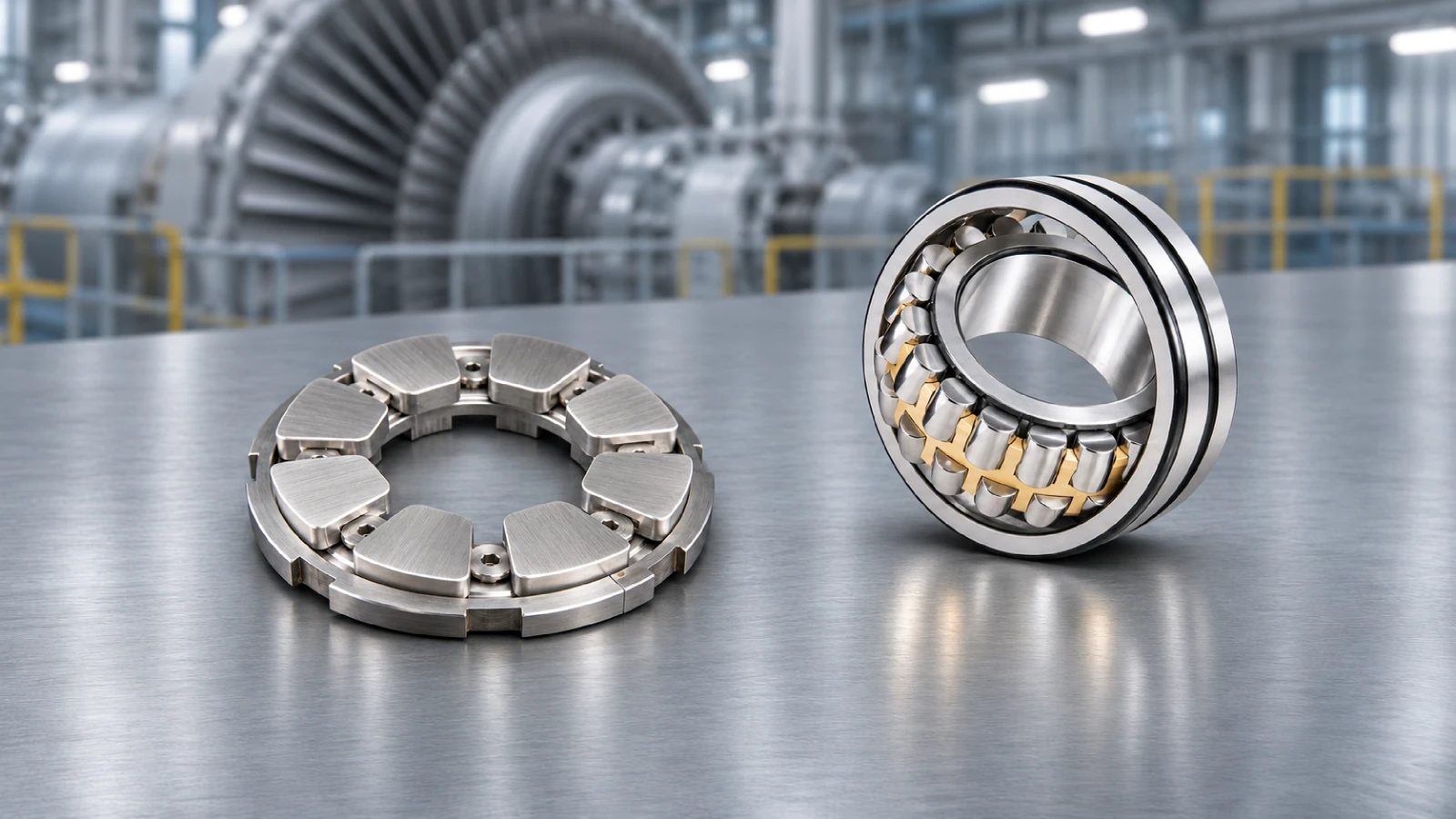
A turbine main bearing request in a steam or gas turbine train may mean a radial journal shell, a thrust assembly or a complete housing. These are different procurement scopes. Oil-film journal supports carry radial rotor load, while a thrust position controls axial travel where the machine design requires it. Begin with the turbine arrangement drawing and exact support number.
The distinction matters during an outage. A loose shell, a damaged lining, or an oil-supply problem can each produce a different repair package. Buying a bearing by turbine name alone risks arriving at the outage with a correct-looking part that cannot be installed or accepted.
Where Is the Main Bearing in a Turbine Train?
A turbine train can include several journal positions along the turbine rotor and separate bearings for a coupled generator. The turbine support nearest the coupling is not automatically the generator bearing. Mark the bearing position and housing on the arrangement drawing. For a radial support, identify the shaft journal; for a thrust support, identify the thrust collar and load direction. Record whether the requested item is a lower shell, an upper and lower shell set, a tilting-pad assembly, a thrust element, or a complete housing. For generator-side support identification, review the double-bearing generator layout separately from the turbine bearing arrangement.
Journal bearings carry radial loads through a hydrodynamic oil film while the rotor turns. That film depends on speed, geometry, clearance, oil properties and supply conditions. At start and stop, the contact regime changes, so surface condition and machine procedures matter. A thrust bearing reacts the specified axial load and controls axial rotor travel. It may share a housing with a journal bearing, but the drawing must identify each component and its load path.
Which Bearing Design Matches the Support?
Turbine supports may use a fixed-geometry sleeve or shell, or a tilting-pad journal bearing. Their pad geometry, pivot arrangement, split line, oil grooves and instrumentation provisions can differ. A photograph of the outer housing seldom resolves those differences. The original drawing and removed assembly establish what the plant actually operates.
A thrust position can use a tilting-pad thrust assembly with defined collar faces, direction and axial setting. It is not interchangeable with a radial journal assembly. Ask whether the thrust element is on the same housing, which rotor direction it reacts, and what mating collar condition was measured. Where an active and an inactive thrust side exist, document both. For more detailed checks on pad geometry, pivot design, lubrication and axial setting, see the tilting pad thrust bearing selection guide.
The turbine maker commonly identifies a journal shell or thrust assembly by its machine-specific drawing, revision and position. A generic rolling-bearing catalog number cannot describe its split line, lining, oil grooves or pad geometry. A scored journal, damaged collar or deformed housing may also require more than a new shell. Reproduce the approved design and inspection criteria; external dimensions alone cannot establish oil-film geometry.
| Requested component | Key interface | Repair decision |
|---|---|---|
| Journal shell or pads | Shaft journal, housing bore and oil feed | Verify clearances, lining and seat condition |
| Thrust assembly | Collar face and axial setting | Verify load direction and end-float procedure |
| Complete housing | Pedestal, seals, pipes and instruments | Define included hardware and site interfaces |
How Do Oil and Operating Conditions Affect Selection?
Oil temperature and viscosity influence film thickness. Low supply pressure, blocked passages or contamination can change the bearing’s operating condition even when its nominal dimensions are right. Include the oil grade, supply temperature and pressure range, filtration details and any abnormal trends with the inquiry. The turbine engineer should interpret those values against the machine’s design limits.
Rotor speed and load history also matter. A bearing sized for a steady unit may see different behavior during startup, coast-down or a modified operating cycle. Thermal growth changes the alignment of hot supports relative to cold measurements. Therefore, a shop should not copy an apparent cold clearance without the applicable assembly procedure.
Temperature probes and vibration sensors often sit near a support. Their locations, wiring passages and pad provisions must survive a replacement. State whether probes, seals and oil deflectors are part of the supply request. When dimensions are converted for a U.S. purchase order, retain the drawing’s units and tolerances rather than rounding a metric journal to a nominal inch size.
What Evidence Guides Repair or Replacement?
Rising bearing temperature or vibration is a prompt for investigation, not proof that the bearing is the only failed item. Compare oil pressure and temperature, rotor position, vibration history and recent maintenance. During teardown, photograph shell markings, orientation and damage. Measure the journal, housing seat, running clearance and any specified axial movement under the qualified repair procedure.
Wiping or scoring may point to oil-film distress, but the cause can lie in the oil system, alignment or operating event. Metal transfer on the journal can make a new shell unsuitable until the shaft is restored and inspected. Record whether the replacement is a like-for-like spare, a repair to an approved drawing, or an engineering change. Only the turbine owner and responsible engineer can approve the latter.
For a scheduled U.S. plant shutdown, distinguish the initial sourcing date from inspection hold points after teardown. Final machining, documentation and fit approval may control the true receiving deadline. Tell the supplier which measurements are pending and when the repair team will release the drawing.
What Should a Turbine Main Bearing RFQ Include?
Organize the RFQ into four groups so HSN can confirm the bearing position, repair scope and acceptance requirements:
- Turbine and position: Manufacturer, model, serial number and exact bearing position on the arrangement drawing.
- Drawing and construction: Complete drawing, revision, old markings, photographs, shell or pad design, and documented material and lining specifications.
- Measured condition and oil system: Shaft and housing measurements, split and oil-feed details, oil conditions and instrument provisions. Mark dimensions pending confirmation after disassembly.
- Scope and schedule: Required component or assembly, quantity, inspection records, drawing-approval point and repair deadline.
HSN can review drawings and existing codes for a difficult standard item. For a non-standard shell or bearing assembly, buyers can request a custom bearing review based on approved drawings and operating conditions. Agree on dimensional, material and relevant inspection records before ordering. The plant’s turbine engineer or qualified repair shop must approve the final design, clearances, shaft condition and installation method. This lets procurement source an identifiable component while the technical team keeps control of machine suitability.
FAQ
Is a turbine main bearing always a rolling bearing?
No. Many steam and gas turbine rotor supports use oil-film journal bearings; identify the exact position from the drawing.
Can a journal shell replace a thrust assembly?
No. Radial support and axial restraint have different duties. Use the turbine’s approved parts and settings.
What date belongs on a U.S. outage RFQ?
Give the drawing-approval date, inspection hold points and required receiving date, plus the quantity.
Why ask HSN about a turbine bearing shell?
HSN can review the drawing and lining requirements, agree on inspection records and quote a supply route and lead time.
Remarks
For detailed turbine main bearing models not listed above, please contact HSN for model confirmation and supply discussion. When checking other bearing references, you can also send the complete model, photos, dimensions, quantity, application, and working conditions.
This article is based on independent analysis of publicly available technical information and industry understanding for knowledge sharing. All brand names and trademarks mentioned belong to their respective owners. HSN Bearing Group is an independent bearing supplier and technical service provider.
Tel: +86 156 6578 7336 Email: service@hsnindustrial.com Website: www.rollingparts.com www.hsnbearing.com
Need Help with a Turbine Main Bearing?
Contact HSN to confirm a hard-to-find model or discuss a replacement after technical review.