

Why Angular Contact Bearing Codes Matter for Selection and Sourcing?

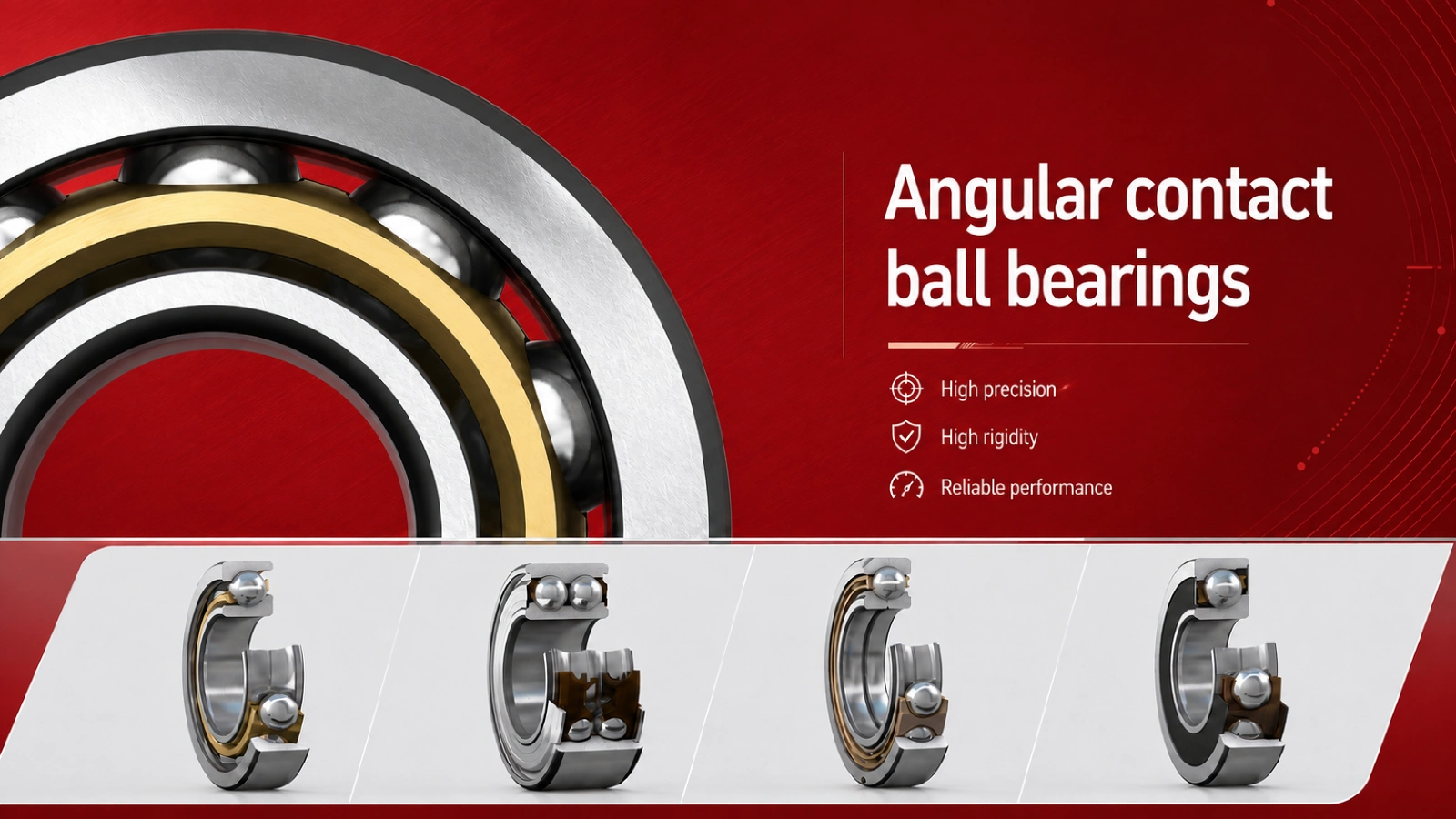
An angular contact bearing supports radial and axial loads through a contact angle between the balls and raceways. However, the bearing direction, contact angle, row arrangement, preload, cage and precision class can change its function. Therefore, buyers should review the complete designation instead of ordering from bore size or basic dimensions alone.
For distributors, maintenance companies and equipment manufacturers, this check reduces several purchasing risks. A bearing with similar dimensions may carry axial load in a different direction, require a matched partner or use a different internal design. The following guide explains the main structures, applications, installation points and model-code checks.
Table of contents
- What Defines the Structure of an Angular Contact Bearing?
- How Do Contact Angle and Row Arrangement Change Performance?
- Which Angular Contact Types Fit Different Load Conditions?
- Where Are Angular Contact Bearings Commonly Used?
- What Should Buyers Check During Installation and Removal?
- How Should Buyers Read Brand Series and Model Codes?
- What Information Is Needed Before Ordering?
- How Can HSN Support Angular Contact Bearing Procurement?
- FAQ
What Defines the Structure of an Angular Contact Bearing?
The inner and outer raceways are offset in relation to each other. As a result, the load passes through the balls at an angle to the radial plane. A larger contact angle generally increases axial load capacity, while a smaller angle is often selected when speed is more important.
Single-row designs carry axial load mainly in one direction. They are commonly installed against a second bearing when the shaft needs location in both directions. Double-row bearings provide a compact arrangement for radial load, axial load in both directions and some moment load. Four-point contact bearings use a split ring arrangement and are primarily selected for axial location in both directions where installation space is limited.
How Do Contact Angle and Row Arrangement Change Performance?
Single-row angular contact bearings can be arranged back-to-back, face-to-face or in tandem. A back-to-back pair provides a wide effective bearing spread and good moment rigidity. A face-to-face pair tolerates some misalignment but has lower moment stiffness. A tandem set increases axial capacity in one direction, so another bearing arrangement may still be needed for the opposite direction.
The contact angle, preload and internal clearance must suit the application. Higher preload can improve rigidity and running accuracy, but it also increases friction and heat. Consequently, buyers should not change a suffix or matched-set code without checking speed, load, lubrication and mounting accuracy.
Which Angular Contact Types Fit Different Load Conditions?
Choose the structure from the actual load path rather than the available space alone:
- Use a single-row bearing when combined load acts with axial force mainly in one direction.
- Use a paired arrangement when the shaft requires axial location in both directions.
- Consider a double-row design when a compact bearing must handle two-directional axial load.
- Consider a four-point contact design for mainly axial duty with limited radial load.
- Confirm a super-precision design separately for spindle speed, runout, preload and lubrication requirements.
The cage, seal, tolerance class and lubricant can also limit speed or temperature. In addition, a universal matching suffix does not automatically confirm the final preload after mounting.
Where Are Angular Contact Bearings Commonly Used?
Machine-tool spindles use angular contact bearings because the arrangement can combine speed, rigidity and positioning accuracy. Pumps and compressors use them to manage radial load together with thrust from the impeller or rotor. Gearboxes, screw drives, electric motors and industrial transmissions may also require controlled axial location.
Nevertheless, one bearing type does not fit every position. A spindle may prioritize precision and low heat, while a pump may prioritize thrust capacity, sealing and lubricant compatibility. Buyers should provide the equipment position and operating conditions before comparing models.




What Should Buyers Check During Installation and Removal?
First, identify the marked face and axial load direction. For matched sets, keep the supplied sequence and arrangement together. Mixing individual bearings from different sets can change preload or load sharing.
During mounting, apply force only to the ring with the interference fit. Do not transmit installation force through the balls. The shaft shoulders, housing seats and spacers should be clean, square and within the required tolerances. After mounting, confirm free rotation, axial location, lubrication and operating temperature.
For removal, select a puller or hydraulic method that acts on the fitted ring. If the bearing will be examined or reused, protect the raceways, seals and cage from impact and contamination.
How Should Buyers Read Brand Series and Model Codes?
International brands use different suffix systems. The table shows representative families and complete examples, but it is not an interchange chart.
| Brand | Representative series | Complete model examples |
|---|---|---|
| SKF | 72/73 single row; 32/33 double row | 7205 BEP; 3205 A-2RS1 |
| Schaeffler FAG | 70/72/73 single row; 32/33 double row; QJ2/QJ3 four-point | 7205-B-XL-TVP; 3205-BD-XL-2Z; QJ206-XL-MPA |
| NSK | 72/73 single row and matched sets; QJ2/QJ3 four-point | 7205BW; 7208 A DB; QJ206M |
For SKF 7205 BEP, 7205 identifies the basic single-row series and size. In this example, B identifies the contact-angle execution, while the remaining suffix letters describe SKF-specific internal and cage design.
For FAG 7205-B-XL-TVP, B, XL and TVP define its contact angle, design generation and cage execution.
For NSK 7205BW, B identifies the contact angle and W identifies the cage execution.
Although these examples share 7205 in the basic designation, the complete products should not be treated as automatically equivalent. Check dimensions, contact angle, internal design, cage, precision, preload or clearance, and permissible speed.
What Information Is Needed Before Ordering?
Send the complete brand and model, not a shortened base number. Also provide dimensions, quantity, equipment position, load direction, speed and lubrication method. For a paired set, state the DB, DF or DT arrangement and any preload or precision requirement.
Photos of the markings and packaging can help identify an older reference. A drawing is more useful when the model is discontinued or the shaft and housing arrangement is non-standard. In addition, tell the supplier whether the request is for original-brand sourcing, a technically confirmed alternative or a customized bearing.
How Can HSN Support Angular Contact Bearing Procurement?
HSN Bearing Group supports model confirmation, sourcing, inspection, and custom supply discussions. Buyers should provide the complete reference, quantity, and mounting position. HSN can then review the contact angle, arrangement, preload, precision, cage, seals, and load direction. Speed and working conditions should also be included. Stock checks use the full designation rather than the base number.
For difficult requirements, HSN can review drawings, samples, dimensions, and fits. Replacement or custom production can be discussed after technical confirmation. Before shipment, agreed checks may cover dimensions, hardness, and clearance. Buyers may also request accuracy, vibration, noise, material, or flaw-detection checks. Similar references do not automatically prove interchangeability.
FAQ
Can angular contact bearings carry thrust both ways?
A single-row bearing mainly carries thrust one way. Use a suitable paired or double-row arrangement for loads in both directions.
Does a larger contact angle improve performance?
It raises axial capacity but may reduce speed capability. Select the angle from load, speed, rigidity and heat requirements.
Can bearings from different matched sets be mixed?
No. Mixing supplied sets can change preload and load sharing. Keep each set in its specified sequence and arrangement.
Which code details should buyers confirm?
Confirm the full designation, contact angle, arrangement, preload or clearance, cage, precision, seals and lubricant.
Remarks
For detailed angular contact bearing models not listed above, please contact HSN for model confirmation and supply discussion. When checking angular contact bearing references, you can also send the complete model number, photos, dimensions, quantity, and working conditions for review.
This article is based on independent analysis of publicly available technical information and industry understanding for knowledge sharing. All brand names and trademarks mentioned belong to their respective owners. HSN Bearing Group is an independent bearing supplier and technical service provider.
Tel: +86 156 6578 7336 Email: service@hsnindustrial.com Website: www.rollingparts.com www.hsnbearing.com
Need Help Finding an Angular Contact Bearing?
If you urgently need a hard-to-find angular contact bearing from stock in China, contact HSN. We can also discuss an alternative or improved solution after technical confirmation.