

When Should Buyers Specify Customized Ball Mill Bearings?

Customized ball mill bearings become relevant when a verified standard bearing cannot meet the installed fit, load or operating arrangement. First identify the bearing position. A mill’s main trunnion or slide-shoe support can use an oil-film design, while its pinion and gearbox may contain rolling bearings. For buyers managing an outage, the quickest route is to confirm the complete existing designation and shaft measurements before requesting any design change.
Where Do Customized Bearings Fit in a Ball Mill?
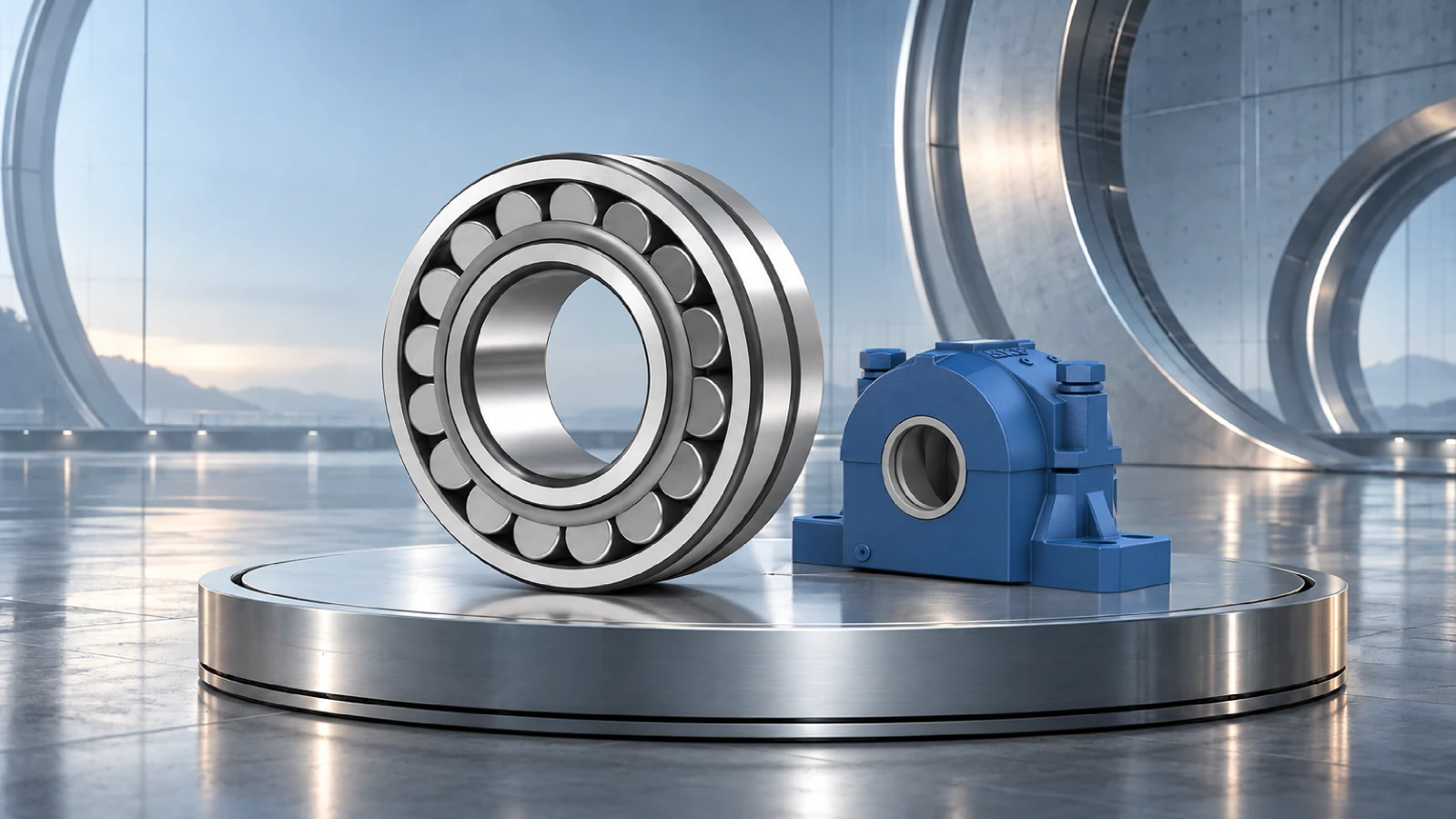
Start at the drive train. The pinion shaft transmits torque to the girth gear, and its bearing positions have defined radial and axial loads. Spherical roller bearings in pillow block housings can support ball mill pinions. A motor or gearbox bearing is another distinct component. Identify the shaft and its inboard or outboard position on the machine drawing.
At the shell, the trunnion or slide-shoe main support can instead contain a sliding insert or pad with a dedicated oil system. Its replacement is a different engineering project. A buyer should not replace a bearing based on a photograph of another mill or an online code for an unrelated support position.
When a plant stocks spares by equipment number, link the bearing’s full code to the installed housing, shaft journal and maintenance record. Note changes made during previous overhauls. If the marked code and the as-found dimensions disagree, hold the purchase until maintenance resolves the discrepancy.
Which Roller Bearing Details May Need Customization?
A customized ball mill roller bearing inquiry should name the departure from the approved standard design. Possible review items include bore and outside diameter, width, internal clearance, cage, lubrication features, seal arrangement and ring material. Each change affects fit or operating behavior, so engineering must approve the complete assembly rather than treating a suffix as a cosmetic option.
| Candidate requirement | Initial supplier check | Engineering evidence |
|---|---|---|
| Full marked code available | Verify stock and complete suffix | Code, shaft fit and housing drawing |
| Nonstandard geometry | Review drawing-based production | Ring dimensions and mating parts |
| Changed clearance or cage | Validate running conditions | Load, speed, temperature and lubricant |
As one product-code example, Timken lists 22322EMW33C3 as a spherical roller bearing with a brass cage. The code verifies that this bearing exists. It does not establish that it fits a particular ball mill pinion. A purchase still requires the installed designation, full suffix, fits, loads and approved housing arrangement.
For a rolling bearing in a split pillow block, confirm whether a proposed change is to the bearing, the adapter or the housing. Altering the shaft diameter or bearing bore can affect the mounting method, sleeve and seal. If only the housing base is damaged, a custom roller bearing may be the wrong purchase scope.
How Do Load, Heat and Lubrication Change the Choice?
Ball mill drives operate under sustained torque, dusty surroundings and start-up loads. Verify pinion load, shaft speed, alignment, drive direction and any known shock or contamination events. An overheated bearing may reflect insufficient lubrication, a misfit or a gear alignment issue; a new bearing alone does not remove those causes.
Measure the shaft seats and housing bores. Document fretting, ovality, shoulder damage and the existing locating or nonlocating function. The plant engineer should approve the fits and operating clearance for the actual shaft and temperature regime. A nominal model series does not define every required tolerance.
Check the grease or oil circuit, fill and relubrication method, seals and access for maintenance. The pinion bearing’s lubricant is not necessarily the same as the open-gear lubricant or the main-support oil. A proposed cage or clearance change should be assessed with the actual lubrication method and temperature history.
When a failure has occurred, preserve the old bearing, photographs and alarm trends. Ask the maintenance team to document which ring rotated, where damage began and whether contamination entered through a seal. Those observations help distinguish a needed bearing specification change from a repair to the surrounding shaft or drive.
What Is the Boundary Between Bearing and Assembly?
“Customized bearings” can describe a rolling element bearing itself or an assembly quoted with seals, sleeves and a split housing. Specify which item is changing. This article addresses the rolling bearing and its fit first; block geometry and foundation repair should be separately defined in the purchase order.
- For a stock check, supply the full brand reference and code, including every suffix.
- For a drawing-based bearing, specify geometry, internal design requirements and permitted tolerances.
- For a mounted assembly, list the sleeve, seals, housing, fasteners and lubrication fittings.
- For a repair, separate shaft machining, alignment, bearing installation and testing responsibilities.
HSN Bearing Group can review stock availability or bearing customization from a model, drawing or sample together with load, speed, quantity and working conditions. Before shipment, dimensional tolerance, hardness and clearance checks are relevant to a rolling bearing. Additional material, vibration or rotational-accuracy checks should be agreed for the order. A proposal to change the installed design still needs the customer’s engineering approval.
Do not select a special bearing only because a standard model previously failed. A bearing of another cage or clearance class can change contact conditions. Ask the supplier to show which requirement prompted the change and which mating components remain compatible. Record the approved version so future spare orders repeat the correct design.
What Should a Mill Buyer Put in the RFQ?
An RFQ should let a supplier decide whether a verified stock item is feasible or a custom design review is needed. State the receiving site, latest acceptable arrival date, required quantity and whether the bearing must be delivered as a loose component or a mounted unit. Avoid an emergency order that identifies only “ball mill bearing.”
Send the mill and drive make, shaft position, bearing markings, prior purchase records, assembly drawing, shaft and housing measurements, photos and the observed damage. Add radial and axial load data when available, speed, temperature, lubricant, environment and the current sealing plan. Distinguish measured values from nominal drawing dimensions.
If an old part has no readable code, provide a measured sample and confirm the design before production. For a new specification, ask for drawing approval, material and inspection requirements, plus a list of any deviations from the original design. Procurement can then compare a stock offer, a manufactured bearing and a complete assembly without treating them as equivalent quotations.
FAQ
Does a ball mill pinion always need a custom roller bearing?
No. Check the complete existing designation and fits; a verified standard bearing may be suitable.
Can I order Timken 22322EMW33C3 for any mill pinion?
No. It is a real bearing code, but fit and application suitability require the installed design data.
For a U.S. mill outage, what must the RFQ include?
Send the full code or drawing, fits, duty, photos, quantity, U.S. receiving site and latest acceptable arrival date.
Why ask HSN to source a customized mill bearing?
HSN can check stock by full code or review a drawing or sample, then agree on supply scope, bearing inspections and delivery timing.
Remarks
For inquiries about customized ball mill bearings, provide the exact drive position, complete original code, drawing or sample, photos, measured bearing and mating dimensions, load and lubrication conditions, quantity and required delivery date. Identify other bearing types in a separate request so the technical scope stays clear.
This article is based on independent analysis of publicly available technical information and industry understanding for knowledge sharing. All brand names and trademarks mentioned belong to their respective owners. HSN Bearing Group is an independent bearing supplier and technical service provider.
Tel: +86 156 6578 7336 Email: service@hsnindustrial.com Website: www.rollingparts.com www.hsnbearing.com
Need Help with Customized Ball Mill Bearings?
Contact HSN to confirm a hard-to-find model or discuss a replacement after technical review.