

Which Slewing Bearings Are Used in Wind Turbines?

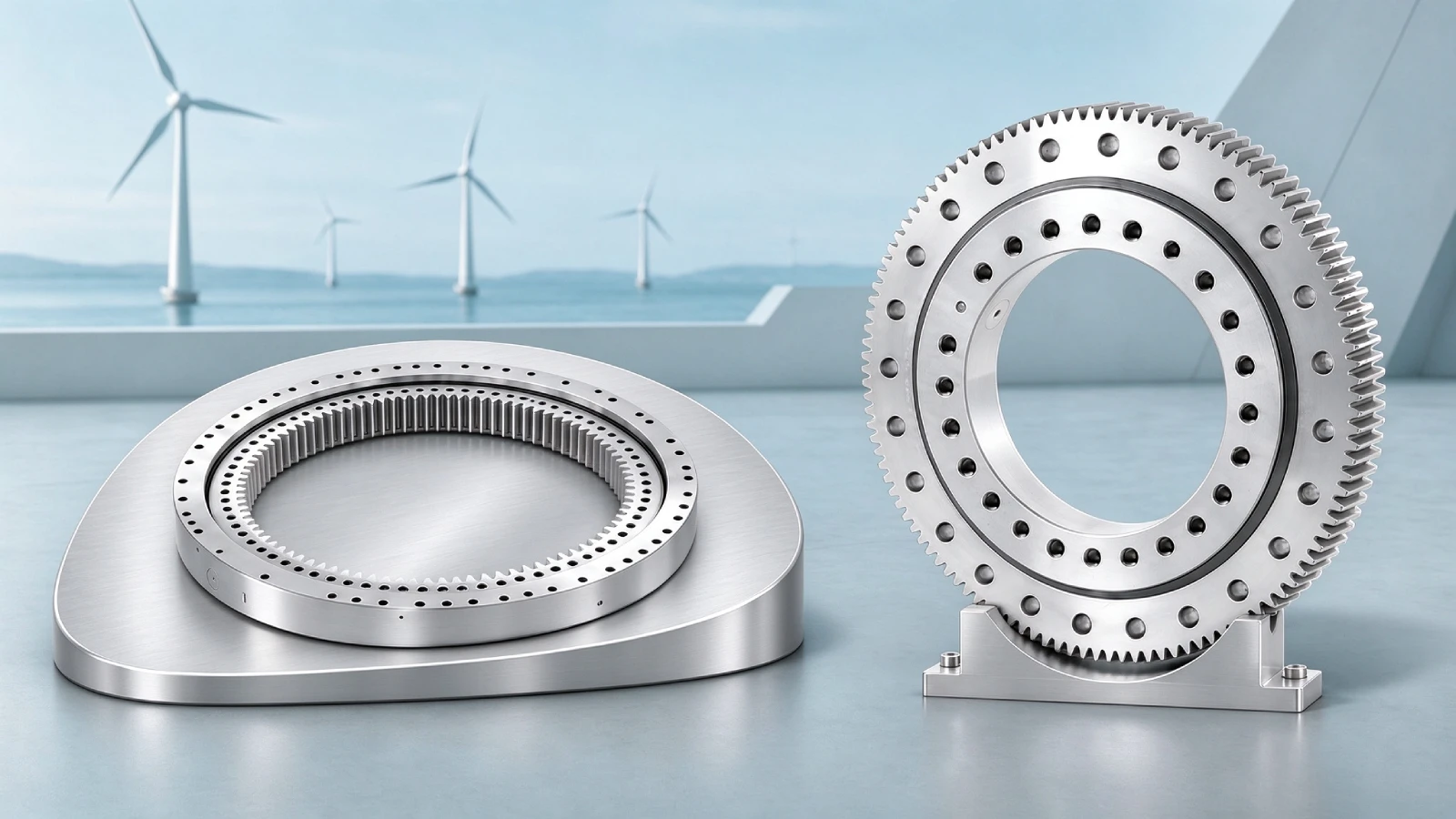
Wind turbines may use slewing bearing arrangements at the blade-pitch and nacelle-yaw interfaces. Pitch systems commonly use large rolling slewing rings to rotate each blade, while yaw systems may use either a rolling slewing ring or a sliding-pad arrangement with a separate gear interface. These positions carry different loads and serve different functions, so they should not be treated as the same bearing application.
For buyers searching for slewing bearing wind turbine solutions, ring diameter is only the starting point. Buyers should also confirm the mounting faces, bolt circles, gear geometry, ring orientation, seals, grease ports, and load requirements. A complete assembly drawing and the original bearing reference provide a much stronger basis for review than a photo or a similarly sized ring.
Where Does a Slewing Ring Work in the Turbine?
Each blade-pitch bearing joins a blade root to the hub. The pitch drive rotates the blade to control its angle, often through a geared interface. The ring transfers blade loads into the hub while experiencing small repeated movements and changing moments. Its operating pattern differs from a bearing that makes full, continuous revolutions.
The yaw interface sits between nacelle and tower. Some turbines use a geared rolling slewing ring; others use a sliding-pad support with a separate gear ring. The installed drive, brake and support layout controls the parts list. Do not assume that every yaw repair requires a rolling ring.
The main shaft carries rotating rotor loads into the drivetrain, and gearbox bearings support gear shafts. Their speed, lubrication and internal geometry differ. A broad wind-turbine parts list should name these positions separately so a pitch-ring inquiry cannot be mistaken for a main-bearing order.
How Do Pitch and Yaw Rings Differ in an RFQ?
Pitch and yaw positions require different identification data because their mounting interfaces, drive arrangements, and support structures are not the same. A pitch-bearing inquiry should start with the blade-to-hub connection, while a yaw inquiry should first confirm whether the turbine uses a rolling slewing ring or a sliding-pad support.
For a pitch ring, identify the affected blade position, hub and blade assembly numbers, ring orientation, and gear location. The blade-side and hub-side bolt circles should be confirmed separately because they may use different dimensions or hole patterns. Seal positions and grease ports should also match the installed arrangement.
For yaw, confirm the support architecture before comparing dimensions. A rolling yaw ring requires tower and nacelle mounting details, fixed and rotating ring orientation, gear position, and mating pinion information. A sliding yaw system instead requires pad, liner, retention, wear-surface, and separate gear-interface data. Similar outside diameters alone do not establish interchangeability.
| Turbine position | Typical arrangement | Key RFQ checks |
|---|---|---|
| Blade pitch | Rolling slewing ring; ball or roller design depending on turbine | Blade-side and hub-side bolt circles, ring orientation, gear position, seals, grease ports |
| Nacelle yaw – rolling | Rolling slewing ring with geared drive | Tower and nacelle bolt circles, fixed/rotating ring, gear geometry, mating pinion, mounting faces |
| Nacelle yaw – sliding | Sliding pads or liners with separate gear ring | Pad and liner dimensions, retention, wear surface, gear interface, mounting arrangement |
Rolling pitch and yaw rings may use different ball or roller arrangements to carry combined axial, radial, and overturning-moment loads. Therefore, buyers should provide the original designation or section drawing whenever possible rather than relying on ring diameter or general appearance.
Which Loads and Interfaces Need Review?
Wind loads create changing axial force and overturning moment at a pitch or yaw interface. The load calculation must include its intended combinations, not only the largest isolated axial number. Small oscillations can focus contact and lubrication demands in limited raceway areas. That behavior makes the actual duty cycle relevant to a custom design review.
Mounting faces must provide the stiffness and geometry assumed in the bearing design. A warped flange can redistribute load even when a replacement ring is manufactured correctly. The fastener grade, pattern, engagement, pretension and tightening procedure also influence the joint. Use the turbine maker’s specified values; a generic torque figure copied from another ring is unsafe.
Confirm gear teeth separately from bearing capacity. Tooth module or pitch, number and position, pressure angle where specified, tooth condition and mating pinion geometry affect the drive. Check seal layout and grease-port location as well. A correctly sized ring with misplaced ports or a different gear hand may be impossible to install without changing the structure.
What Damage Should the Maintenance Team Examine?
Excess play, rough motion, grease leakage, abnormal drive load or visible tooth damage calls for inspection. None of these signs alone proves raceway failure. Check bolt condition, flange flatness, pinion engagement, lubrication supply and seal integrity. A loose joint can mimic or accelerate ring damage.
Document the old ring’s raceway condition if teardown allows it. Local wear can point to repeated movement under load, while corrosion or debris may suggest sealing or grease problems. Record the affected angular zones and the machine’s operating history. The finding guides review; it does not by itself establish that a different ring design will solve the problem.
Before replacement, the repair plan should include support and lifting of the blade or nacelle, joint inspection and the specified bolt procedure. The responsible service team determines the safe method and acceptance checks. Procurement should confirm whether bolts, seals, gear parts and lubrication fittings are included in the order or sourced separately.
What Makes a Slewing-Bearing Inquiry Complete?
Buyers searching for slewing bearing wind turbine solutions should identify the turbine maker, model, serial number, and exact pitch or yaw position. A rolling-ring inquiry should also include the complete designation, section drawing, envelope dimensions, both bolt circles, gear details, seals, and grease ports. A sliding yaw system instead requires pad, liner, retention, and separate gear information. Quantity, photographs, ring orientation, and relevant flange measurements should also be provided.
A scheduled U.S. crane or blade job should include the drawing-approval deadline and required receipt date. Buyers should also confirm which inspection records the repair contractor requires, such as agreed dimensional checks and gear or bolt-interface inspection. HSN can review a hard-to-find ring or custom design against this information and discuss sourcing options after technical review. The turbine owner or qualified engineer should approve the load capacity, joint design, and installation procedure before the turbine returns to service.
FAQ
Is a pitch ring the same as a yaw ring?
No. Their locations, loads, gear interfaces and mounting drawings differ by turbine design.
Can equal diameters prove interchangeability?
No. Compare race design, both bolt circles, gear, height, seals and load rating against the drawing.
How should U.S. buyers compare slewing-ring quotes?
Compare the same supply scope, gear details, inspection records, lead time, and delivery requirements.
Why ask HSN to review a slewing ring?
HSN can compare the drawing, agree on dimensional and material checks, and report sourcing options and lead time before approval.
Remarks
For detailed wind turbine pitch or yaw slewing bearing models not listed above, please contact HSN for model confirmation and supply discussion. When checking other bearing references, you can also send the complete model, photos, dimensions, quantity, application, and working conditions.
This article is based on independent analysis of publicly available technical information and industry understanding for knowledge sharing. All brand names and trademarks mentioned belong to their respective owners. HSN Bearing Group is an independent bearing supplier and technical service provider.
Tel: +86 156 6578 7336 Email: service@hsnindustrial.com Website: www.rollingparts.com www.hsnbearing.com
Need Help Sourcing a Turbine Slewing Ring?
Contact HSN to confirm a hard-to-find model or discuss a replacement after technical review.