

How to Specify a Wind Turbine Main Bearing

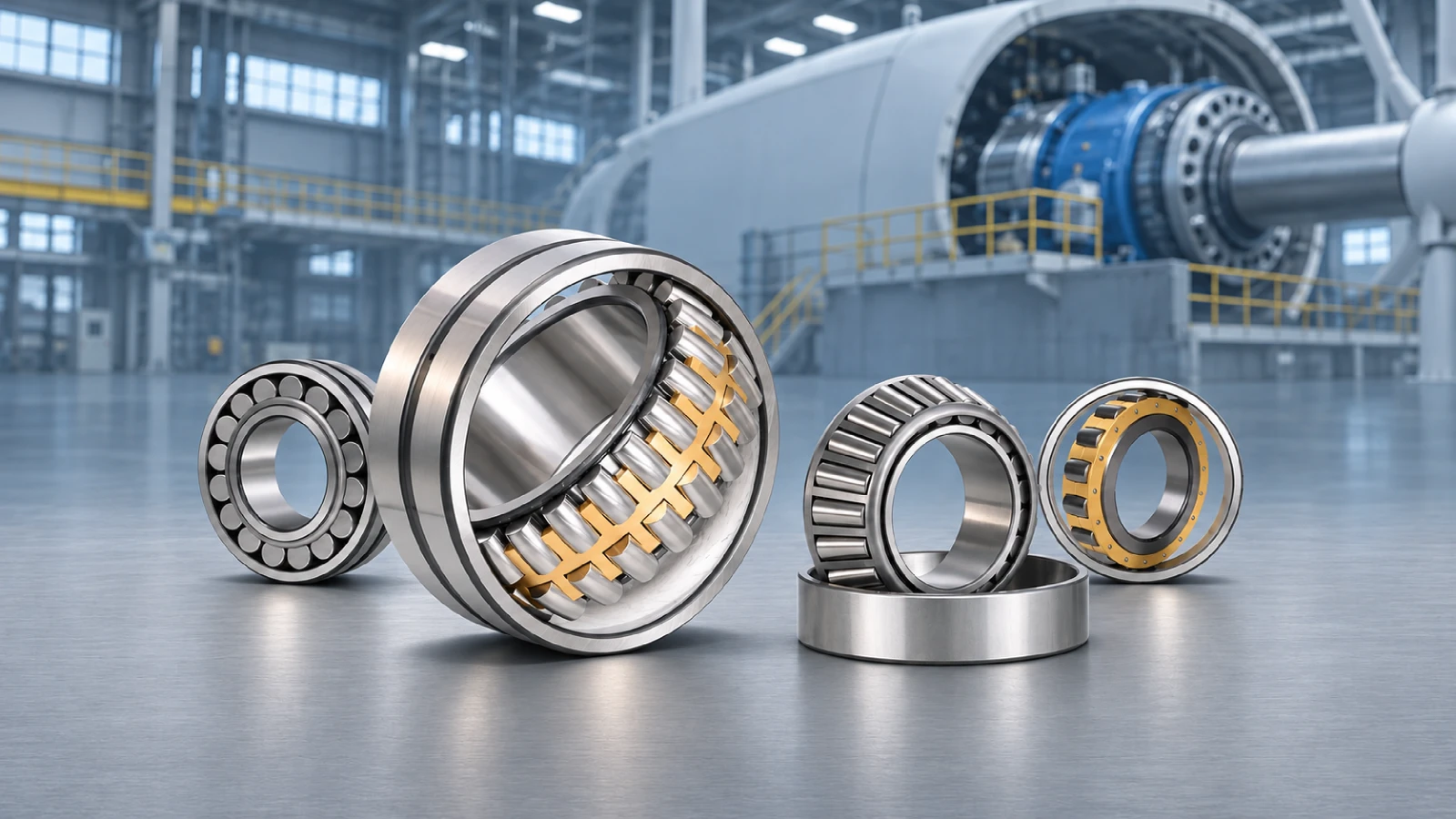
A search for a wind turbine main bearing may lead to a loose bearing, a sealed unit or a complete rotor-support assembly. The bearing supports the low-speed rotor load path into the nacelle. Turbine output and nominal diameter alone are insufficient for a quote; use the installed assembly drawing and its current revision.
This guide identifies the installed main-shaft component for procurement. Begin with the turbine and assembly identity, then establish the bearing type, axial location and installation scope. Diagnosis of a particular failure requires a separate inspection.
Where Is the Main Bearing in the Load Path?
The main bearing sits behind the hub along the rotor support path. It takes reactions from wind thrust, blade weight and bending through the low-speed shaft or an integrated support. In a geared design, the gearbox follows downstream; in a direct-drive design, the generator arrangement differs. The main bearing is distinct from bearings inside the gearbox and from pitch or yaw slewing rings.
One turbine may use a single main-bearing position with the gearbox providing another part of the support. Another may use two main-shaft bearings. The locating and non-locating functions determine where axial movement is restrained and where thermal or structural displacement is accommodated. A spare chosen for the wrong position can change the shaft’s intended freedom to move.
The phrase wind turbine main bearing usually points to a physical position, not a universal product family. Ask for the bearing cross-section and adjacent support layout. Those drawings reveal whether the procurement line should be a loose bearing, mounted unit, pair, or assembly with seals and housing.
Which Original Design Must the Buyer Identify?
The original design may use spherical, toroidal or tapered rollers in different arrangements. SKF describes a ScanWind 3 MW turbine with two housed, oil-lubricated units: spherical roller bearing 249/950 CA/W33 and toroidal roller bearing C30/710 M. These are complete published designations for that specific case, not interchangeable alternatives or model numbers for all turbines. Ask the machine drawing which position and arrangement is installed.
Record turbine maker, model, serial number, main-shaft assembly number and full bearing designation, including every suffix. The section drawing should identify shaft shoulders, housing, retainers, spacers, seals and oil or grease route. A removed sample can establish dimensions when markings are illegible, but approved internal geometry and material need confirmation.
| Item on the request | What to confirm | Why it matters |
|---|---|---|
| Bearing or assembly | Loose part, sealed unit or housing package | Changes order scope and installation plan |
| Shaft location | Locating/non-locating role and adjacent support | Controls axial movement and load transfer |
| Drawing revision | Turbine variant and modification history | Prevents ordering for an older configuration |
In the published SKF example, the spherical and toroidal types serve different functions within the same two-unit support. An RFQ must identify the specific unit, its housing and the exact drawing revision; ordering one code as a substitute for the other would change the arrangement.
How Do Loads and Interfaces Shape the Specification?
Rotor thrust can reverse or fluctuate, while bending changes how the support is loaded. The engineering review should use the actual load cases, speed range and surrounding shaft and housing stiffness. A published dynamic load rating cannot show whether a ring will fit a worn shaft seat or whether a different bearing arrangement keeps gearbox input movement within limits.
Measure the shaft and housing seats during repair planning and record any corrosion, fretting or shoulder damage. Fits affect ring support and load sharing. Bearing setting or operating clearance must follow the approved arrangement; a tapered-roller unit and a spherical-roller unit may require different assembly procedures. Grease type, fill and replenishment need to align with the seals and lubricant delivery route.
For a custom inquiry, define the intended construction and acceptance criteria. A dimensional match can support a preliminary search, but it does not prove the candidate’s internal geometry, capacity or installation compatibility. The turbine owner or qualified engineer must approve a changed design before ordering it as an alternative.
When Should Monitoring Affect a Replacement Order?
Condition trends help the maintenance team decide what to inspect and when to plan access. They cannot identify a complete replacement code. A rising temperature, vibration change or grease debris finding should be correlated with sensor location and machine state. If the bearing is removed, retain its markings, photographs and inspection results for the final specification.
Procurement may request a contingency availability check while diagnosis continues. However, it should not release an installation order until the approved bearing code, order scope and acceptance criteria are confirmed. A new bearing with the wrong mounting package can delay the repair despite arriving on time.
For a U.S. outage with crane work scheduled, record a decision gate for drawing approval and a separate receiving deadline. Procurement can then compare stock, custom manufacturing and assembly options against the actual repair plan. Avoid promising a drop-in interchange from a cross-reference alone.
What Should HSN Receive for a Main-Bearing Inquiry?
Send the following information so HSN can review the specified part and order scope:
- Machine and assembly: Turbine maker, model, serial number and main-shaft assembly number.
- Bearing and drawing: Complete bearing code, current drawing revision, photographs, bore, outside diameter and width.
- Measured condition and duty: Shaft and housing measurements, lubricant, seals, load and speed duty.
- Order controls: Quantity, required supply scope, and required receipt date.
HSN can review a hard-to-find bearing model or drawing, check sourcing options and discuss a custom specification. Agreed dimensional or material inspections can be arranged for an order. A complete request lets a distributor and maintenance contractor compare the same part and scope.
FAQ
Is a main bearing a gearbox bearing?
No. Identify the rotor support and gearbox positions separately on the drivetrain drawing.
Can diameter alone identify a main bearing?
No. Full code, internal design, width, fits, seals and assembly scope also matter.
What should a U.S. outage order specify?
State the drawing revision, quantity, approval deadline, receiving date and installation scope.
Can HSN reproduce the original bearing design?
HSN can review detailed drawings or same-revision production records, then build to approved drawings. Send old-part photos for review.
Remarks
For detailed wind turbine main bearing models not listed above, please contact HSN for model confirmation and supply discussion. When checking other bearing references, you can also send the complete model, photos, dimensions, quantity, application, and working conditions.
This article is based on independent analysis of publicly available technical information and industry understanding for knowledge sharing. All brand names and trademarks mentioned belong to their respective owners. HSN Bearing Group is an independent bearing supplier and technical service provider.
Tel: +86 156 6578 7336 Email: service@hsnindustrial.com Website: www.rollingparts.com www.hsnbearing.com
Need Help Sourcing a Wind Turbine Main Bearing?
Contact HSN to confirm a hard-to-find model or discuss a replacement after technical review.