

Why Linear Ball Bearing Selection Requires Type and Code Checks?

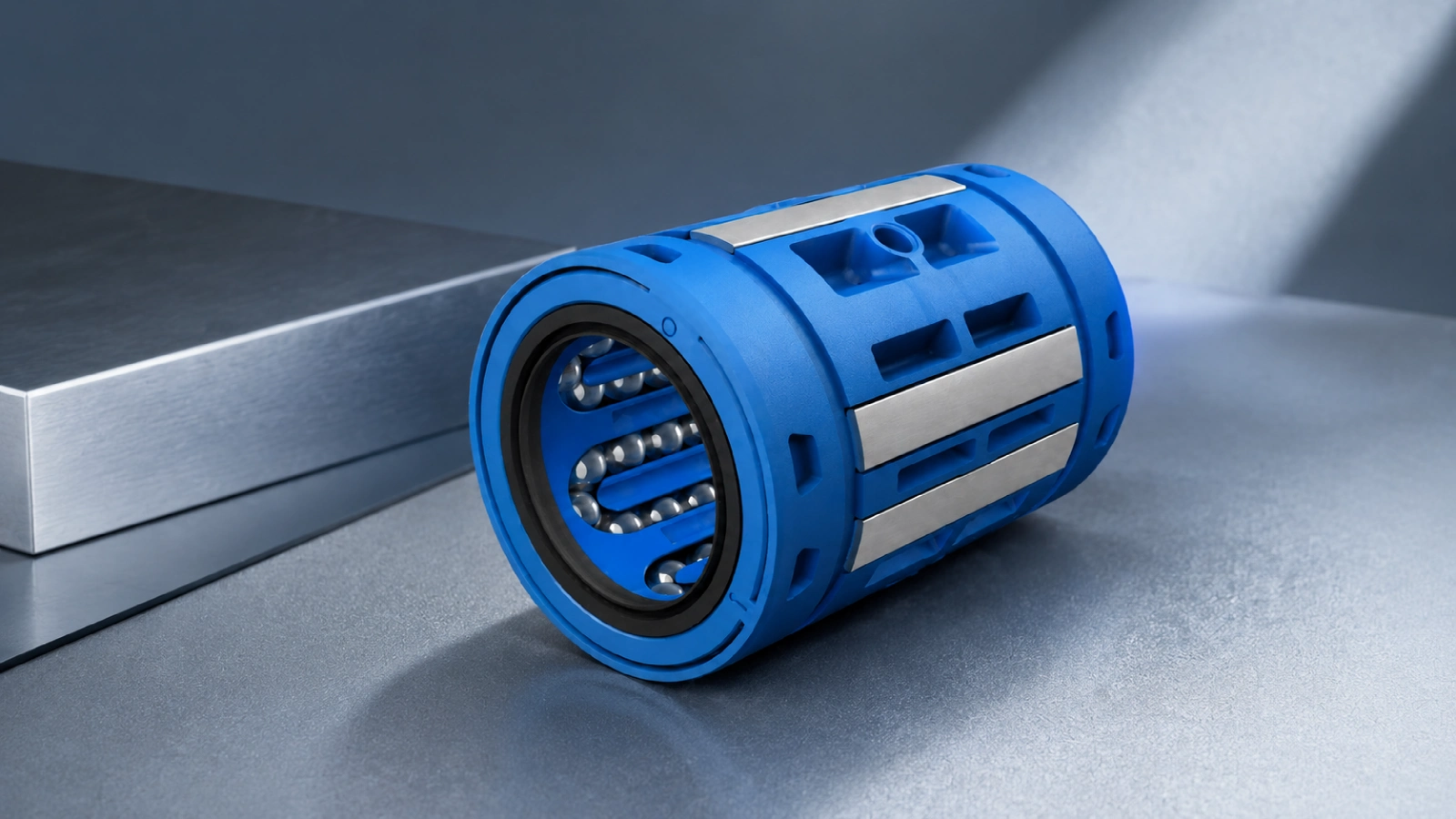
A linear ball bearing guides a component along a cylindrical shaft with recirculating balls. It offers low-friction linear travel, but the bearing cannot work correctly as an isolated part. Shaft hardness, surface finish, support, housing fit, alignment, sealing and lubrication all influence the complete guidance system.
Buyers often start with the shaft diameter, yet that value does not identify the bearing design. A closed, open, adjustable, self-aligning or flanged unit may share the same nominal shaft size. Therefore, the full model and mounting arrangement need confirmation before sourcing.
Table of contents
- What Is a Linear Ball Bearing and How Does It Guide Motion?
- Which Linear Ball Bearing Structures and Units Are Available?
- How Do Closed, Open, Adjustable, and Flanged Designs Differ?
- Which Machines and Motion Systems Use Linear Ball Bearings?
- What Should Buyers Check During Installation and Removal?
- How Do Brand Series and Model Codes Identify Each Design?
- What Data Should Buyers Provide Before Ordering?
- How Can HSN Support Linear Ball Bearing Selection?
- FAQ
What Is a Linear Ball Bearing and How Does It Guide Motion?
Balls move through loaded raceway zones and return through recirculation channels in the cage. The loaded balls contact the shaft and transfer radial force to the outer sleeve or housing. This structure creates continuous straight travel instead of the rotary motion used by a conventional ball bearing.
Load capacity changes with ball-row orientation. In addition, a single bushing on one shaft should not be expected to carry a large moment load. Designers commonly use two bearings on a shaft, two parallel shafts or a complete unit arrangement to control pitch, yaw and roll.
Which Linear Ball Bearing Structures and Units Are Available?
A rigid closed bearing suits a fully supported housing and an unsupported round shaft. A self-aligning design can compensate for limited fitting error, although it cannot correct a badly aligned machine frame. Open bearings have a sector removed so they can run on shafts supported along their length.
Adjustable bearings or housings allow radial clearance or preload to be set within the specified range. Flanged units provide a ready mounting interface. Tandem and multi-bearing units increase spacing and improve moment support. Each option changes the housing, shaft support and installation method.
How Do Closed, Open, Adjustable, and Flanged Designs Differ?
Closed designs surround the shaft and are compact, but the shaft cannot have a continuous support rail through the bearing. Open designs work with supported shafts and can provide greater system stiffness over long spans. However, the open section reduces the load zone, so orientation matters.
An adjustable version requires a suitable slotted housing and controlled adjustment. Too much preload increases friction and heat, while too much clearance reduces guidance accuracy. A flanged bearing or unit simplifies fastening, but its flange shape, bolt pattern and height must match the machine.
Which Machines and Motion Systems Use Linear Ball Bearings?
Ball linear bearings appear in packaging equipment, assembly machines, material-handling devices, measuring systems, light machine tools and automation modules. They also support sliding doors, positioning tables and medical or office equipment where smooth movement and moderate loads are required.
Nevertheless, contamination, shock and washdown can change the preferred design. Woodworking or foundry equipment may need a rugged metal construction and effective wipers. Clean equipment may prioritize smooth, quiet travel. For every application, stroke, speed, acceleration, duty cycle and load direction should be reviewed.

What Should Buyers Check During Installation and Removal?
Check the shaft diameter, hardness, surface quality, straightness and support before mounting. The housing bore must provide the specified fit without crushing the outer sleeve. In a multi-shaft system, verify parallelism and the mounting height of both guides.
Use a mounting arbor where appropriate and prevent balls or seals from being damaged by sharp shaft edges. Align the main load direction with the bearing’s marked load zone when the design requires it. After assembly, move the carriage through its full stroke and check resistance, noise and lubrication.
For removal, support the housing and push on the outer sleeve rather than the cage. Record wear marks and contamination if the part is being inspected for failure.
How Do Brand Series and Model Codes Identify Each Design?
Brand codes describe the bearing form, nominal shaft diameter, seal arrangement and sometimes housing or material. The following examples are complete references, but they should not be used as automatic cross-brand equivalents.
| Brand | Representative series or design | Complete model examples |
|---|---|---|
| SKF | LBCR rigid; LBCD self-aligning; LUCE adjustable unit; LVCR flanged unit | LBCR 20 D-2LS; LBCD 20 D-2LS; LUCE 20 D-2LS; LVCR 20 D-2LS |
| THK | 6LM standard bushing; LMF flanged; SC encased unit | LM20UU; LMF20UU; SC13UU |
| Bosch Rexroth | KBM standard metal; KBC compact; KBH Super | KBM-20-DD (R060202010); KBC-20-DD (R065822040); KBH-20-DD (R073222040) |
In the SKF examples, 20 identifies the nominal shaft size, while 2LS identifies the sealed execution. The initial letters separate rigid, self-aligning, adjustable-unit and flanged-unit designs.
In THK LM20UU, LM identifies the bushing family, 20 identifies shaft size and UU identifies seals at both ends.
For Bosch Rexroth, KBM, KBC and KBH identify different design families. The number 20 identifies shaft size, and DD identifies two seals in these examples. The additional R-number is the complete material number, which buyers should retain on the inquiry.
What Data Should Buyers Provide Before Ordering?
Provide the full model, brand, shaft diameter, outer dimensions and housing style. State whether the bearing is closed, open, adjustable, self-aligning or flanged. Also send the shaft drawing, support method and the distance between bearings.
Operating data should include load and direction, stroke, speed, acceleration, duty cycle, temperature, contamination and lubrication. Photos help when the marking is incomplete, while a sample or drawing is important for a non-standard housing. Include quantity, delivery target and inspection requirements.
How Can HSN Support Linear Ball Bearing Selection?
HSN Bearing Group reviews the bearing, shaft, and housing as one linear system. Buyers should provide the complete bearing and housing codes. Shaft size, open or closed design, seals, preload, and load direction also matter. HSN also reviews speed, stroke, mounting layout, quantity, and operating environment. These details support accurate model confirmation and supply checks.
For difficult or non-standard units, HSN can review drawings, samples, dimensions, and fits. Replacement or custom supply can follow technical confirmation. Before shipment, agreed checks may cover dimensions, hardness, clearance, appearance, and movement. Buyers may also request material, running accuracy, vibration, or noise checks. Similar bore sizes do not prove system compatibility.
FAQ
Can a linear ball bearing run on any round shaft?
No. Shaft hardness, finish, diameter, straightness and support must suit the bearing and expected load.
When is an open linear bearing needed?
It is used with a shaft supported along its length, often where long travel or greater system stiffness is required.
Can one bearing support a large moment load?
Usually not. Use suitable bearing spacing, multiple bearings or parallel shafts to control pitch, yaw and roll. clearance, cage, precision and lubricant requirements.
What details identify the correct linear unit?
Confirm the full code, shaft size, open or closed design, housing, seals, preload, load direction and lubrication.
Remarks
For detailed linear ball bearing models not listed above, please contact HSN for model confirmation and supply discussion. When checking ball linear bearing references, you can also send the complete model number, photos, dimensions, quantity, and working conditions for review.
This article is based on independent analysis of publicly available technical information and industry understanding for knowledge sharing. All brand names and trademarks mentioned belong to their respective owners. HSN Bearing Group is an independent bearing supplier and technical service provider.
Tel: +86 156 6578 7336 Email: service@hsnindustrial.com Website: www.rollingparts.com www.hsnbearing.com
Need Help Confirming a Linear Ball Bearing?
If you urgently need a hard-to-find ball linear bearing from stock in China, contact HSN. We can also discuss an alternative or improved solution after technical confirmation.