

Why Kingsbury Thrust Bearing Selection Needs Design and Duty Checks?

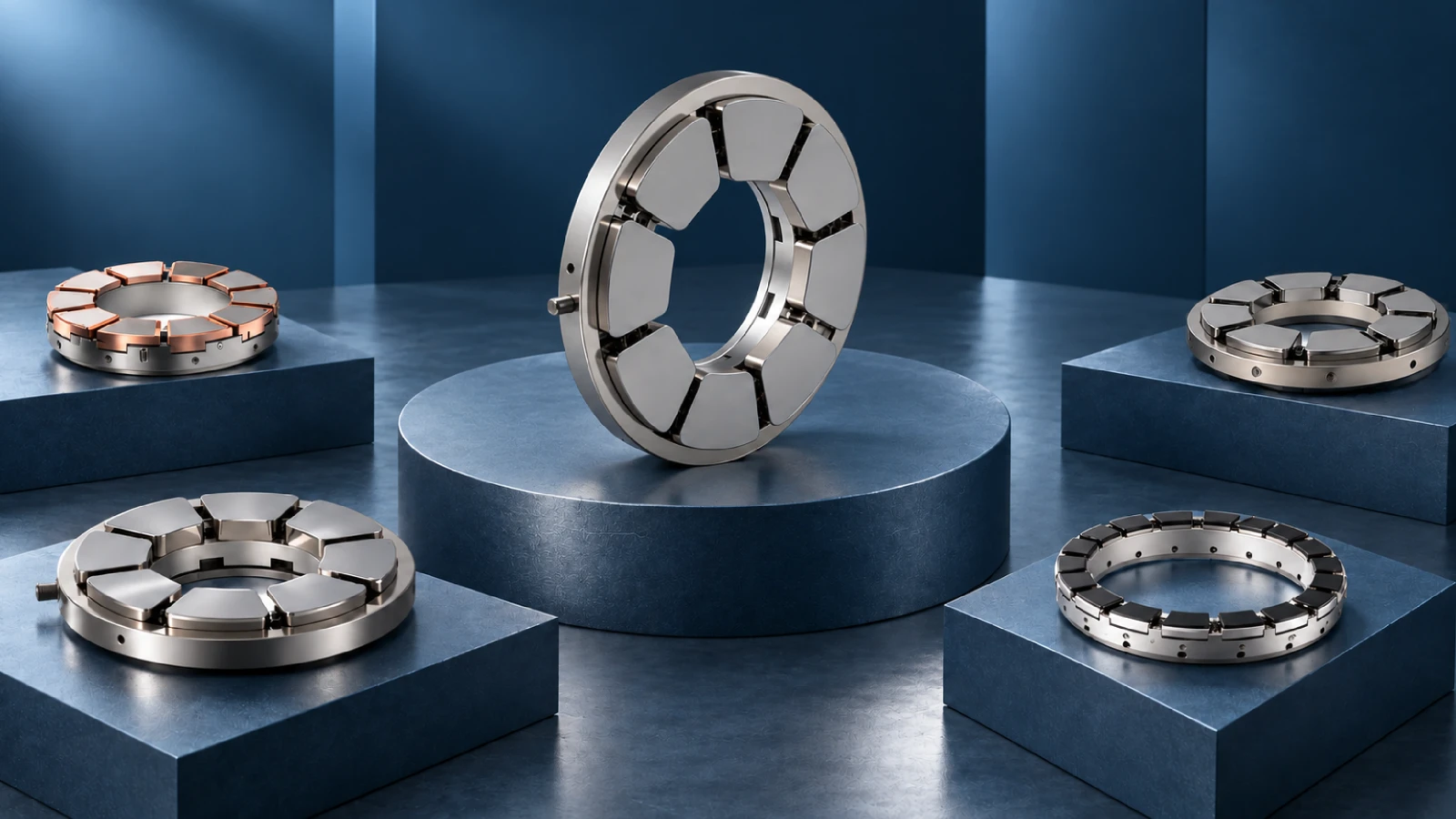
A kingsbury thrust bearingis usually considered when a rotating shaft must carry substantial axial load through a hydrodynamic oil film. The product name alone, however, is not enough for selection. Buyers must confirm the bearing arrangement, equalizing system, lubrication method, shaft speed, collar condition, available envelope, and operating temperatures.
This matters for distributors, repair companies, and equipment engineers. A visually similar bearing can behave differently if its pad geometry, pivot position, oil delivery, or load-sharing mechanism changes.
Table of contents
Who Is Kingsbury and What Does Its Bearing Range Cover?
Kingsbury has designed and manufactured tilting-pad hydrodynamic thrust and journal bearings since the first successful installation of Albert Kingsbury’s fluid-film thrust bearing in 1912. Its current range covers tilting-pad thrust bearings, tilting-pad journal bearings, combination thrust-and-journal bearings, fixed-profile designs, and related service support for critical rotating machinery.
For buyers, the important distinction is functional:
- Thrust bearings support axial load along the shaft axis.
- Journal or guide bearings support radial load and influence shaft position and vibration behavior.
- Combination bearings integrate axial and radial support where the machine layout requires a compact assembly.
- Fixed-profile bearings use a different geometry from tilting-pad designs and should not be treated as an automatic equivalent.
An inquiry marked only “Kingsbury bearing” is incomplete. Use the nameplate, assembly drawing, shaft orientation, and duty data to identify the required function.
How Does a Kingsbury Thrust Bearing Carry Axial Load?
A tilting-pad thrust bearing operates by forming a pressurized lubricant film between a rotating thrust collar and stationary pads. Collar movement draws oil into the converging space created as each pad tilts. The resulting hydrodynamic pressure separates the running surfaces and transfers axial force through the pads to the supporting structure.
Four conditions are central to this process:
- Relative motion: The collar must move fast enough to develop the required oil wedge during normal operation.
- Correct oil supply: Viscosity, inlet temperature, flow, pressure, and drainage affect film formation and heat removal.
- Pad freedom: The pads must tilt as designed, without damage, contamination, or incorrect assembly restricting movement.
- Suitable alignment: Collar runout, housing alignment, and pad load distribution influence the maximum pad temperature and film thickness.
Film conditions during start-up, shutdown, turning-gear operation, and oil disturbances differ from steady running and belong in the duty review.
Which Kingsbury Thrust Bearing Types Should Buyers Compare?
Kingsbury groups its tilting-pad thrust products first by equalizing or non-equalizing construction and then by flooded or directed lubrication. Buyers should preserve both distinctions because the equalizing mechanism and oil-delivery method affect load distribution, temperature, and machine interfaces.
| Product-family example | Design point to verify | Typical purchasing question |
|---|---|---|
| EQH-B, EQH-J, EQH-S | Equalizing arrangement with flooded lubrication | Does the replacement preserve load sharing and housing interfaces? |
| J-, B-, or S-Style LEG | Directed lubrication feeds oil toward the pad’s leading edge | Can the existing oil system provide the required supply and drainage? |
| SlimLine LEG | Reduced axial envelope with directed lubrication | Are the axial space, collar geometry, and mounting features confirmed? |
| KingCole or NE | Non-equalizing tilting-pad arrangement | Is the machine duty suitable for a non-equalizing design? |
| VK | Vertical-shaft bearing with a non-equalizing thrust arrangement | Does the application permit non-equalizing load distribution? |
| KBV | Vertical-shaft bearing with an equalizing thrust arrangement | Does the replacement preserve the equalizing mechanism and guide-bearing interfaces? |
These are product-family examples, not automatic interchange references. Consequently, buyers must also confirm pad count, active area, materials, instrumentation, rotation direction, oil connections, mounting details, complete designation, and drawing revision.
Why Do Load, Speed and Lubrication Need Duty-Specific Checks?
Selection combines thermal, hydrodynamic, and structural checks rather than a dimensional lookup alone. First, the bearing must carry the applied thrust while maintaining adequate oil-film thickness. Next, the oil system must control pad temperature and remove heat. Finally, the complete arrangement must keep power loss, alignment, and axial movement within the machine limits throughout the operating cycle.
Before discussing supply, review the following:
| Duty input | Why it matters |
|---|---|
| Normal, maximum, and transient axial load | Determines pad loading and the severity of start-up or upset conditions |
| Shaft speed and direction of rotation | Affects oil-wedge formation and may determine pad or groove orientation |
| Collar diameter, finish, flatness, and runout | Influences film stability, heat generation, and load distribution |
| Oil grade, viscosity, inlet temperature, flow, and pressure | Controls lubrication and heat removal |
| Shaft orientation and allowable axial movement | Affects bearing arrangement, locating function, and assembly clearances |
| Measured pad or drain-oil temperatures | Helps compare actual operation with the intended duty |
| Housing dimensions and instrumentation | Confirms physical fit and provisions for temperature monitoring |
For example, changing from a flooded EQH arrangement to a LEG directed-lubrication design involves more than replacing the bearing assembly. Buyers must review oil entry, internal distribution, discharge, drainage, and control requirements as part of the complete machine system.
What Should Buyers Confirm Before a Replacement Inquiry?
An effective inquiry identifies the existing design and why replacement is needed. Send the original brand, complete model, nameplate photos, interface drawings, shaft and collar dimensions, quantity, and schedule.
Also provide:
- normal, peak, reverse, and transient axial loads;
- shaft speed, rotation direction, and start-stop pattern;
- lubricant grade, viscosity, inlet temperature, flow, and pressure;
- operating and alarm temperatures, if available;
- pad material, backing construction, equalizing arrangement, and sensor details;
- observed failure mode, wear pattern, or reason for the change;
- inspection, documentation, packaging, and preservation requirements.
HSN Bearing Group can support sourcing and alternative discussions using the complete model, drawings, samples, dimensions, and working conditions. For a fluid-film thrust bearing, the agreed inspection plan may cover interface dimensions, pad and collar geometry, axial setting or end-float requirements, pad material, babbitt condition, equalizing components, oil passages, rotation orientation, and specified documentation. Confirm every alternative against the actual machine duty before ordering.
FAQ
Can shaft diameter identify a Kingsbury thrust bearing?
No. Also confirm axial load, speed, oil conditions, pad geometry, equalizing method, thermal limits and housing interfaces.
How do EQH and LEG designs differ?
EQH uses a flooded equalizing design. LEG directs oil to the pad’s leading edge, so any change requires an oil-system and duty review.
Are EQH-J, SlimLine, and KingCole interchangeable?
No. Compare the full designation, dimensions, load-sharing arrangement, lubrication method, rotation direction and machine interfaces.
Can HSN review a Kingsbury bearing alternative?
Yes, after reviewing the model, drawings, dimensions, materials, lubrication, loads, speed and inspection requirements.
Remarks
For detailed Kingsbury bearing models beyond the examples listed above, or for other bearing types, please contact HSN with the complete designation and application details.
This article is based on independent analysis of publicly available technical information and industry understanding and is intended for knowledge sharing. All brand names and trademarks belong to their respective owners. HSN Bearing Group is an independent bearing supplier and technical service provider.
Tel: +86 156 6578 7336 Email: service@hsnindustrial.com Website: www.rollingparts.com www.hsnbearing.com
Need Help Confirming a Kingsbury Thrust Bearing?
Contact HSN to confirm a hard-to-find model or discuss a replacement after technical review.