

Why Heavy Duty Linear Bearing Slide Rails Need System Checks?

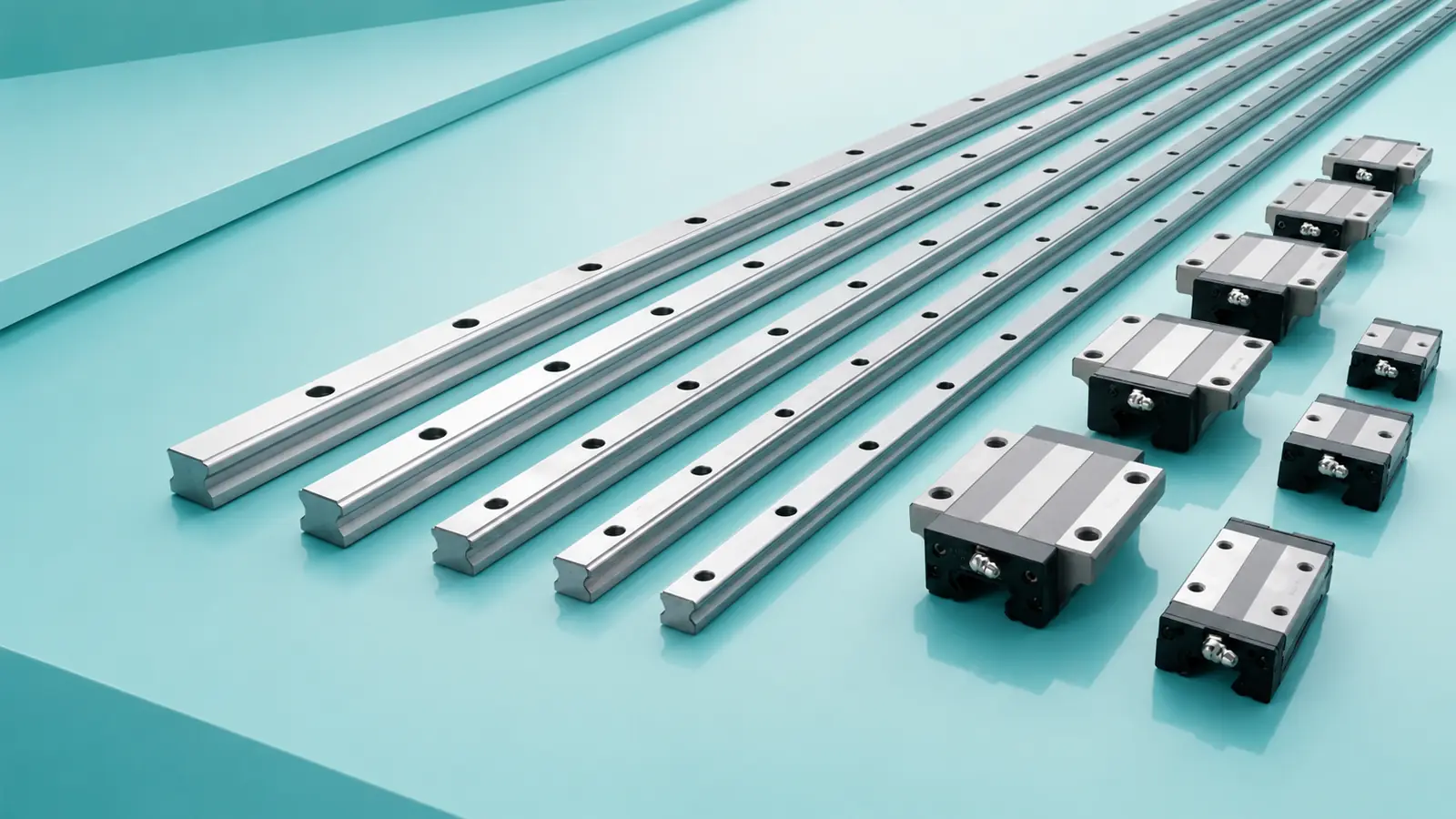
Heavy duty linear bearing slide rails guide a machine component along a straight path by recirculating balls or rollers between a rail and one or more blocks. Their profiled raceways can carry high loads while maintaining controlled linear motion. Depending on the contact geometry, a guide can support radial, reverse-radial, lateral, and moment loads.
The rail and block must be treated as a matched system, not as separate generic parts. Buyers need to confirm the series, size, block shape, rail length, block count, preload or clearance, accuracy, seals, lubrication, and mounting arrangement. Similar rail widths do not prove that blocks from different series will fit or run correctly.
Table of contents
- What Defines a Heavy-Duty Linear Guide System?
- Which Heavy-Load Rail and Block Types Are Available?
- Where Are Heavy Duty Linear Bearing Slide Rails Used?
- What Selection Data Must Buyers Confirm?
- What Matters During Installation and Removal?
- Which Brand Series and Complete Models Should Buyers Know?
- How Do Buyers Read a THK Linear Guide Code?
- How Can HSN Support Linear Guide Inquiries?
- FAQ
What Defines a Heavy-Duty Linear Guide System?
A typical system includes a hardened profiled rail, recirculating block, rolling elements, return passages, end caps, seals, and lubrication connections. The balls or rollers circulate through loaded raceways and return channels as the block travels.
Ball guides combine load capacity with smooth movement and practical speed. Roller guides use line contact and can provide higher rigidity under heavy load, although mounting accuracy becomes especially important. Caged-ball and caged-roller designs separate adjacent rolling elements, which can improve circulation and lubricant retention.
Heavy duty does not refer to rail width alone. It depends on the complete load case, block length, number of blocks, guide spacing, preload, mounting stiffness, and required life.
Which Heavy-Load Rail and Block Types Are Available?
The main structural choices affect load direction, rigidity, installation space, and maintenance:
| Type | Main characteristic | MainSuitable selection question |
|---|---|---|
| Guide design – Four-way equal-load ball guide | Supports loads from major directions with similar rated capacity | Will the load direction change during operation? |
| Guide design – Radial-load ball guide | Designed for applications with a dominant radial or downward load | Is the guide mainly supporting a horizontal table or carriage? |
| Guide design – Roller guide | Provides high rigidity and load capacity for demanding applications | Can the mounting base meet the required accuracy and stiffness? |
| Block form – Long block | Longer load zone can increase load and moment capacity | Is there enough installation length for the longer block? |
| Block form – Wide flange block | Broad mounting surface supports flexible fastening arrangements | How will the carriage or moving table connect to the block? |
| Rail form – Wide rail | Wider rail geometry can improve moment stability | Is a single-rail layout or higher moment resistance required? |
| Rail form – Low-profile rail | Reduces the overall guide assembly height | Is installation height limited? |
The final arrangement may use two rails with multiple blocks, a single wide rail, or another layout based on load and moment calculations. Buyers should confirm the complete system geometry, mounting surface, load direction, and required rigidity before selecting the rail or block form.
Where Are Heavy Duty Linear Bearing Slide Rails Used?
Common applications include machining centers, industrial presses, injection-moulding equipment, large automation lines, handling systems, measuring machines, semiconductor equipment, welding systems, and heavy positioning tables. These machines need controlled straight travel under combined load, acceleration, and repeated cycles.
Machine tools often prioritize rigidity, accuracy, preload, and contamination protection. Handling equipment may place more emphasis on shock, moment load, stroke length, and relubrication access. In dirty environments, protective seals, rail covers, bellows, or lubrication units can be as important as the basic load rating.





What Selection Data Must Buyers Confirm?
Record the maximum radial, reverse-radial, lateral, rolling, pitching, and yawing loads. Also identify acceleration, impact, vibration, speed, stroke, cycle frequency, and expected life. A static load value by itself cannot describe a moving guide system.
The inquiry should also state:
- Rail length, rail size, block quantity, and block spacing
- Mounting orientation and travel direction
- Block shape and top, bottom, or side mounting method
- Preload or radial-clearance class
- Accuracy grade and required parallelism
- Jointed-rail requirement for long travel
- Seal, scraper, cover-strip, or bellows arrangement
- Lubricant and relubrication access
- Temperature, contamination, corrosion, and clean-environment needs
For a replacement project, provide the complete code from both block and rail. A photograph should show the reference surfaces, mounting holes, end seals, and lubrication port.
What Matters During Installation and Removal?
The mounting base controls the guide’s running accuracy. Remove burrs, dents, dust, paint, and raised edges before placing the rail. Confirm that the corner radius, reference-surface height, perpendicularity, and mounting-hole positions suit the selected guide.
Keep blocks and rails with their intended combination when the manufacturer identifies them by the same serial number. Align the reference surfaces, tighten rail bolts in the specified sequence, and establish the required parallelism between master and subsidiary rails. Then place the table on the blocks and tighten block bolts evenly.
Do not pull a block off the rail without a suitable transfer or retaining device. Balls or rollers can move out of position. During removal, support long rails to prevent bending, mark rail orientation and block position, and protect the raceways from impact and contamination.
Which Brand Series and Complete Models Should Buyers Know?
The following examples show how international suppliers describe heavy-load blocks. They are not direct cross references.
| Brand | Main heavy-load series | Complete model example |
|---|---|---|
| THK | HSR full-ball, SHS caged-ball, SRG caged-roller | HSR45LR |
| NSK | NH high-load ball guide and RA roller guide | NH45GM |
| HIWIN | HG heavy-load ball guide and RG roller guide | HGW45HCZ0H |
| Bosch Rexroth | High-precision ball and roller rail systems | R18514322X |
These examples can identify a block family, but an assembly still needs the correct rail and configuration. Rail length, block count, preload, accuracy, seals, surface treatment, lubrication, and matched-set requirements may appear elsewhere in the ordering code or order specification.
How Do Buyers Read a THK Linear Guide Code?
THK model HSR45LR provides a compact example of the basic block designation.
| Code | Code section | Meaning |
|---|---|---|
| HSR | Series | Full-ball LM Guide with four-way equal-load capability |
| 45 | Nominal size | Size section used for the compatible HSR45 rail |
| L | Block length | Long-block arrangement with increased load capacity |
| R | Mounting shape | Narrow block mounted by bolts from above |
Additional ordering information can identify the number of blocks, rail length, contamination accessories, clearance or preload, accuracy, surface treatment, and special operating conditions. Therefore, HSR45LR alone should not be treated as the complete specification for a multi-block rail set.
How Can HSN Support Linear Guide Inquiries?
HSN Bearing Group reviews heavy-duty linear guides as complete block-and-rail systems. Buyers should provide the full codes, drawings, rail length, hole layout, and block spacing. HSN can review accuracy, preload, seals, lubrication, loads, moments, speed, and stroke. Duty cycle, environment, quantity, and mounting conditions also matter. These details support model confirmation and supply checks.
For obsolete or difficult systems, HSN can compare dimensions, geometry, and working conditions. Replacement or custom supply can follow technical confirmation. Before shipment, checks may cover dimensions, hardness, rail straightness, mounting surfaces, appearance, and block movement. Clearance, preload behavior, vibration, or noise checks can also be discussed. A matching rail width alone does not prove compatibility.
FAQ
Can a guide block fit any rail of the same width?
No. Series, size, raceway geometry, preload, accuracy and matched-set requirements must all be confirmed.
Why should the rail and block be treated as a system?
Their geometry, spacing, mounting accuracy and preload control load sharing, rigidity and running accuracy.
Can a block be removed without a transfer rail?
Avoid it. Use a suitable transfer or retaining device so balls or rollers do not move out of position.
Which data defines heavy-duty suitability?
Confirm loads, moments, speed, stroke, cycles, spacing, preload, accuracy, sealing, lubrication and mounting.
Remarks
For detailed heavy-duty linear bearing slide rail models not listed above, please contact HSN for model confirmation and supply discussion. When checking heavy-duty linear bearing slide rail references, you can also send the complete model number, photos, dimensions, quantity, and working conditions for review.
This article is based on independent analysis of publicly available technical information and industry understanding for knowledge sharing. All brand names and trademarks mentioned belong to their respective owners. HSN Bearing Group is an independent bearing supplier and technical service provider.
Tel: +86 156 6578 7336 Email: service@hsnindustrial.com Website: www.rollingparts.com www.hsnbearing.com
Need Help Finding Heavy-Duty Linear Slide Rails?
Contact HSN with the block and rail codes, drawing, rail length, loads, accuracy, quantity and working conditions for technical confirmation.