

Why Flanged Ball Bearings Need Fit and Code Checks?

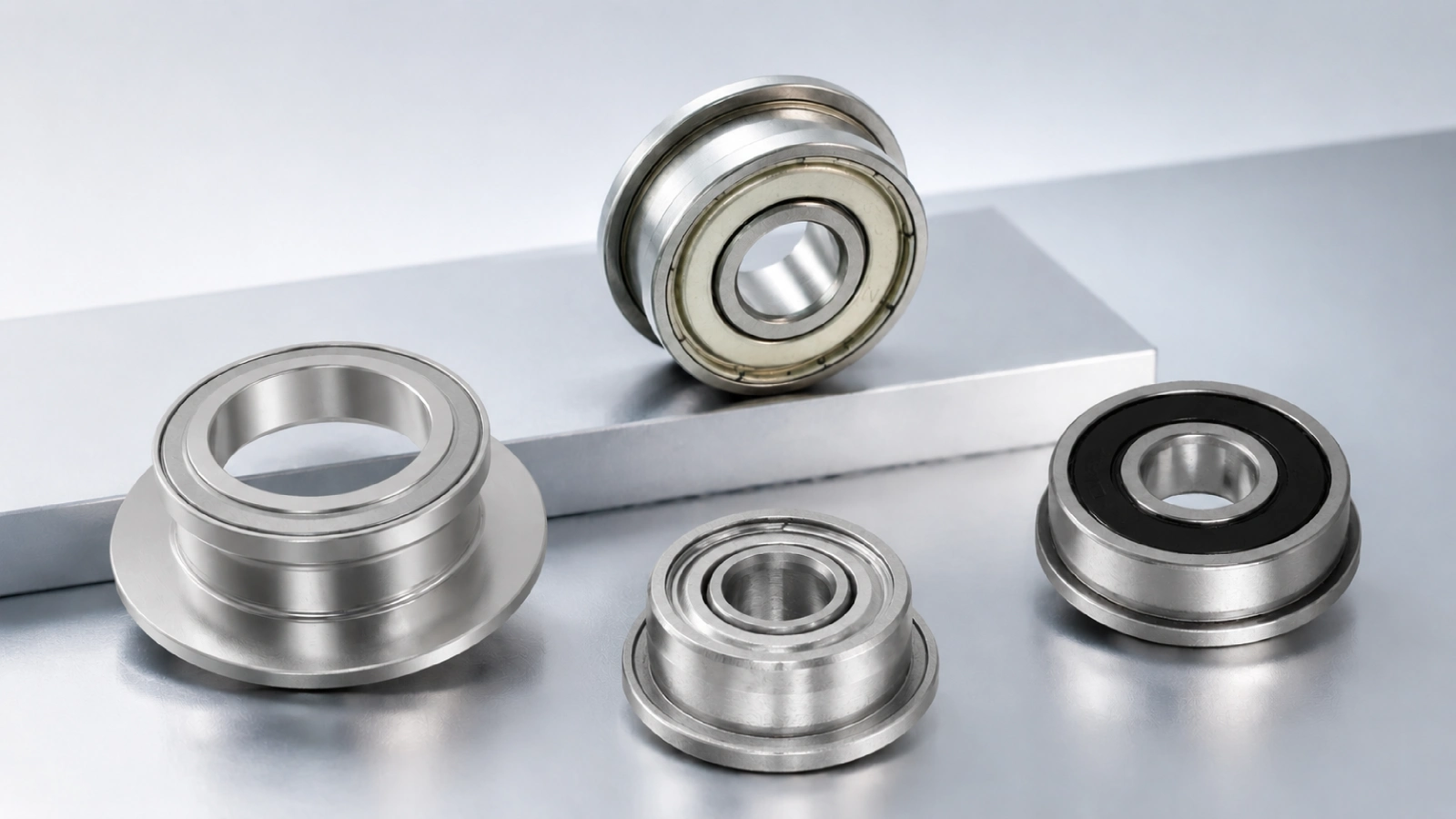
Flanged ball bearings are compact deep groove ball bearings with a locating flange formed on one side of the outer ring. The flange helps position the bearing axially against a housing face. This can simplify assembly when the housing is thin or when a conventional shoulder is difficult to machine.
However, the flange is only one part of the design. Buyers still need to confirm the bore, outside diameter, width, flange diameter, flange width, enclosure, material, clearance, accuracy, and lubricant. A similar basic number does not always identify the same complete bearing. Therefore, procurement should start with the full code and installation dimensions.
Table of contents
- What Defines a Flanged Ball Bearing?
- Which Flanged Ball Bearing Types Are Available?
- Where Are Flanged Ball Bearings Commonly Used?
- What Must Buyers Confirm Before Ordering?
- What Matters During Installation and Removal?
- Which Brand Series and Complete Models Should Buyers Know?
- How Do Buyers Read an NMB Flanged Bearing Code?
- How Can HSN Support Flanged Ball Bearing Orders?
- FAQ
What Defines a Flanged Ball Bearing?
This article focuses on miniature and extra-small radial ball bearings with an integral flange on the outer ring. It does not cover large cast flange bearing units, where an insert bearing is mounted inside a separate two-, three-, or four-bolt housing.
The internal rolling arrangement is generally a single-row deep groove design. It can support radial load and limited axial load in both directions. The outer-ring flange provides a locating surface, but it is not intended to carry every axial or moment load by itself.
The flange can also reduce the risk of pushing a small bearing too far into a housing. Nevertheless, the housing bore must still provide the specified fit. The supporting face must also clear the outer-ring chamfer and support the flange without distortion.
Which Flanged Ball Bearing Types Are Available?
The main classifications relate to size system, enclosure, material, and internal specification:
| Type | Structural feature | Main ordering check |
|---|---|---|
| Metric flanged bearing | Metric bore and boundary dimensions | Complete metric code and flange dimensions |
| Inch flanged bearing | Inch-series bore and outside diameter | Retain fractions and brand punctuation |
| Open bearing | Raceway is not covered by shields or seals | External protection and lubrication plan |
| Shielded bearing | One or two metallic shields | Shield count, lubricant and contamination level |
| Sealed bearing | Contact or non-contact rubber seals | Seal type, torque, speed and temperature |
| Stainless-steel version | Stainless rings and balls, depending on design | Exact material, cage, lubricant and corrosion exposure |
Open versions can suit clean assemblies with a controlled lubrication supply. Shields reduce grease leakage and entry of larger particles with relatively low torque. Seals can provide stronger protection, but their friction and temperature limits must fit the application.
Where Are Flanged Ball Bearings Commonly Used?
Typical positions include small electric motors, cooling fans, office equipment, measuring instruments, medical devices, robotics, miniature gear drives, encoders, printers, and compact automation assemblies. In each case, the flange supports repeatable axial location in a limited mounting space.
The application still determines the specification. A fan motor may prioritize noise, torque, lubricant life, and speed. A measuring device may need tighter runout and accuracy control. Meanwhile, a humid or chemically exposed assembly may require verified material and lubricant compatibility rather than a standard shielded version.



What Must Buyers Confirm Before Ordering?
Begin with the complete existing model and the drawing. If neither is available, measure the bore, outside diameter, ring width, flange diameter, and flange width separately. Do not treat flange diameter as the bearing outside diameter.
Also confirm:
- Radial load, axial load, speed, and operating cycle
- Shaft and housing tolerances
- Open, single-shield, double-shield, or sealed construction
- Steel, stainless steel, or another specified material
- Radial internal clearance and accuracy requirement
- Noise or running-torque requirement
- Lubricant, operating temperature, and contamination level
- Quantity, packaging, and inspection requirements
Small changes can be significant in miniature assemblies. A different flange width can alter the axial position, while a different seal can change starting torque. For this reason, a dimensional match alone is not a complete selection check.
What Matters During Installation and Removal?
Keep the bearing wrapped until the mounting area is clean. Check the shaft and housing for burrs, raised edges, dents, and contamination. Use a press tool that contacts the ring being fitted. Pressing through the balls can mark the raceways and increase noise or vibration.
When the outer ring has an interference fit, apply installation force to the outer ring without loading the flange edge unevenly. Confirm that the housing corner radius clears the bearing chamfer. The flange should sit flat against its support face without being clamped into a distorted condition.
During removal, support the surrounding component and use a tool suited to the available access. Avoid levering directly against a thin flange. After removal, inspect the flange, raceways, seals, and fits before deciding whether any component can be reused.
Which Brand Series and Complete Models Should Buyers Know?
Several international brands use different codes for this product group. The examples below are identification references only. They do not establish automatic interchangeability.
| Brand | Main series or arrangement | Complete model example |
|---|---|---|
| NMB | RF and LF metric flanged series; RIF inch flanged series | DDRF-1340ZZRA5P25LG |
| NSK | F metric series and FR inch series with flange | F624ZZMC3P5 |
| NTN | FL metric open series and FLA shielded arrangements | FL608 |
The NMB example corresponds to a flanged, double-shielded miniature bearing and includes additional specification characters. The NSK example adds clearance and tolerance information to the F624ZZ base designation. NTN FL608 is an open flanged bearing.
Before comparing these references, check all boundary and flange dimensions, enclosure details, material, internal clearance, accuracy, lubricant, and load data.
How Do Buyers Read an NMB Flanged Bearing Code?
The published NMB numbering method can be illustrated with the core section DDRF-1340ZZ from the complete reference above.
| Code | Code section | Meaning |
|---|---|---|
| DD | Ring and ball material | Martensitic stainless-steel material code |
| RF | Series | Metric R-series bearing with an outer-ring flange |
| 1340 | Size section | 13 mm outside diameter and 4 mm bore |
| ZZ | Enclosure | Metallic shield on both sides |
| Remaining suffix | Specification | Additional retainer, accuracy, lubricant or special-feature data |
This method belongs to NMB designation system. Other brands can place the flange, seal, clearance, and accuracy information in different positions. Buyers should retain every suffix and separator when requesting a quotation.
How Can HSN Support Flanged Ball Bearing Orders?
HSN Bearing Group supports model confirmation, sourcing, inspection, and custom supply discussions. Buyers should provide the complete reference, quantity, load, speed, and operating conditions. HSN can review dimensions, flange geometry, enclosure, clearance, precision, lubricant, and fits. Availability is confirmed against the complete execution rather than the bore size alone.
For miniature, obsolete, or difficult models, HSN can review drawings, samples, and mounting space. Replacement or custom supply can follow technical confirmation. Before shipment, checks may cover dimensions, hardness, clearance, appearance, and flange geometry. Buyers may also request rotational accuracy, vibration, noise, material, or other inspections. Similar bore sizes do not confirm the same flange or housing fit.
FAQ
What is the purpose of the bearing flange?
It helps locate the bearing at the housing face, but does not replace all radial support or retention requirements.
Are flanged ball bearings always sealed?
No. Open, shielded and sealed versions exist. Choose the enclosure from speed, contamination and lubrication needs.
Can the same bore size guarantee flange fit?
No. Check outside diameter, width, flange diameter, flange thickness, corner radius and housing geometry.
How should a miniature flanged bearing be mounted?
Apply force only to the fitted ring, support the bearing squarely and protect the flange, seals and raceways.
Remarks
For detailed flanged ball bearing models not listed above, please contact HSN for model confirmation and supply discussion. When checking flanged ball bearing references, you can also send the complete model number, photos, dimensions, quantity, and working conditions for review.
This article is based on independent analysis of publicly available technical information and industry understanding for knowledge sharing. All brand names and trademarks mentioned belong to their respective owners. HSN Bearing Group is an independent bearing supplier and technical service provider.
Tel: +86 156 6578 7336 Email: service@hsnindustrial.com Website: www.rollingparts.com www.hsnbearing.com
Need Help Finding Flanged Ball Bearings?
Contact HSN with the full model, dimensions, enclosure, material, quantity, application and inspection requirements for technical confirmation.