

Why Rotary Kiln Support Roller Bearing Orders Need Assembly Checks?

A rotary kiln support roller bearing carries the shaft that holds a support roller beneath the kiln tyre. The tyre transfers shell weight to the rollers and their bearings at each pier. When a plant plans a shutdown, the buyer must identify the failed support, bearing arrangement and repair scope before ordering. A bearing marking alone does not describe the condition of the roller, shaft or housing.
This guide focuses on cement kiln support rollers. It separates a bearing-only purchase from a housing or roller-unit repair, then shows which records make an inquiry usable. The machine drawing and approved maintenance procedure govern the final replacement.
Where Does the Support Roller Bearing Work?
At a support pier, two rollers normally contact the kiln tyre and carry load through their shafts into the supporting structure. Their bearings sit at the shaft ends, away from the hottest part of the shell but exposed to sustained loading, dust and heat from the surrounding process. The pier number and roller side identify a service position more clearly than the phrase “kiln bearing.”
The tyre, support rollers and thrust or guide rollers have different duties. The latter help control axial kiln movement; their bearings should not be conflated with the principal support roller bearings. Record whether the requested part belongs to a support roller, a thrust roller or an adjacent drive. Photograph its installed orientation and lubrication lines before removal.
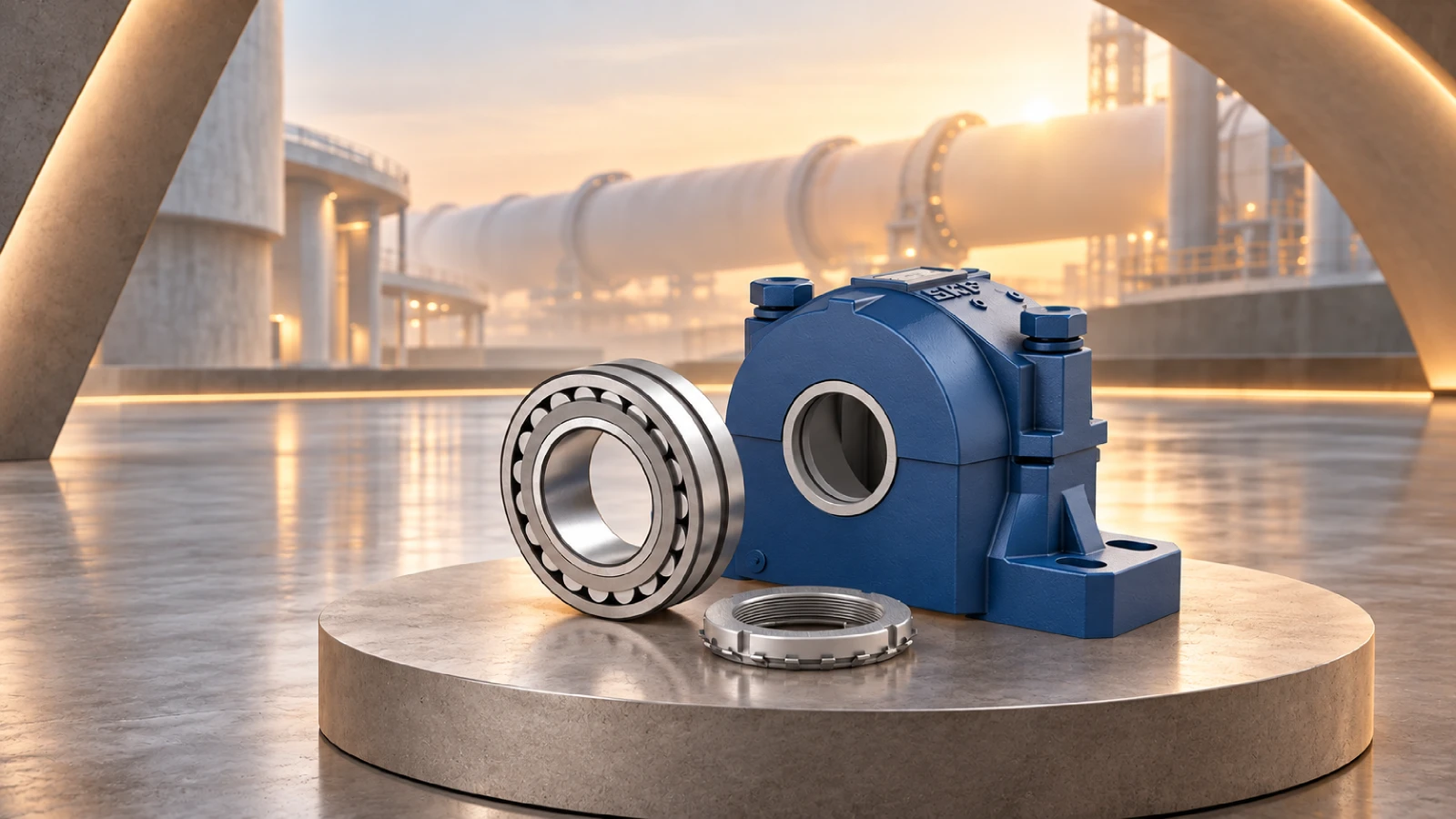
Some older support rollers use plain or sleeve bearings with an oil system. Other arrangements use rolling bearings in housings. In an SKF-documented project for Argex’s expanded-clay rotary kiln, each engineered support roller unit used two spherical roller bearings with 500 mm bores, two split housings and centralized lubrication. That case illustrates one support-unit arrangement, not a standard specification for a cement-clinker kiln.
Which Kiln Roller Bearings and Housings Need Review?
First determine whether the bearing is a sleeve assembly or a rolling bearing. A sleeve design requires journal diameter, bearing-metal condition, running clearance, oil-feed geometry and the complete housing arrangement. Replacing it with a spherical roller bearing is a redesign of the support unit, not a simple bearing substitution.
For a rolling-bearing arrangement, identify the locating and non-locating positions. Thermal growth and shaft deflection can change axial movement requirements. Record the full bearing designation, bore type, clearance, cage, mounting sleeve, housing style, seals and lubrication entry. Confirm which component actually provides axial location; do not infer this from an isolated bearing number.
Separate SKF examples, 23040 CC/W33 and 23040 CCK/W33, each have a 200 mm nominal bore but different bore forms. They demonstrate why a missing K changes the mounting review. They are not the 500 mm bearings in the Argex project, nor confirmed fits for any kiln in this guide. The support-unit drawing and shaft arrangement decide whether a candidate is suitable.
| Purchase scope | Evidence to collect | Review point |
|---|---|---|
| Bearing only | Full designation and both seat drawings | Bore, clearance, fit and axial role |
| Bearing and housing | Housing code, seals, cap and base photos | Mounting, lubrication and alignment |
| Complete roller unit | Shaft, roller, base and pier drawings | Interfaces, load path and installation plan |
How Do Load, Heat, Dust and Lubrication Affect Selection?
Support-roller loads depend on kiln mass, tyre contact, pier alignment and the current operating condition. An apparent bearing failure may follow uneven tyre contact or shaft misalignment. Ask the maintenance team for the load basis and the machine builder’s requirements rather than estimating capacity from roller diameter alone.
Ambient temperature near the pier is not the same as bearing operating temperature. Record measured housing and lubricant temperatures, normal trends and abnormal peaks. Heat can change lubricant performance and the intended internal clearance. Check the required lubrication type, flow or regreasing plan, grease compatibility and oil-line routing against the installed system.
Cement dust can enter through compromised seals or maintenance openings. Before ordering, inspect seal tracks, housing joints and breathers. A new bearing in a worn housing or contaminated lubricant circuit can fail early. Specify whether the offer covers seals, sleeves or related mounting parts so the maintenance crew can prepare a complete repair.
When Does Replacement Need a Custom Review?
A stock inquiry is appropriate when the full bearing identity and mating parts are known and the seats remain within specification. A custom review begins when the marking is unreadable, the original support design is obsolete or wear has changed the shaft and housing interfaces. Measurements from a damaged part help identification, but an approved drawing supplies the intended tolerances.
Separate the failure observation from its cause. Rising temperature, metal debris or vibration calls for inspection of the bearing, lubrication, roller surface, journal and foundation alignment. Do not promise that a new bearing alone will correct poor tyre contact. If the repair includes conversion from a sleeve bearing, involve the plant’s responsible engineer and the support-unit designer.
When a U.S. cement plant schedules a fixed kiln outage, identify the support position, U.S. receiving site and latest acceptable arrival date. Request separate quotation lines for the bearing and related components, each with its inspection scope. Agree on dimensional, hardness and clearance checks against the specified values. HSN can review a hard-to-find code, drawing or sample for stock or custom supply once the requirements are clear; the plant approves the final installation.
What Should Buyers Send for a Kiln Bearing RFQ?
Send the kiln make, pier and roller location, full bearing or housing marking, shaft and housing drawings, photographs, quantity and operating conditions. Include bore, outside diameter and width if a rolling bearing has been removed. For a sleeve arrangement, provide its journal, liner, oil-feed and clearance specifications instead of forcing a rolling-bearing code onto the inquiry.
State the lubrication system, seal construction, observed damage and whether the request covers a bearing, housing or complete support unit. Identify the source of every dimension as drawing, in-service measurement or removed-part measurement. Give the planned removal and receiving dates so the supplier can distinguish a stock check from a longer engineering review.
Before placing the order, confirm the final designation, documentation, inspection criteria and responsibility for fitting the bearing to the shaft and housing. These steps keep a support-roller repair aligned with the approved kiln maintenance plan.
FAQ
Can I order kiln roller bearings by the kiln model alone?
No. Send the pier and roller position, complete bearing or housing code, drawing, photos and quantity.
Can a sleeve bearing be replaced by a rolling bearing?
That changes the support-unit design. The plant engineer must review loads, alignment, lubrication and interfaces.
Why ask HSN for a hard-to-find support bearing?
HSN can review the code or drawing, define the supply scope, and agree on bearing inspection criteria and a feasible delivery date.
Does HSN support shipping and customs clearance for U.S. customers?
Yes. HSN supports flexible trade terms, shipping arrangements, customs documentation, and delivery coordination for U.S. orders.
Remarks
For a rotary kiln support roller bearing inquiry, send HSN the complete model, photos, dimensions, quantity and working conditions. Include the pier location, housing details and support-unit drawing; identify other bearing needs separately.
This article is based on independent analysis of publicly available technical information and industry understanding for knowledge sharing. All brand names and trademarks mentioned belong to their respective owners. HSN Bearing Group is an independent bearing supplier and technical service provider.
Tel: +86 156 6578 7336 Email: service@hsnindustrial.com Website: www.rollingparts.com www.hsnbearing.com
Need Help with a Rotary Kiln Support Roller Bearing?
Contact HSN to confirm a hard-to-find model or discuss a replacement after technical review.