
What Are the Main Rollway Bearing Types and Their Key Features?

A Rollway bearing catalog helps buyers distinguish several bearing families that may appear under the same brand name but serve very different load paths. The catalog distinguishes radial, thrust, and journal roller products. Before interpreting a model number, buyers should first identify the bearing family, machine position, and whether the application carries radial load, axial load, or both.
The complete designation then provides the next level of detail. Rollway uses different numbering systems, series codes, suffixes, and component references across its product families, so one code pattern should not be transferred to another. This guide explains how the main Rollway bearing types differ, how the catalog organizes their models and components, and supply details buyers should confirm before sending a sourcing inquiry.
What Are the Main Rollway Bearing Types?
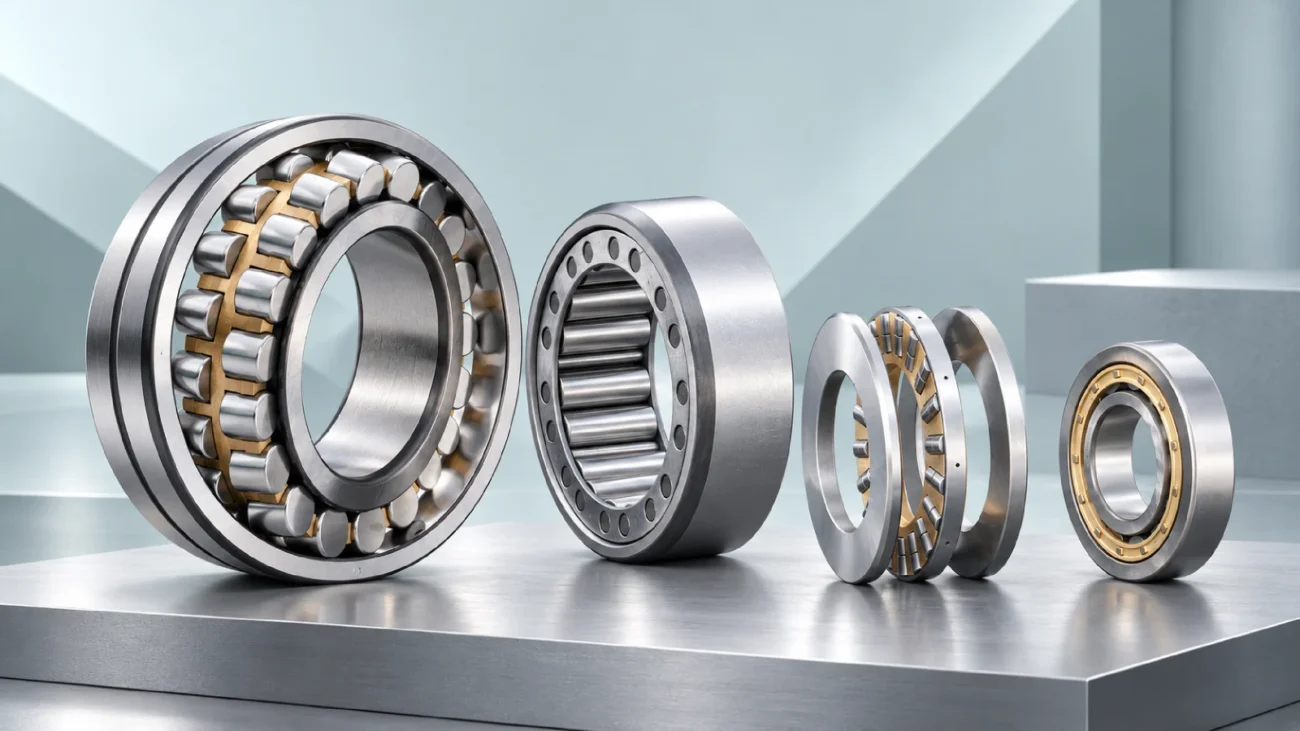
The Rollway bearing catalog covers several roller-bearing constructions designed for different load paths and mounting arrangements. Within the product families discussed in this guide, the main types include cylindrical radial roller bearings, cylindrical roller thrust bearings, tapered roller thrust bearings, tandem thrust bearings, and steel-cage journal roller bearings. Identifying the family first helps buyers avoid interpreting a model number under the wrong dimensional or component system.
| Product family | Verified example | Primary role |
|---|---|---|
| Cylindrical radial roller bearing | E-5214-B | Radial shaft support; ring and flange arrangement controls axial behavior |
| Cylindrical roller thrust bearing | T-624 | Carries axial load through a cylindrical roller thrust arrangement |
| Tapered roller thrust bearing | T-611 | Carries axial load through inclined tapered-roller contacts |
| Tandem thrust bearing | TAB-040100 | Distributes axial load through a two-stage thrust arrangement |
| Steel-cage journal roller bearing | D-307 | Provides radial journal support with separately identifiable components |
These examples represent distinct cataloged constructions rather than interchangeable models. E-5214-B belongs to the radial cylindrical family, while T-624 and T-611 belong to different thrust-bearing families. TAB-040100 is listed as a two-stage tandem thrust design, so its multiple thrust stages, overall assembly dimensions, lubrication, and mounting should be reviewed as a complete arrangement rather than as a conventional single-stage thrust bearing.
The D-307 journal roller example introduces another purchasing distinction because the complete assembly and its individual components can carry separate identifiers. Therefore, buyers should confirm whether an inquiry concerns a complete bearing, a specific ring or roller assembly, or a multi-stage thrust unit before comparing dimensions or availability.
Catalog examples also do not guarantee current production or stock. For legacy or hard-to-find Rollway references, retain the complete designation and product-family information, then confirm the current supply status and required configuration before ordering.
How Do Rollway Bearing Types Differ in Structure and Use?
A radial cylindrical roller bearing carries heavy radial loading through a line-contact roller arrangement. Its outer and inner ring flanges control whether the shaft position can move axially or guide limited thrust. For a gearbox, the choice depends on which support locates the shaft and which accommodates thermal growth. The cage construction also affects the application envelope.
A cylindrical thrust bearing instead carries axial force between thrust plates. Rollway describes single-acting three-piece arrangements and variations for specific mounting needs. A tapered thrust bearing uses inclined contact geometry and may suit a different thrust-load arrangement; it is not a radial tapered cone-and-cup assembly merely because it has tapered rollers. A tandem thrust assembly distributes thrust across multiple stages and requires its own mounting and lubrication review.
The steel-cage journal roller range can be supplied as an assembly or separate inner ring, outer ring, and roller assembly. An example D-307 is listed alongside its component identifiers E-307-60, B-307-70, and WS-307. That component distinction helps when a removed machine has only a ring marking or when an order mistakenly lists an assembly as a single ring.
How Does the Rollway Catalog Organize Each Bearing Family?
Catalog : Rollway Bearings Catalog (PDF). Its printed pages 6–9 explain radial codes, while pages 14–27 give radial product data. Thrust types and data appear on pages 32–50; journal data appears on pages 58–59. Use this dated catalog for identification, then confirm current product details before ordering.
The Rollway bearing catalog starts with radial configurations and a numbering guide, then gives dimensions and application information. It separates cylindrical thrust types from tapered thrust and tandem thrust designs. Journal roller assemblies have their own section. This layout lets a buyer choose the family before interpreting a number that may resemble one from another family.
For radial bearings, locate the style diagram before the data table. The diagram identifies separable rings, flanges, and any retaining parts. The thrust sections use different drawings and dimensions because they describe plates, roller assemblies, and axial height. The journal section explicitly lists complete assemblies and components side by side. Copy the exact row and supplied-unit description into an RFQ; a part number alone can obscure what the supplier is expected to deliver.
An older edition is useful for identifying a legacy part, but its presence does not establish current stock. The current Rollway product range provides a further place to check the present product family. If an old number has no current listing, preserve the original marking and drawing instead of declaring it discontinued.
How Do Rollway Series and Suffixes Describe Bearing Features?
Rollway radial cylindrical bearings use separate TRU-ROL, MAX, and ISO-style numbering systems. Decode a marking within its confirmed family. Rollway lists the radial model NUP 2211 EM. NUP has a loose rib arrangement for axial location in both directions. In Rollway’s ISO numbering guide, E indicates extra capacity, while M identifies a machined brass retainer. The full product specification still governs its operating limits.
The radial model E-5214-B follows the TRU-ROL pattern. Its E prefix describes an inner race separable in both directions. The B suffix specifies an outer race with two snap rings retaining the roller set. The 5214 size designator does not state all mounting dimensions. In this radial system, variations 003, 005, and 007 denote Rollway clearance classes; they are not ISO C3, C5, and C7 suffixes.
Do not decode T-624 using the E-5214-B pattern. It belongs to the cylindrical thrust family, which has its own numbering and component rules. Keeping the family heading with the photographed marking prevents a plausible but wrong code interpretation.
Which Catalog Specifications Should Buyers Compare?
Start with the dimensions that suit the family: bore, outside diameter, and width for a radial assembly; bore, outside diameter, and overall height for a thrust assembly. For a journal bearing, identify whether the requirement is the complete D-307 or one named component. Then compare ring or plate construction, fits, shoulder support, cage, clearance, load direction, speed, and lubrication. A shaft-position drawing often answers more than an isolated size measurement.
For a U.S. plant with a fixed shutdown date, send the complete marking, machine position, drawing or sample, quantity, and required date. Separate identification from availability and any replacement approval. HSN can check possible stock in China or assess a drawing-based option; an agreed inspection may cover dimensions, hardness, and clearance. A substitute must still pass the customer’s technical review for the actual assembly.
FAQ
What if an order lists T-624 but the part page says T624?
Quote both identifiers and confirm the cylindrical thrust construction, size and supplied components.
Can a journal outer ring number order the full bearing?
No. Specify D-307 for the assembly or the exact component number shown in its catalog row.
What should a U.S. buyer include in an urgent inquiry?
Send the complete number, drawing, machine duty, quantity, approval contact, and required date.
Can HSN review a legacy Rollway model?
Yes. HSN can compare the marking and drawings, check possible stock, or discuss a reviewed option.
Remarks
For detailed models beyond those listed above, or for other bearing types, please contact HSN. Send the complete model, photographs, dimensions, quantity, and working conditions so the inquiry starts with the right information.
This article is based on independent analysis of publicly available technical information and industry understanding, and aims to provide knowledge sharing. All brand names and trademarks mentioned in this article belong to their respective owners. HSN Bearing Group is an independent bearing supplier and technical service provider.
Tel: +86 156 6578 7336 Email: service@hsnindustrial.com Website: www.rollingparts.com www.hsnbearing.com
Need Help With a Rollway Bearing Catalog Model?
Contact HSN to confirm a hard-to-find model or discuss a replacement after technical review.