

Why Cone Crusher Bearings Are Critical for Heavy-Duty Crushing Equipment ?

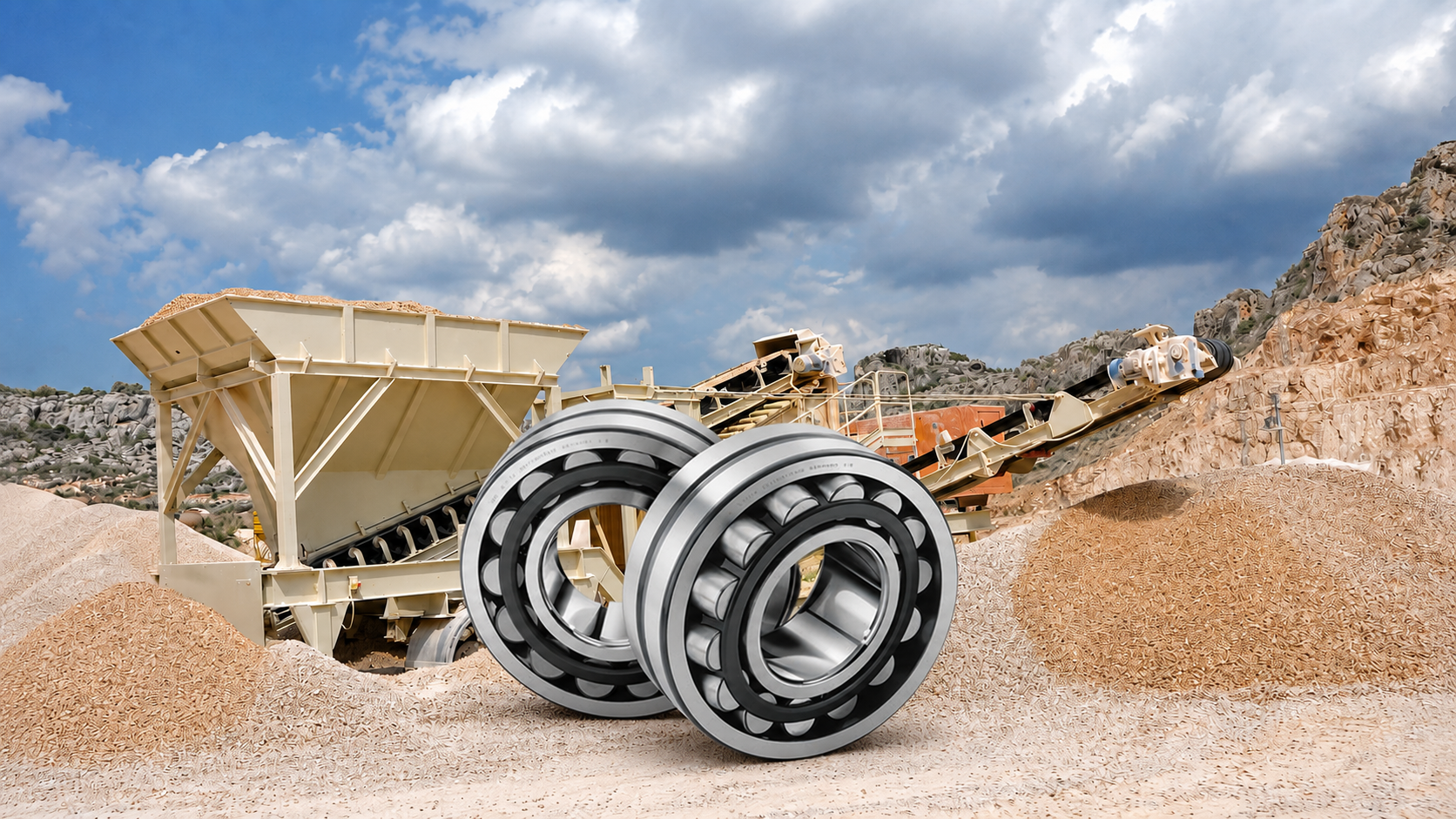
Cone crushers operate under heavy radial and axial forces, repeated load changes, vibration, and contaminated conditions. As a result, cone crusher bearings cannot be selected by boundary dimensions alone. The bearing position, internal design, clearance, fit, lubrication method, and surrounding components must all match the machine.
For distributors and industrial users, the main purchasing task is to identify the exact bearing arrangement before ordering. Some cone crushers use specialized rolling bearings at radial and thrust positions, while other designs use different combinations of rolling and plain bearings. The complete crusher model and assembly information therefore remain essential.
Table of contents
- What Bearings Are Used in Cone Crushers?
- Why Cone Crusher Bearings Work Under Heavy Load, Shock and Dust
- Cone Crusher Thrust Bearing: Function, Load and Replacement Signs
- Drive Shaft Bearing of Cone Crusher: Why Custom Supply May Be Needed
- Key Parameters for Cone Crusher Bearing Replacement
- HSN Support for Cone Crusher Bearing Solutions
- Frequently Asked Questions
What Bearings Are Used in Cone Crushers?
There is no single bearing arrangement for every cone crusher. Technical examples show radial, axial, main-shaft, and drive-system positions that use different bearing types according to the crusher design.
| Bearing position | Bearing type used in some designs | Main function | What buyers should confirm |
|---|---|---|---|
| Upper or lower radial support | Special cylindrical roller bearing | Supports radial forces in the cone or shaft system | Model, dimensions, internal design, fit |
| Upper or lower thrust support | Cylindrical or tapered roller thrust bearing | Carries axial force | Load direction, contact faces, lubrication |
| Main shaft support | Specialized roller or plain bearing arrangement | Supports the main rotating or gyrating assembly | Position, structure, clearance |
| Drive shaft or countershaft | Roller bearing arrangement | Supports the shaft that drives the pinion or gear | Shaft size, housing, seals, alignment |
These descriptions are functional references rather than a universal parts list. For example, a bearing used in an upper radial position on one crusher cannot be assumed to fit another machine with a similar capacity.
Before ordering, buyers should confirm the original reference, crusher model, serial information, installation position, and assembly drawing.
Why Cone Crusher Bearings Work Under Heavy Load, Shock and Dust
Crushing equipment receives high start-up torque and repeated load changes as material moves through the chamber. Uncrushable material, uneven feed, or temporary overload can also produce load spikes. At the same time, dust and fine particles create a constant contamination risk.
Several conditions affect bearing performance:
- Heavy radial and axial loads can increase contact stress.
- Shock and vibration can affect rollers, raceways, cages, and fits.
- Dust or moisture can damage lubricant and working surfaces.
- Incorrect lubrication can cause excessive heat or inadequate film formation.
- A fit that is too tight or too loose can change internal clearance.
- Shaft deflection or housing wear can disturb alignment.
- Damaged seals can allow contaminants to enter the bearing position.
Therefore, maintenance teams should review the bearing together with the shaft, housing, seals, lubricant, and mating components. Replacing only the visible damaged bearing may not correct the cause of failure.
Cone Crusher Thrust Bearing: Function, Load and Replacement Signs
A cone crusher thrust bearing supports axial force within the crusher arrangement. Depending on the model, the thrust position may use a tapered roller thrust bearing, cylindrical roller thrust bearing, or another dedicated support design. Cone crusher examples can include separate upper and lower thrust positions as well as radial support positions.
The following signs justify a detailed inspection:
- Abnormal axial movement or end play.
- Rising operating temperature near the thrust position.
- Metallic particles or unusual discoloration in the lubricant.
- Scoring, pitting, spalling, or uneven running marks.
- Increased vibration or noise after load changes.
- Damage on the mating thrust faces or locating parts.
These signs do not prove that the bearing alone is responsible. The inspection should also cover lubrication flow, contact surfaces, alignment, shaft condition, and the complete load path.
A replacement should only be selected after the position, dimensions, and internal structure have been confirmed.
Drive Shaft Bearing of Cone Crusher: Why Custom Supply May Be Needed
The drive shaft, often called a countershaft in cone crusher discussions, transfers power through a pinion and gear arrangement. Its bearings help control shaft position, gear contact, vibration, and heat.
Custom supply may be needed when the original bearing has:
- Non-standard inch or metric dimensions.
- Special shoulders, grooves, holes, or locating features.
- A cage or roller arrangement developed for the crusher.
- Clearance selected for the original fit and operating temperature.
- An obsolete reference that is no longer readily available.
- Dimensions changed during an earlier repair.
- A housing or shaft design that does not accept a standard catalogue bearing.
Cone crusher bearing designs can include customizable clearance, tapered bores, lubrication provisions, and locating features. However, these features must be confirmed for the current machine rather than copied from another model.
In these situations, matching the outside diameter alone is not sufficient. Buyers should provide the complete reference, drawings, sample details, shaft and housing dimensions, and confirmed operating conditions.
A customized cone crusher drive shaft bearing should be reviewed together with the shaft, housing, seals, lubrication system and gear arrangement.
Key Parameters for Cone Crusher Bearing Replacement
Before comparing stock, replacement, or custom options, collect the following information:
| Parameter | Why it matters |
|---|---|
| Crusher brand, model, and serial information | Identifies the machine and assembly version |
| Bearing position | Distinguishes radial, thrust, main-shaft,and drive positions |
| Full bearing reference and suffix | Indicates details beyond basic dimensions |
| Bore, outside diameter, and width | Confirms boundary dimensions |
| Internal design and cage | Affects load distribution and operating behavior |
| Radial or axial clearance | Must suit fit, temperature, and machine design |
| Shaft and housing fits | Influence installed clearance and stability |
| Lubrication and sealing | Affect heat removal and contamination control |
| Drawings, photos, or sample | Support non-standard or obsolete bearing review |
| Quantity and inspection requirements | Guide sourcing, production, and quality checks |
If the old bearing has failed, include photographs of the raceways, rollers, cage, shaft seat, housing bore, and lubricant. This information helps distinguish a matching problem from an installation or operating problem.
HSN Support for Cone Crusher Bearing Solutions
HSN Bearing Group supports overseas buyers with bearing model confirmation, stock review, replacement discussion, customization, and inspection before shipment. The review can begin from a complete model, drawing, sample, or confirmed working conditions.
For standard references, HSN can check available supply resources. For obsolete or special designs, HSN can discuss a replacement option or customized production after comparing:
- Boundary dimensions and internal structure.
- Bearing position and load direction.
- Cage and roller arrangement.
- Clearance and mating fits.
- Lubrication and sealing.
- Application and operating requirements.
Before shipment, HSN focuses on dimensional tolerance, hardness, and clearance. Additional checks such as material verification, rotational accuracy, vibration, noise, or flaw detection can be discussed according to customer requirements.
This process does not remove the need for correct installation and application confirmation. However, it gives buyers a clearer technical basis for procurement.
Frequently Asked Questions
What bearings are used in cone crushers?
Depending on the design, cone crushers may use cylindrical, tapered, thrust or plain bearing arrangements.
Why is crusher bearing clearance important?
Correct clearance helps control heat, vibration, load distribution and bearing performance after mounting.
What are signs of bearing problems?
Watch for high temperature, vibration, noise, lubricant contamination, excessive play or visible raceway damage.
Can standard bearings replace crusher bearings?
Only after checking dimensions, clearance, internal design, fit, lubrication and the exact bearing position.
Remarks
For detailed cone crusher bearing models not covered here, please contact HSN for model confirmation and supply discussion. For other bearing types, you can also send the complete reference, photos, dimensions, quantity and working conditions.
This article is based on independent analysis of publicly available technical information and industry understanding, and aims to provide knowledge sharing. HSN Bearing Group is an independent bearing supplier and technical service provider.
Tel: +86 156 6578 7336 Email: service@hsnindustrial.com Website: www.rollingparts.com www.hsnbearing.com
Need Help Confirming Cone Crusher Bearings?
If you urgently need a hard-to-find bearing from stock in China or want to discuss a cost-effective alternative or improved solution after technical confirmation, contact HSN with your inquiry details.