

How Can Buyers Use a Timken Bearing Catalog to Select Models?

A Timken bearing catalog helps turn a worn marking or incomplete spare-parts record into a better purchasing inquiry. Start by identifying the installed bearing family, then open that family’s catalog and compare the full designation with its product drawing. This guide provides a practical search sequence, and the checks that separate an identified part from an approved replacement. Catalog listings do not establish a supplier’s current stock.
What Are the Main Timken Bearing Types?
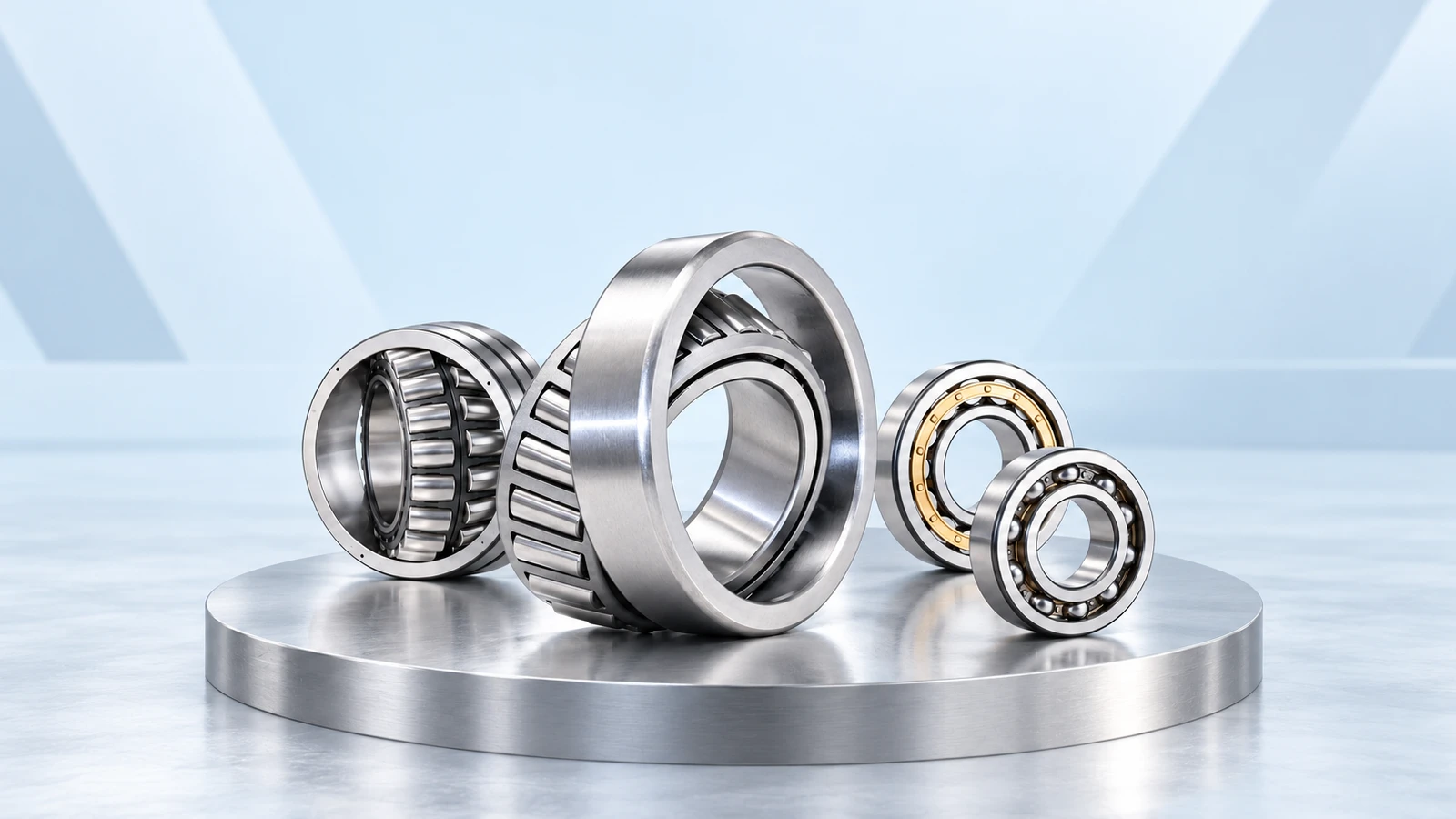
Four families provide a useful starting point for many industrial searches: tapered roller, spherical roller, cylindrical roller, and deep groove ball bearings. They do different jobs, so a bore measurement or number fragment cannot establish the family. Look at the rolling elements, rings, and machine position before choosing a document.
A tapered roller bearing has a cone and cup; a spherical roller bearing has two rows of rollers and accommodates angular misalignment. Cylindrical roller designs vary in their ring ribs and axial function. Deep groove ball bearings may be open, shielded, or sealed. Timken supplies other designs as well, so do not force an unfamiliar component into these four categories. A photograph of both sides and any separate parts often resolves the first uncertainty faster than a broad number search.
How Do These Bearing Types Differ in Use?
The machine position determines which differences matter. In a tapered wheel-end or gearbox arrangement, the cone, cup, mating parts, and installed setting need attention. For a shaft that deflects under heavy load, a spherical roller design may accommodate misalignment, provided its clearance and operating conditions are suitable. These examples describe selection questions, not automatic application approvals.
For a cylindrical roller bearing, ask whether the position locates the shaft or allows thermal expansion. An NU configuration can permit displacement within the bearing; a different ring style may change that function. A deep groove ball bearing is common in compact rotating equipment, yet its seals, grease, clearance, and speed suitability still affect the purchase. The next step is to open the catalog for the identified family and verify the actual part entry.
Which Timken Catalog Covers Each Bearing Type?
Use the manufacturer’s family-specific documents as the primary reference rather than relying on an undifferentiated number list or an isolated page from an older manual. The official Timken resources below provide practical starting points for product identification and engineering review. Before using any dimension, rating, or designation for an order, confirm the current document revision and verify the value against the exact product page and related engineering section.
| Bearing family | Official Timken catalog | First detail to locate |
|---|---|---|
| Tapered roller | Timken Tapered Roller Bearing Catalog | Assembly, cone, and cup numbers |
| Spherical roller | Timken Spherical Roller Bearing Catalog | Full series, cage, clearance, and lubrication codes |
| Cylindrical roller | Timken Cylindrical Roller Bearing Catalog | Ring arrangement, separable parts, and dimensions |
| Deep groove ball | Timken Deep Groove Ball Bearing Catalog | Seals or shields, clearance, and size |
Timken’s catalog and literature index provides another route if a link moves or a newer edition appears. For a legible number, the manufacturer’s CAD catalog can lead directly to a product entry and drawing. Use a family catalog to understand the designation and design options; use the specific product entry to confirm the part being discussed.
How Can You Find a Bearing Model in the Catalog?
First, photograph every marking, including letters before and after the main number. Record the machine position and whether the removed item includes separable rings. Choose the relevant catalog from the table, then search the complete marking in its product tables or in Timken’s CAD catalog. If there is no exact result, search the base series and compare the remaining letters against that family’s nomenclature. Do not drop a suffix simply to make a result appear.
For example, Timken 6205-2RS leads to a deep groove ball bearing entry with contact seals. The seal information makes a bare 6205 search insufficient for an exact inquiry. Timken NU2226EJ belongs in the single-row cylindrical roller family. Its NU ring arrangement is relevant when a machine relies on axial movement. Keep EJ in the full inquiry; confirm any detailed suffix meaning in the correct Timken document.
Other families require a different route. A spherical 22220EJW33C3 entry carries cage, lubrication, and clearance information beyond its base series. A tapered 30205 entry lists both an assembly and named cone and cup components. Those examples show why a search result must be read at the correct level: a component number is not necessarily an order for the complete bearing. For detailed dimension conventions, use the corresponding Timken drawing rather than a number fragment.
An absent online result does not prove that an old marking is discontinued. Retain the original text in the RFQ, attach photographs and any dated drawing, and ask whether the listing or designation changed. This is particularly useful when a U.S. maintenance team has an old part book but has also modified the machine since installation.
Which Specifications Should Buyers Check in the Catalog?
Read the dimensional columns against the manufacturer’s sectional drawing. Confirm bore, outside diameter, and the width used for that bearing family. For a tapered assembly, distinguish cone width, cup width, and assembled width; also identify whether the request is for both components. For a cylindrical bearing, compare the ring ribs and the locating or floating role. A sealed ball bearing requires the exact seal arrangement, while a spherical roller bearing may need a specified cage, clearance, or lubrication feature.
Next, check shaft and housing fits, load ratings, speed data, lubrication, and operating conditions. Published ratings depend on their stated assumptions and cannot approve a replacement on their own. A match in overall dimensions also cannot establish that two internal designs work the same way. Document any difference and obtain engineering approval before a substitute is purchased.
For urgent sourcing, give the full marking, photographs, machine position, quantity, and required date. Include the drawing and duty information when a technical alternative is under consideration. HSN can check possible stock in China and discuss a drawing-based option where appropriate.
FAQ
What if an older marking is absent from today’s catalog?
Keep the original marking and send photos and old drawings. An absent result alone does not prove that the part is discontinued.
Do I need both numbers for a tapered cone and cup?
Yes. Identify the installed components and state whether the request is for the complete assembly or one part.
Can HSN check a hard-to-find catalog number?
Yes. Send the complete marking and drawing for a stock check or a technically reviewed alternative.
Does HSN support shipping and customs clearance for U.S. customers?
Yes. HSN supports flexible trade terms, shipping arrangements, customs documentation, and delivery coordination for U.S. orders.
Remarks
For detailed models beyond those listed above, or for other bearing types, please contact HSN. Send the complete model, photographs, dimensions, quantity, and working conditions so the inquiry starts with the right information.
This article is based on independent analysis of publicly available technical information and industry understanding, and aims to provide knowledge sharing. All brand names and trademarks mentioned in this article belong to their respective owners. HSN Bearing Group is an independent bearing supplier and technical service provider.
Tel: +86 156 6578 7336 Email: service@hsnindustrial.com Website: www.rollingparts.com www.hsnbearing.com
Need Help Using a Timken Bearing Catalog?
Contact HSN to confirm a hard-to-find model or discuss a replacement after technical review.