

How Should Buyers Specify Bucket Elevator Bearings?

Bucket elevator bearings support rotating shafts at the head and boot of a vertical material-handling machine. A U.S. cement or mining plant ordering an urgent spare needs to identify the exact shaft position, drive or take-up arrangement and bearing unit. Head and boot positions face different loads and exposure to material. This guide turns those differences into a practical bearing RFQ for distributors, maintenance contractors and plant engineers.
Where Are Bearings Used on a Bucket Elevator?
The head shaft carries the drive pulley or sprocket and transfers power to the moving belt or chain. Its bearings are commonly mounted outside the casing in housings that permit inspection and service. The boot shaft guides the return at the inlet end; its bearings may be part of an adjustable take-up arrangement. Exact layouts vary, so confirm the elevator drawing before ordering.
The head-shaft supports and the boot take-up work as parts of the same belt or chain path. Uneven take-up adjustment can misalign the shaft, bearings and seals, so an inquiry should record the travel and condition on both sides. Maintenance should coordinate bearing replacement with the equipment maker’s tracking procedure.
Record the elevator number, head or boot position and drive side for each machine. Include whether it lifts abrasive minerals, cement raw material or another bulk solid. Dust concentration, washdown and inlet leakage affect the sealing plan. A head bearing code from another elevator in the facility does not establish boot-side fit.
Which Types and Mounted Units Should Buyers Compare?
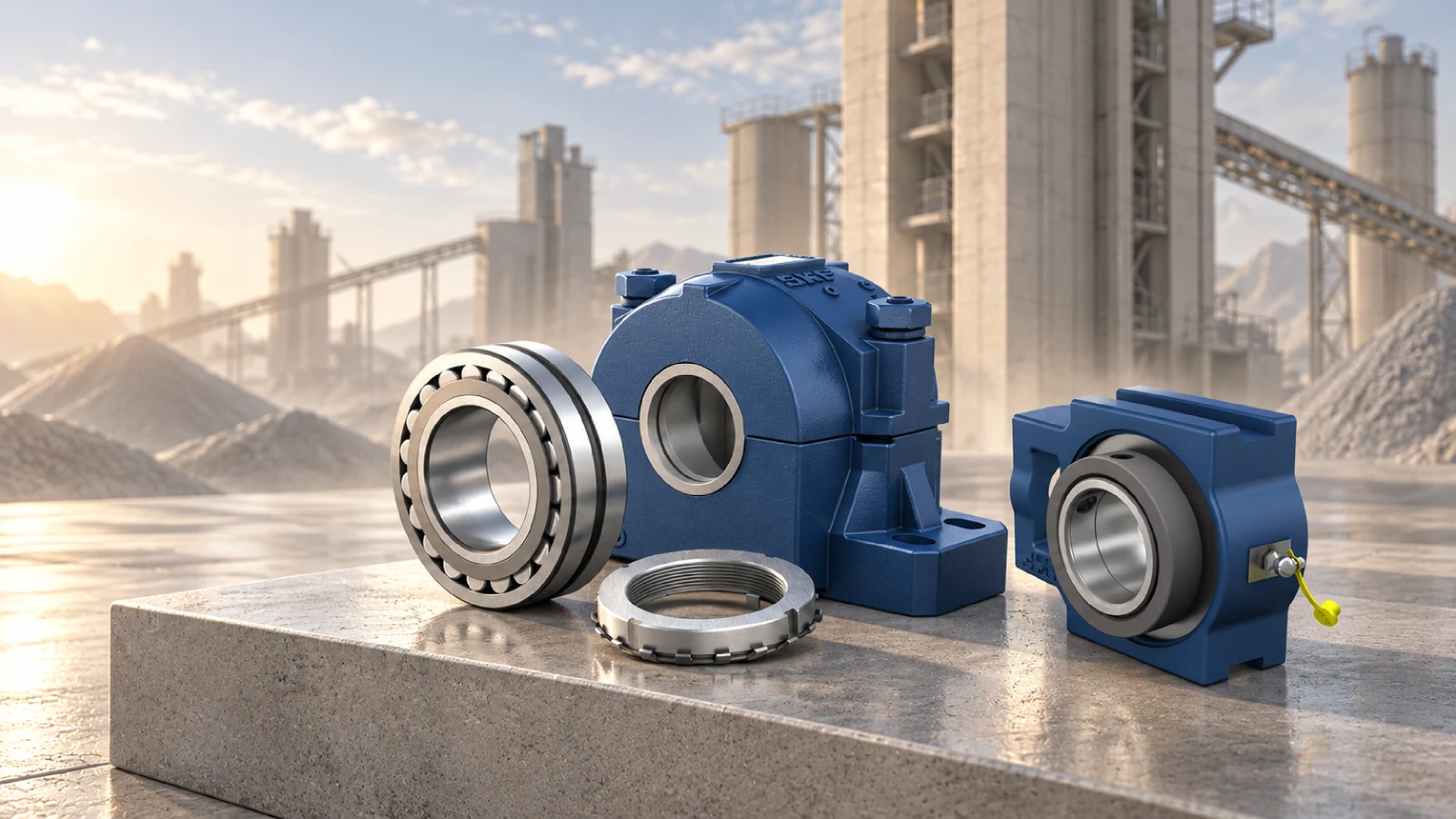
Some designs use spherical roller bearings in split pillow block housings for the head shaft. Other designs use a mounted ball bearing unit, depending on shaft size, load and speed. A boot take-up can include an adjustable bearing arrangement whose travel and mounting dimensions matter as much as the rolling bearing. The equipment specification determines the installed choice.
| Position or unit | Typical purchase question | Verify before replacement |
|---|---|---|
| Head shaft pillow block | Loose bearing or complete housing? | Shaft seat, load, locating role and seals |
| Boot take-up bearing | Bearing or adjustable unit? | Adjustment travel, mounting and exposure |
| Drive-side auxiliary bearing | Is it part of the elevator drive? | Motor or gearbox code and shaft position |
For example, Timken SAF 22318 is a split pillow block mounted spherical roller bearing unit. The catalog’s full part number is SAF22318 for its listed fixed assembly; a float unit requires a specified Float or FL suffix. This is a real housing-unit example, not a universal bucket elevator spare. Confirm the shaft fit, footprint, seals, locating role and included components before quoting. A bare 22318 bearing does not supply the same assembly.
If the unit uses an adapter sleeve, capture the sleeve and seal design as well as the bearing code. Check whether the plant’s spare includes only the rolling bearing or a full mounted set. The locating arrangement also matters: the engineer must determine how the shaft is axially restrained and where thermal movement is allowed.
How Do Load, Seals and Environment Affect Selection?
At the head, calculate the effects of transmitted drive torque and belt or chain tension on the shaft supports. At the boot, consider take-up forces, possible material buildup and shaft movement through adjustment travel. Ask the machine engineer for actual loads and speed; elevator height alone does not define the bearing rating.
Dust ingress can damage raceways and contaminate lubricant. Inspect the casing seals, shaft seals, bearing housing and grease paths. A taconite-style sealing arrangement can be considered for severe contamination, but its components and space must match the installed housing. No seal can be assumed to fit every existing unit.
Lubrication should match the installed bearing and housing. Provide the grease or oil specification, replenishment method, interval and temperature observations. Overgreasing, blocked relief and damaged seals can cause problems even with a correctly sized bearing. Align the head and boot shafts after work on the take-up or casing, then verify tracking under the manufacturer’s procedure.
During an outage, photograph the position of the take-up and measure the shaft seat before removal. Note corrosion, fretting, looseness and dust caking. A replacement that copies an old part number without checking a worn shaft or shifted frame may fail to solve the underlying problem.
When Is Replacement or Customization Needed?
Begin with a stock check when the complete marking and assembly drawing are available. Confirm the suffixes, bore and mounting method. If the shaft or housing has been altered, a standard code alone may no longer define the fit. A plant engineer should decide whether to repair the shaft, replace the bearing unit or specify a custom component.
The boot take-up is a common source of ambiguous requests. A buyer might need a loose rolling bearing, a take-up frame with an installed bearing, or a complete sliding carriage. Specify which item is damaged. A new bearing cannot restore travel if the adjustment screws or guides are seized or distorted.
For older elevators, a drawing-based housing or sleeve may be considered when the original part is unavailable. Provide the old assembly, measured interfaces and operating conditions for review. Do not assume an alternative brand will be a direct drop-in replacement based on a shaft diameter alone.
HSN Bearing Group can review bearing codes, drawings or samples for stock and customization discussions. Before shipment, dimensional tolerance, hardness and clearance checks are relevant to rolling bearings. Additional checks should follow the agreed order requirements. The buyer should confirm the unit’s included housing, seals and mounting components before accepting a quoted alternative.
What Information Belongs in a Bucket Elevator RFQ?
List the elevator ID, location, make, head or boot position and shaft size. Send a marked assembly photo, full bearing and housing codes, sleeve and seal details, bolt pattern and take-up travel where applicable. Add load, speed, lubrication, material handled, contamination level and quantity. State the U.S. site address and required shutdown or delivery date.
For a distributor quoting more than one elevator, separate each machine into its own line item. Ask the maintenance team which measurements are original and which reflect shaft wear. If the bearings on the drive and non-drive sides have different locating roles, note that on the inquiry. Request an itemized offer for the bearing, housing, seals and optional take-up hardware.
For a repeat purchase, retain the approved final assembly code and inspection records with the machine number. After installation, document alignment, take-up position and operating observations. Those records make the next spare purchase faster and reduce the chance of ordering the right bearing for the wrong end of the elevator.
FAQ
Are head and boot elevator bearings interchangeable?
Not automatically. Confirm each position’s load, mounting, take-up movement and sealing arrangement.
Can I order a complete unit from a bare bearing code?
No. Provide the housing, sleeve, seal and mounted-unit designation or an approved assembly drawing.
Does HSN support shipping and customs clearance for U.S. customers?
Yes. HSN supports flexible trade terms, shipping arrangements, customs documentation, and delivery coordination for U.S. orders.
Why ask HSN to source a bucket elevator bearing?
HSN can review the full unit code or sample, clarify stock and custom options, and agree on inspection records and feasible delivery timing.
Remarks
For bucket elevator bearings inquiries, send HSN the full model or marked unit code, photos, dimensions, head or boot position, quantity, load and working conditions. Identify the take-up and sealing details so the quoted scope matches the maintenance order.
This article is based on independent analysis of publicly available technical information and industry understanding for knowledge sharing. All brand names and trademarks mentioned belong to their respective owners. HSN Bearing Group is an independent bearing supplier and technical service provider.
Tel: +86 156 6578 7336 Email: service@hsnindustrial.com Website: www.rollingparts.com www.hsnbearing.com
Need Help with Bucket Elevator Bearings?
Contact HSN to confirm a hard-to-find model or discuss a replacement after technical review.