

Why Must Buyers Verify a Double-Bearing Generator’s Layout?

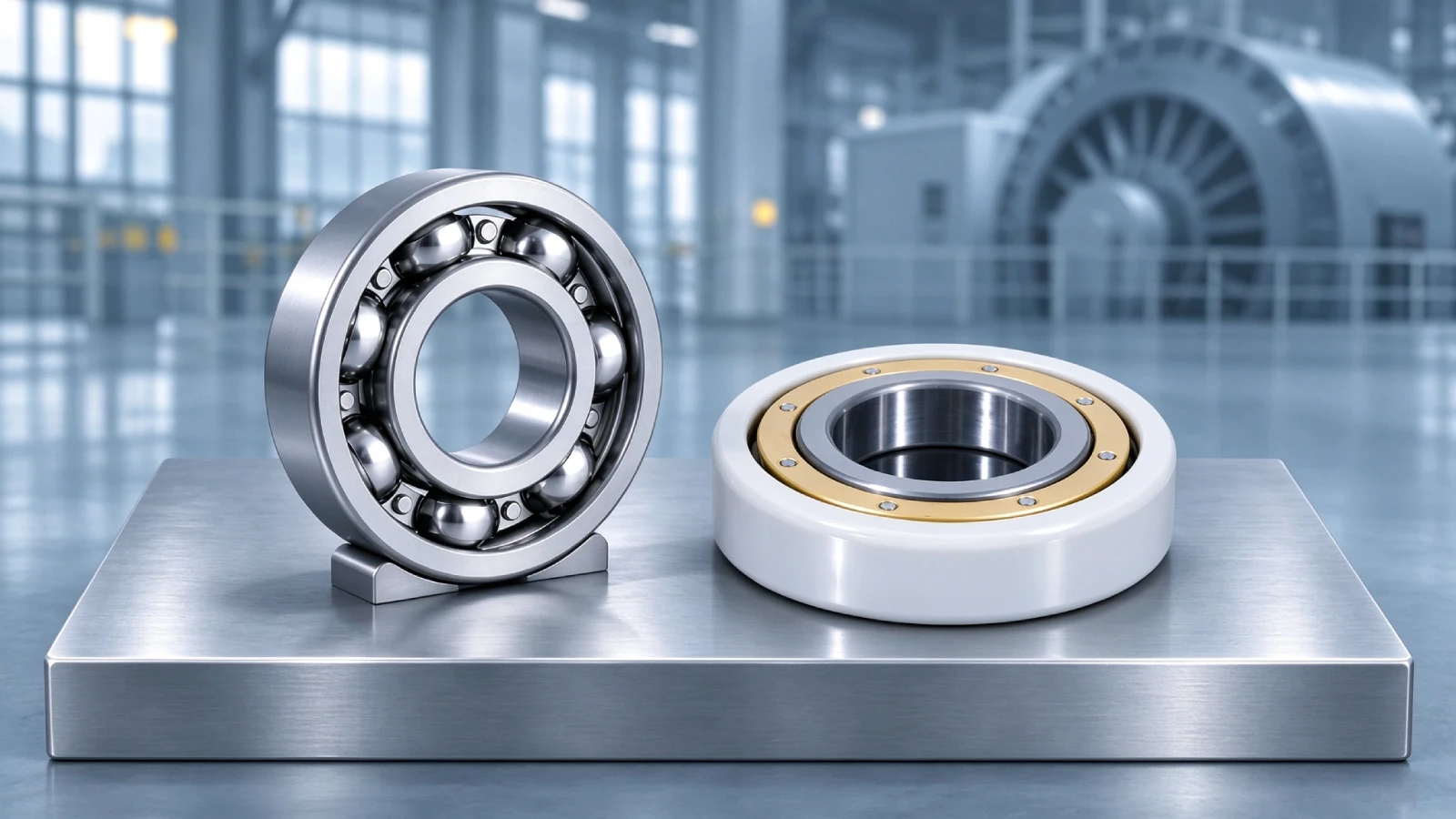
A double bearing generator has rotor supports at both the drive end and the non-drive end. In contrast, a single bearing generator commonly uses a non-drive-end bearing while the coupled prime mover helps support the other end of the rotor. The distinction describes the generator’s support and coupling architecture, not two rows inside one bearing. It changes which spare parts exist and how the machine is aligned during repair.
For a generator-set buyer, the machine nameplate and assembly drawing settle the layout. A quotation for “two bearings” without end locations, codes and coupling details can omit a critical fit or specify a drive-end part for a machine that has none.
Where Does Each Bearing Support the Rotor?
In a double-bearing alternator, two positions carry rotor reactions into the frame or external supports. The drive end faces the coupling; the non-drive end is opposite it. One position may locate the shaft axially while the other permits designed movement. The drabwing decides the duties, and the bearing codes need not match. For example, Mecc Alte lists a front 6308-2RS C3 and rear 6305-2RS C3 for its ECP3-3S/2 alternator. Its OEM spare numbers are 9900905110 and 9900905095, respectively. Match the maker’s front/rear labels to the actual end drawing; check machine options, markings and dimensions before ordering.
A single-bearing alternator usually has a non-drive-end support and a drive-end connection to the engine flywheel or other specified prime-mover interface. The coupling carries part of the support duty. When that connection is separated, the rotor may need a service or transport restraint. The equipment maker’s procedure governs lifting and disassembly.
Some large generators use sleeve or pedestal bearings rather than end-shield rolling bearings. “Double bearing” still names two support positions, but does not say whether each position contains a ball bearing, roller bearing or oil-film assembly. Identify the internal type before sourcing.
How Does the Coupling Change the Purchase?
The drive-end connection in a double-bearing arrangement is generally designed around two independently supported shafts and an appropriate coupling. Alignment and permitted movement must match that arrangement. A single-bearing alternator’s drive-end rotor attachment is part of its support scheme. These are not interchangeable generator packages merely because voltage, frequency and frame outline appear similar.
Request the alternator and driver models, coupling drawing, adaptor details and current configuration. A field modification may have changed the original arrangement. For a proposed single- to double-bearing conversion, the machine designer must review coupling forces and alignment. A spare-part quote cannot approve that conversion.
Shipping and repair handling also differ. A single-bearing rotor may need a restraint when disconnected from its prime mover, while a double-bearing unit has its own supported shaft. Neither observation replaces the lifting and transport procedure for the exact machine. Include any required transit hardware in the repair plan rather than assuming it arrives with the bearing.
| Layout | Bearing positions to identify | Coupling question |
|---|---|---|
| Single bearing | Usually non-drive end | How does the prime mover support drive end? |
| Double bearing | Drive and non-drive ends | How are two supported shafts aligned? |
A two-bearing machine may use end-shield or pedestal housings. Confirm the housing, lubrication system and included hardware separately from the number of rotor-support positions. This comparison is a map for the RFQ. It does not assign a universal bearing number or coupling type to every machine.
Which Duty Factors Affect the Two Supports?
Rotor weight, speed, coupling forces and thermal expansion influence bearing loading. The drive end can see a different environment from the non-drive end. Check the actual fits, axial-location duty, clearance or setting, and lubrication method for each position. A higher-capacity bearing at one end cannot compensate for poor alignment across the generator and driver.
Grease-fed rolling bearings need their specified lubricant and distribution path. A sealed bearing may be ordered with a particular fill; a regreasable design needs functioning inlet and outlet. Sleeve-bearing machines require oil supply and clearance information instead. Temperature trends should be interpreted against the installed support type.
Electrical protection may also vary by end. Some generators use an insulated bearing or housing to interrupt circulating current, but the required location follows the machine’s electrical design. Replacing only one bearing with a different insulation arrangement can change the current path. Obtain the generator engineer’s approval before altering that feature.
What Should Be Inspected Before Replacement?
Vibration or heat at one end does not prove that bearing alone is the cause. Check coupling alignment, rotor balance, foundation, end-shield or pedestal fits, cooling and lubricant condition. Compare trends at both ends with speed and load. The maintenance team should use the machine-specific procedure to decide whether the unit must stop.
During teardown, mark each removed bearing by end and orientation. Measure shaft and housing seats, inspect raceways or sleeve surfaces, and photograph seals, retainers and any preload elements. A worn seat can make a correct new bearing ineffective. If the two ends have different codes, keep their parts and inspection records separate throughout the repair.
For a U.S. generator-set outage, state whether the order covers one affected end, both bearings or an end-shield kit. Give the shop’s approval date and required receipt date. A quoted bearing may be available while the seals or coupling parts needed to finish the job are still outstanding.
What Should a Two-Bearing Generator RFQ Include?
Label the records for each end separately:
- Machine and coupling: Generator and driver maker, model and serial number; support layout, assembly drawing and coupling drawing. Note any field modification.
- DE and NDE identification: Full bearing code, housing details, dimensions and quantity for each end.
- Duty and measured condition: Shaft and housing measurements, speed, duty, lubricant or oil system, insulation requirements and damage evidence for each end.
- Scope and approval: State whether the repair covers one end, both ends or associated parts. Include the approving engineer and required receipt date.
HSN can review the full codes or drawings for stock, difficult models or custom bearing discussions. Agreed dimensional and material checks can be specified before supply. The qualified generator repair team must approve fits, axial location, coupling alignment and electrical protection. A single-versus-double label is the beginning of identification, not a replacement specification.
FAQ
Does double bearing mean two rows in one bearing?
No. It refers to rotor support at two generator positions, usually drive and non-drive ends.
Can I convert a single-bearing set with new bearings?
No simple part swap establishes this; the coupling and rotor-support system need engineering review.
What should a U.S. outage buyer specify?
Send both end codes, coupling drawing, scope, quantity, approval date and receipt date.
Can HSN reproduce the original bearing design?
HSN can review detailed drawings or same-revision production records, then build to approved drawings. Send old-part photos for review.
Remarks
For detailed bearing models used in double-bearing generators but not listed above, please contact HSN for model confirmation and supply discussion. When checking other bearing references, you can also send the complete model, photos, dimensions, quantity, application, and working conditions.
This article is based on independent analysis of publicly available technical information and industry understanding for knowledge sharing. All brand names and trademarks mentioned belong to their respective owners. HSN Bearing Group is an independent bearing supplier and technical service provider.
Tel: +86 156 6578 7336 Email: service@hsnindustrial.com Website: www.rollingparts.com www.hsnbearing.com
Need Help with a Double Bearing Generator?
Contact HSN to confirm a hard-to-find model or discuss a replacement after technical review.