

Why Wind Turbine Main Bearing Failure Requires Root-Cause Review?

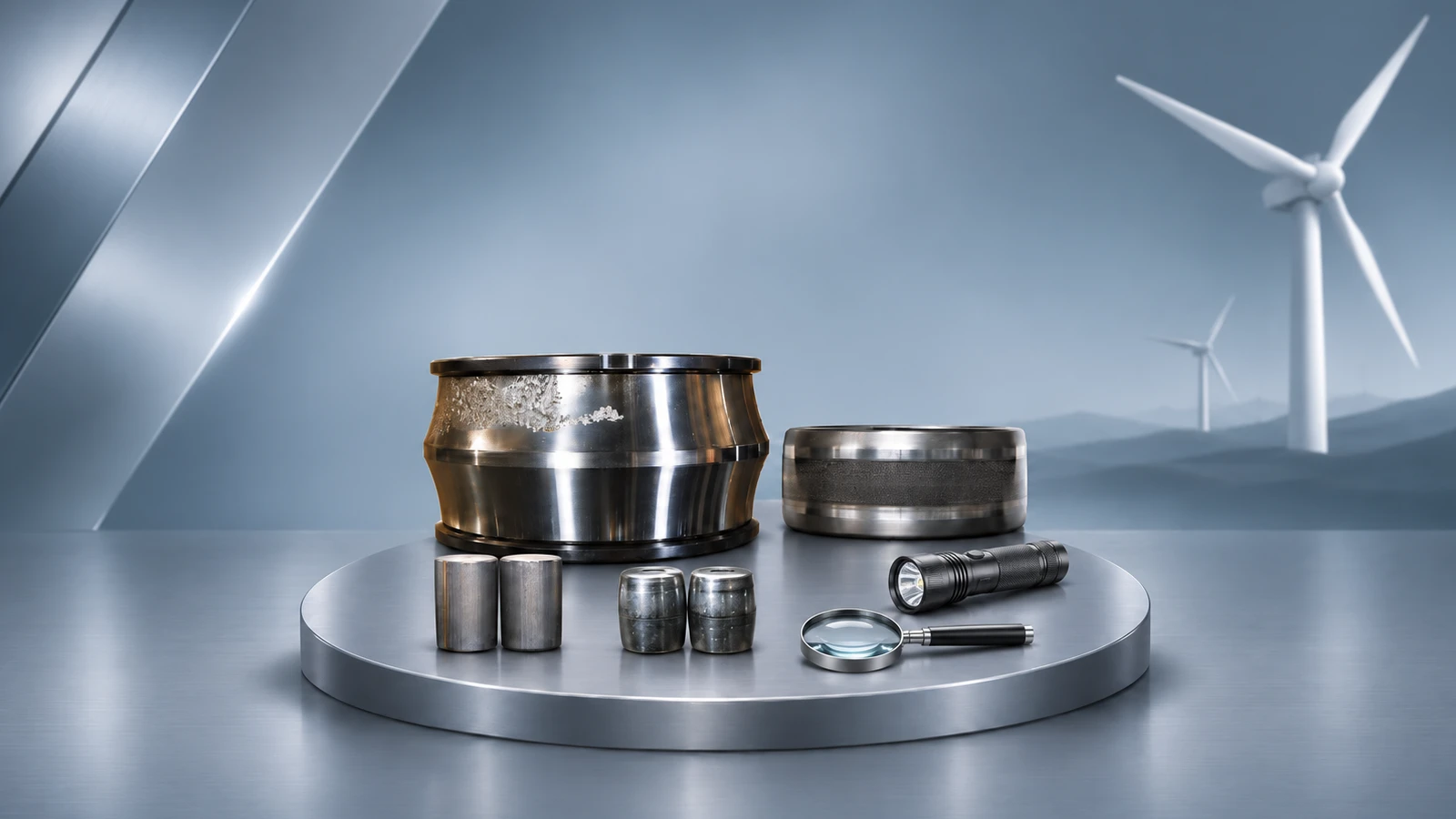
A wind turbine main bearing failure can start as an alarm, grease finding or change in shaft movement. None of these observations alone identifies a root cause. Because the main bearing supports the rotor, damage can affect shaft position and adjacent interfaces even when it is concentrated in one bearing row. A repair decision should follow the actual support arrangement, the loading history and the condition of the shaft, housing and lubrication system.
This article focuses on the main bearing rather than gearbox, pitch or yaw positions. The immediate task is to establish whether the bearing is damaged, why the load path changed, and which parts must be ready for the repair. A replacement code becomes useful only after that evidence is tied to the installed turbine.
Why Can a Main Bearing Wear Prematurely?
The rotor applies radial reaction, wind thrust and bending. In some spherical-roller layouts, high thrust can concentrate load on one row. Wear can increase shaft displacement and change gearbox input loads. Another machine may use tapered rollers or a two-bearing layout with a different location and setting strategy. Housing deflection, shaft-seat wear, incorrect fit and thermal movement can alter contact in either case. The engineer needs the assembly section and the original design criteria before attributing a damaged race to an inadequate bearing type.
Grease delivery and sealing matter. Contamination, poor distribution or an unsuitable replenishment procedure can reduce the lubricant film. Low and variable rotor speed may also produce mixed lubrication even when grease is present. Sample grease from identified locations and inspect purge paths alongside the raceways. Compare surface distress with the sampling location, refill record and operating history before assigning a cause. Label damage photographs by bearing row and orientation so the repair team can assess the load distribution.
How Does Main-Bearing Damage Shape the Outage?
A main-bearing repair may require rotor support, lifting equipment and access to a large shaft and housing. Depending on the turbine, the job can involve an up-tower exchange or removal of a larger drivetrain assembly. The maintenance contractor should determine the method and safe work scope. Purchasing needs that method before deciding whether to order a loose bearing, seals, housing parts or a preassembled unit.
The timing decision has two parts. First, the responsible engineer decides what the observed trend means for operation under the machine’s procedure. Second, the repair planner sets a parts and crane window. An abnormal vibration or temperature trend warrants investigation, but this article cannot declare continued running safe or require immediate removal without machine-specific evidence.
For a U.S. wind-farm outage, coordinate technical approval with the planned crane and access window. Give procurement both the decision deadline and the receiving date. A part with unresolved fit or setting questions is not ready to install, even if delivered on time.
What Evidence Should Be Collected Before and During Removal?
Preserve the alarm and trend history with rotor speed, power, temperature and operating state. Identify where sensors sit: a gearbox vibration channel is not a direct measurement of the main bearing. Review grease condition, seal leakage and any shaft displacement or endplay measurements. These observations help choose inspection points but do not replace teardown evidence.
During disassembly, photograph both bearing rows or raceways, rolling elements, cage and seals. Mark orientation relative to rotor and gearbox. Record whether damage concentrates on the upwind or downwind side and measure the shaft seat, housing bore, shoulders and supporting faces. If grease is sampled, label its location and avoid mixing used material from different cavities.
| Observation | What it may suggest | Follow-up needed |
|---|---|---|
| Uneven row wear | Load concentration or support movement | Compare load path, setting and seat measurements |
| Grease debris or water | Contamination or seal issue | Inspect source, distribution and race surfaces |
| Excess shaft movement | Wear or altered location | Measure bearing, fits and gearbox interface |
The table is a triage aid, not a root-cause verdict. Correlate the findings with the assembly drawing and service history before choosing a corrective action.
How Can Replacement Avoid Repeat Main-Bearing Damage?
If the original design remains suitable, specify the full bearing code and all critical features: internal construction, clearance or setting, seals, lubricant and mounting method. Replace damaged seats or sealing components as required by the repair engineer. A correctly made bearing installed into a loose housing or starved grease system can repeat the failure.
If the repair team proposes a different bearing type, the review is broader. A tapered design may change shaft stiffness and axial location compared with a spherical design. It may also change load reaching the gearbox. Even when a manufacturer offers a fit-compatible upgrade for a particular platform, that claim does not authorize a different supplier’s candidate or every turbine variant. Obtain written design approval for the actual machine.
Installation records should capture measurements, heating or mounting method, setting where applicable, grease fill and initial operating trend. These form a baseline for later monitoring. Do not treat a clean initial vibration reading as proof that the underlying load or lubrication issue was solved.
What Should a Failure-Related RFQ Contain?
Group the failure-related RFQ around the turbine, inspection evidence, supply scope and outage schedule:
- Turbine and drawing: Give the turbine maker, model and serial number, main-bearing assembly drawing, full installed code, bearing position and quantity.
- Failure evidence: Include photos of markings and damage, shaft and housing measurements, grease findings, operating history and seal condition. Identify the affected bearing row where possible.
- Supply scope: State whether the repair needs a loose bearing, matched arrangement or larger assembly. Identify any seals or housing parts required by the approved repair plan.
- Approval and schedule: Provide the decision deadline, planned crane window and required receiving date.
HSN can use the model, drawing or measured sample to review stock and a custom bearing route. For an agreed order, dimensional and material inspection requirements can be specified before shipment. The turbine owner and qualified repair engineer must approve any alternative, mounting setting and return to service. That boundary protects the outage plan from a dimension-only cross-reference.
FAQ
Can another bearing type correct premature wear?
It may be considered, but shaft location, gearbox loads, fits and setting need design approval.
Can delivery meet our scheduled U.S. shutdown?
Send the required arrival date and delivery ZIP code. HSN can review stock, production and transit timing before confirming a plan.
Can HSN reproduce the original bearing design?
HSN can review detailed drawings or same-revision production records, then build to approved drawings. Send old-part photos for review.
Can I order just one custom bearing set?
MOQ: 1 set for medium/large bearings, 10–200 sets for small, and 50–10,000 sets for miniature. Confirm the requirement by model.
Remarks
For detailed wind turbine main bearing models not covered in this article, please contact HSN for model confirmation and supply discussion. When checking other bearing references, you can also send the complete model, photos, dimensions, quantity, application, and working conditions.
This article is based on independent analysis of publicly available technical information and industry understanding for knowledge sharing. All brand names and trademarks mentioned belong to their respective owners. HSN Bearing Group is an independent bearing supplier and technical service provider.
Tel: +86 156 6578 7336 Email: service@hsnindustrial.com Website: www.rollingparts.com www.hsnbearing.com
Need Help with Wind Turbine Main Bearing Failure?
Contact HSN to confirm a hard-to-find model or discuss a replacement after technical review.