

How Should Buyers Select Thrust Bearings?

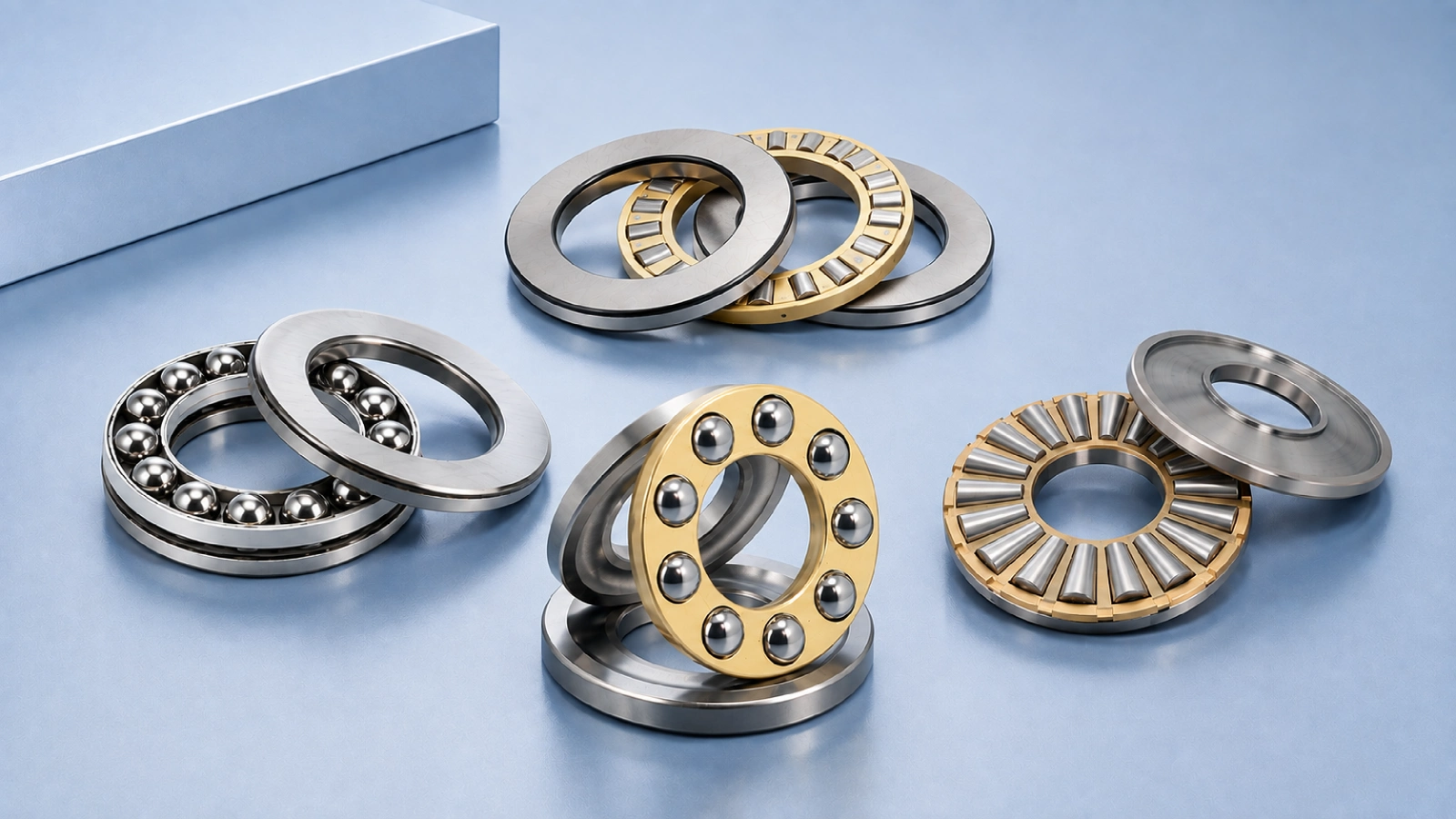
Thrust bearings control axial shaft movement in gearboxes, pumps, machine tools, and other rotating equipment, but different designs cannot be selected by bore size alone. Ball, needle, cylindrical roller, tapered roller, and spherical roller thrust bearings differ in load capacity, speed, alignment capability, washer arrangement, and mounting requirements. This guide helps B2B buyers compare the main structures, application conditions, brand-series examples, model codes, and installation checks needed to prepare a reliable inquiry or evaluate a possible replacement.
What Thrust Bearing Types Should Buyers Compare?
Thrust bearings are designed primarily to locate a shaft and carry load along its axis. The correct structure depends on load magnitude and direction, speed, available space, stiffness, alignment, lubrication, and the surrounding support system. A single-direction design carries axial load in one direction; a double-direction design supports alternating thrust in both directions.
Ball thrust bearings use balls between shaft and housing washers. They offer relatively low friction and suit moderate axial loads and higher speeds, but standard designs do not carry radial load and are sensitive to misalignment. Angular-contact thrust arrangements may provide greater rigidity, although their setting and preload requirements must be confirmed.
Needle roller thrust bearings provide high axial capacity in a very thin section. They may be supplied as a cage-and-roller assembly with separate washers, or used against hardened, accurately finished raceways. Cylindrical roller thrust bearings provide greater stiffness and capacity at moderate speeds. Tapered roller thrust bearings suit heavy-duty thrust arrangements, while spherical roller thrust bearings can accommodate very high axial load, some radial load, and misalignment. These designs are not automatically interchangeable because their load paths, dimensions, speed limits, and mounting details differ.
Where Are Thrust Bearings Used?
Gearboxes and machine-tool spindles use thrust bearings to locate shafts and react to axial forces produced by helical gears, lead screws, or machining loads. Ball thrust bearings often suit moderate axial loads and relatively high speeds. However, precision arrangements also require close control of runout, preload, heat, and lubrication. Because standard thrust ball bearings do not carry radial load, another bearing normally provides radial shaft support.
Pumps, compressors, industrial fans, and extruders generate continuous axial forces through impellers, pressure, or screw action. Needle and cylindrical roller thrust bearings suit compact or stiff arrangements, but minimum load, raceway hardness, lubricant supply, and operating temperature must be checked. Reversing equipment also needs axial support in both directions or an approved opposed arrangement.
Cranes, marine drives, presses, mining machinery, and heavy material-handling equipment may use tapered designs for heavy thrust arrangements or spherical roller thrust bearings where misalignment and combined loading occur. Buyers should state axial and radial loads separately, together with speed, duty cycle, shaft orientation, shock, contamination, temperature, available space, and expected life. The selected structure must match the actual load path and mounting system.



What Should Buyers Verify Before Ordering?
Begin with the complete manufacturer designation, including prefixes, suffixes, and accuracy or clearance symbols. Then confirm bearing type, single- or double-direction operation, bore, outside diameter, height, washer configuration, cage material, internal design, and whether washers are supplied. Record axial load, any radial load, speed, duty cycle, temperature, shaft orientation, shock, contamination, target life, and lubrication method.
Also verify shaft and housing seat dimensions, tolerances, shoulder geometry, runout, surface finish, and available axial space. For replacement work, a dimensional match is only a starting point; internal geometry, capacity, speed, setting, and mounting requirements must also be equivalent.
Which Brand Series and Complete Models Should Buyers Know?
Brand series can help narrow a search, but the complete model controls the technical review. The following examples show common naming patterns; availability and suffix meanings should be confirmed against current manufacturer data.
| Brand | Series examples | Complete model example |
|---|---|---|
| SKF | 511/512/513/514 thrust ball; 292/293/294 spherical roller thrust | 51105; 29412 E |
| INA | AXK axial needle roller and cage assemblies | AXK2035-A/0-10 |
| Timken | TTSP; TTSPS; TTSPL tapered thrust series | T126AW-90010 |
SKF 51105 is a single-direction thrust ball bearing. SKF 29412 E is a spherical roller thrust bearing. INA AXK2035-A/0-10 is an axial needle roller and cage assembly, while Timken T126AW-90010 belongs to a tapered thrust design. Buyers should compare structure, envelope, ratings, speed, washers, and mounting instructions before discussing any alternative.
For example, the basic SKF designation 51105 can be read as follows.
| Code | Code section | Meaning |
|---|---|---|
| 5 | Bearing type | Thrust ball bearing type |
| 11 | Dimension series | Diameter and height series combination |
| 05 | Bore code | 25 mm nominal bore |
The code identifies the basic size and family, but it does not describe every operating limit. Buyers should still confirm the current product record, washer arrangement, cage, ratings, speed, lubricant, and tolerances.
What Installation and Removal Practices Matter?
Keep all bearing components clean, dry, and protected from impact. Confirm identification before unpacking, and do not mix washers, cages, or rollers from different sets. Apply mounting force only to the ring or washer receiving the fit. Never transmit press or hammer force through the rolling elements, and use a suitable sleeve, press, heater, or lifting device for the bearing size and design.
In a separable thrust ball bearing, the shaft washer is located on the shaft, while the housing washer normally has radial clearance between its bore and the shaft. The supporting shoulders must remain flat, square, and rigid. Seat every component against the correct shoulder, maintain the specified alignment, and follow the approved setting or preload procedure. Over-preload can raise torque and temperature; excessive endplay can reduce positional accuracy and damage contact surfaces.
After assembly, rotate the shaft by hand where practical and check freedom of movement, runout, endplay or preload, seal drag, and lubricant quantity. Commission the unit under controlled load while monitoring noise, vibration, and temperature. During removal, support the assembly, use correct pullers or presses, protect the seats, and mark component positions. Inspect raceways, rolling elements, cages, washers, lubricant, fits, and adjacent parts before deciding whether reuse is permitted.
How Can HSN Support Thrust Bearing Orders?
HSN can review the complete designation, thrust-bearing type, load direction, dimensions, speed, alignment requirements, lubrication, fits, quantity, and application before sourcing begins. For incomplete markings, photos, drawings, and measured dimensions can support initial identification, but the final selection should follow the confirmed manufacturer data and operating requirements.
Agreed incoming checks can cover markings, dimensions, runout, visible surface condition, cage and washer configuration, hardness, packaging, and traceability. HSN can arrange additional inspection when the purchase specification defines the method and acceptance criteria. Before discussing a replacement, HSN compares the complete envelope, load data, speed, internal design, suffixes, and mounting requirements rather than relying on bore size alone.
FAQ
Can a thrust ball bearing carry radial load?
No. Standard thrust ball bearings are designed for axial load and should not be selected for radial support.
When is a thrust needle bearing useful?
It is useful when axial space is limited and the arrangement provides suitable washers or hardened raceways.
Can one thrust bearing carry load both ways?
A double-direction thrust bearing can carry axial load in both directions. Some applications can also use an approved opposed arrangement.
What information should buyers send?
Send the full code, loads, speed, dimensions, fits, lubricant, direction, quantity, and application conditions.
Remarks
For detailed thrust bearing models not listed above, or for other bearing types, contact HSN with the reference, photos or drawing, dimensions, quantity, application, and working conditions.
This article is based on independent analysis of publicly available technical information and industry understanding for knowledge sharing. All brand names and trademarks belong to their respective owners. HSN Bearing Group is an independent bearing supplier and technical service provider.
Tel: +86 156 6578 7336 Email: service@hsnindustrial.com Website: www.rollingparts.com www.hsnbearing.com
Need Help Finding Thrust Bearings?
Contact HSN to confirm a hard-to-find model or discuss a replacement after technical review.