

How Should Buyers Use a Timken Bearing Cross Reference?

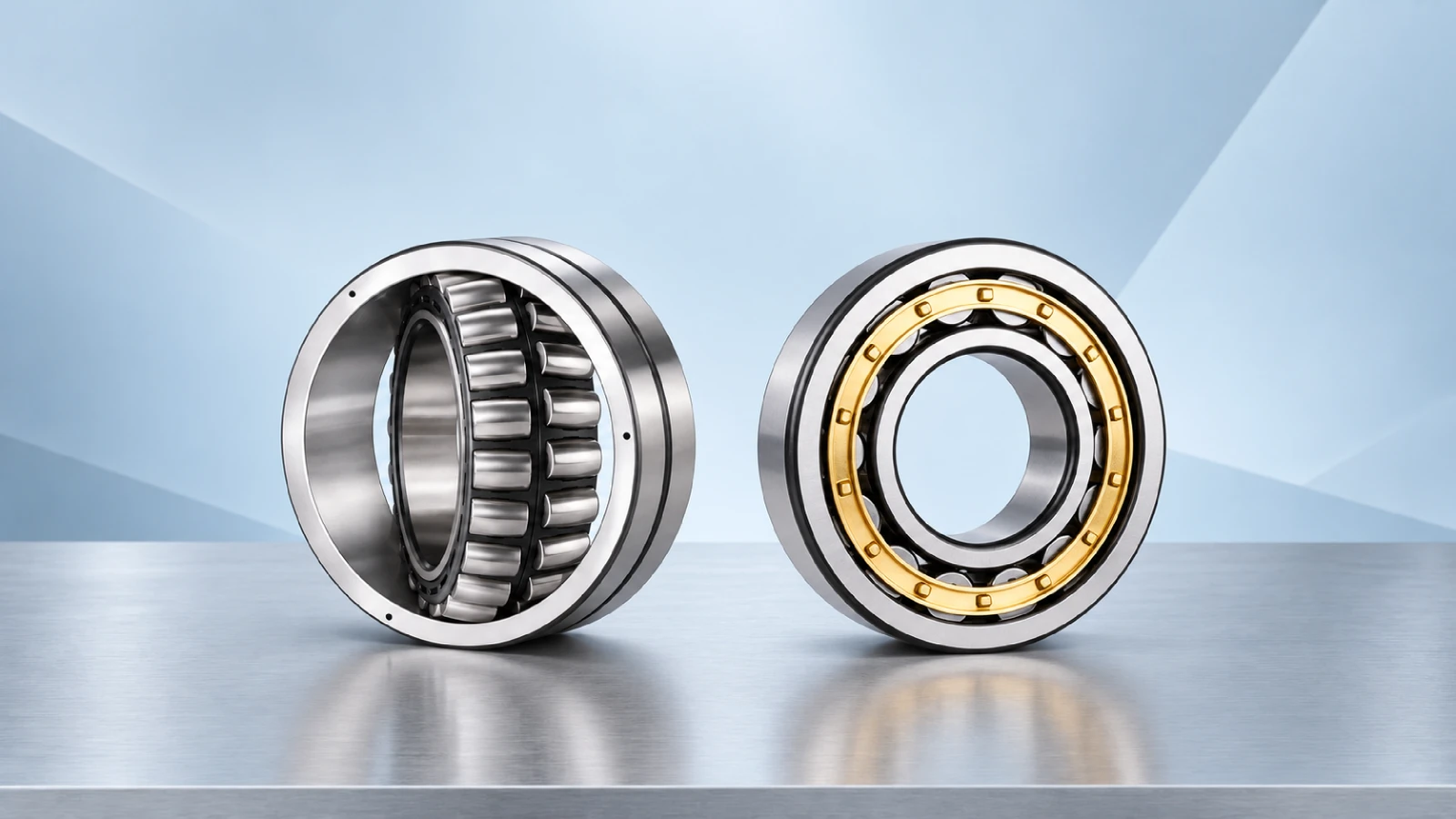
When an installed bearing is unavailable or has a long lead time, a Timken bearing cross reference can help buyers identify replacement candidates. However, similar numbers and shared dimensions do not establish technical equivalence. The complete designation, bearing structure, and operating requirements must guide the comparison before purchasing approves an alternative.
Timken, SKF, and FAG use common bearing category names, while their model designations distinguish specific configurations. For shaker-screen spherical roller bearings, the published interchange chart provides complete numbers for comparison. Cylindrical roller bearings codes such as NU and EJ help identify ring arrangement and cage design. Understanding these details helps buyers narrow the search and recognize differences that require engineering review.
How Do Timken, SKF and FAG Classify These Bearings?
Timken, SKF, and FAG use the same broad category names for the four bearing families below. Buyers can therefore use these shared terms to find the corresponding catalog section. However, matching category names does not establish matching product specifications.
| Shared category name across Timken, SKF and FAG | Main design characteristic | Priority when comparing models |
|---|---|---|
| Spherical roller bearings | Accommodate angular misalignment while carrying substantial radial load | Standard or vibrating-screen design, cage, clearance, and lubrication features |
| Cylindrical roller bearings | Carry high radial loads; ring ribs determine axial function | Locating or floating arrangement, rib configuration, cage, and clearance |
| Tapered roller bearings | Support combined radial and axial loads through angled raceways | Complete cup-and-cone combination, overall dimensions, and mounting adjustment |
| Deep groove ball bearings | Support radial load and some axial load in both directions | Seals or shields, grease, clearance, speed, and operating temperature |
Use the category name to identify the correct bearing family before comparing complete part numbers. For example, a spherical roller bearing inquiry for a vibrating screen requires more detail than the general category alone provides. Its application-specific configuration must also match the equipment requirements.
The following Timken bearing cross reference chart addresses selected shaker-screen spherical roller bearings. It does not establish replacement numbers for the other categories listed above.
How Do You Use the Timken Bearing Cross Reference Chart?
Record the full marking on the installed bearing, including its suffixes. Identify the bearing family and application before searching a brand column. Then retain the entire candidate number and the bore stated on the source chart.
The following selected entries appear in Timken’s shaker-screen spherical roller bearing interchange guide:
| Bore | Timken number | FAG number | SKF number |
|---|---|---|---|
| 40 mm | 22308EMW33W800C4 | 22308-E1-T41A | 22308E/VA405 |
| 100 mm | 22320EMW33W800C4 | 22320-E1-T41D | 22320EJA/VA405 |
| 110 mm | 23322EMW33W800C4 | 23322-AS-MA-T41A | 453322EJA/VA405 |
Read across a single row rather than combining numbers from different rows. The SKF entry paired with the Timken 23322 number begins 453322; it should not be rewritten as a 23322 SKF number. Each entry is a published comparison candidate, not permission to install one brand in place of another.
The full marking matters even when the basic number repeats. The Timken guide lists 23322EMW33W800C4 with a 110 mm bore. A different entry, 23322EMW810C4, has a 100 mm bore and no FAG or SKF counterpart in its row. An inquiry based only on “23322” could therefore misstate the shaft fit.
Which Timken Spherical Roller Features Need a Closer Look?
A vibrating screen subjects its bearings to repeated vibration and contamination. The Timken chart addresses that application, so a standard spherical roller bearing with similar outside dimensions should not be substituted merely because it belongs to the same family.
For the selected Timken rows, preserve the full W33W800C4 portion of the designation. The chart lists SKF VA405 and FAG T41A or T41D within the corresponding complete numbers. These brand-specific suffixes are not letter-for-letter translations of Timken’s code. The catalog and drawing must establish the actual features of each proposed product.
Compare the bore, outside diameter, width, tolerances, internal clearance, cage, lubrication provisions, and mounting interfaces. Check vibration duty and operating conditions as well. A recorded chart row narrows the search; it cannot determine whether all differences are acceptable to the equipment owner.
For a U.S. plant preparing a screen shutdown, capture both the current bearing marking and the machine drawing before requesting prices. This lets purchasing distinguish a source-chart candidate from a technically approved purchase item.
How Do You Read a Timken Cylindrical Roller Number?
The spherical roller chart does not apply to a cylindrical roller bearing. Consider the different family illustrated by Timken NU2226EJ. Its designation separates ring style, dimension series, bore code, and cage type:
| Code | Code section | Meaning |
|---|---|---|
| NU | Bearing style | Cylindrical roller style that permits axial displacement within the bearing |
| 22 | Dimension series | Width series 2 and diameter series 2 |
| 26 | Bore code | 130 mm bore under the metric code rule: 26 × 5 mm |
| EJ | Cage designation | Roller-guided, stamped-steel cage |
Timken lists NU2226EJ as a single-row cylindrical roller bearing with a 130 mm bore, 230 mm outside diameter, and 64 mm width.
Its NU ring arrangement can suit a non-locating position where axial movement is required. Other cylindrical styles, such as NJ and NUP, have different rib arrangements and axial functions; the machine drawing must establish the intended position.
This decoding helps identify the correct family and configuration before any cross-brand search. It does not create an SKF or FAG equivalent for NU2226EJ. Check the full proposed designation, clearance, mounting interfaces, and catalog dimensions independently.
What Must Be Verified Before a Cross-Referenced Order?
First, identify the scope of the evidence. A family-name table classifies bearings, while a manufacturer interchange row proposes numbers for a stated application. Neither is a substitute for the equipment specification.
For purchase approval, compare the following once for each proposed candidate:
- Identity: Complete installed marking, candidate designation, source-chart row, and bearing position.
- Geometry: Bore, outside diameter, width, tolerances, shoulders, and shaft and housing fits.
- Function: Internal design, cage, clearance, seals or lubrication features, and locating or floating role.
- Duty: Load, speed, temperature, vibration, contamination, and maintenance method.
- Approval: Document differences and obtain the customer’s technical acceptance before ordering.
For an urgent U.S. RFQ, include quantity, required date, and the person who can approve a design change. HSN can review the complete numbers and drawings, check possible stock in China, or discuss a drawing-based option. An agreed inspection plan may include dimensions, hardness, and clearance before shipment. Stock availability and technical acceptance remain separate decisions.
FAQ
Is a listed SKF or FAG number a direct replacement?
No. A Timken interchange row supplies a candidate; verify its full specification and obtain equipment-owner approval.
Which SKF number belongs in the Timken 23322 inquiry?
Use the listed 453322EJA/VA405, then confirm the drawing and application. Do not replace its prefix with 23322.
Does HSN support shipping and customs clearance for U.S. customers?
Yes. HSN supports flexible trade terms, shipping arrangements, customs documentation, and delivery coordination for U.S. orders.
How can HSN help review a hard-to-find chart entry?
HSN can check possible supply and review drawings, dimensions, and inspection needs before proposing an option.
Remarks
For detailed models beyond those listed above, or for other bearing types, please contact HSN. Send the complete model, photographs, dimensions, quantity, and working conditions so the inquiry starts with the right information.
This article is based on independent analysis of publicly available technical information and industry understanding, and aims to provide knowledge sharing. All brand names and trademarks mentioned in this article belong to their respective owners. HSN Bearing Group is an independent bearing supplier and technical service provider.
Tel: +86 156 6578 7336 Email: service@hsnindustrial.com Website: www.rollingparts.com www.hsnbearing.com
Need Help With a Timken Bearing Cross Reference?
Contact HSN to confirm a hard-to-find model or discuss a replacement after technical review.