
Why Do Timken Rail Bearings Need Load, Lubrication and Fit Checks?

Timken rail bearings serve different positions across axle journals, traction motors, and gearboxes, and each position has its own load path, speed, lubrication, mounting, and service requirements. Timken AP and AP-2 assemblies, for example, are integrated tapered roller bearing systems for rail journal applications, while motor and gearbox positions may use different bearing constructions. Identifying the exact vehicle and bearing position is therefore the first step in a replacement review.
The review should then consider axle or shaft loads, speed, shock duty, sealing, lubrication, fits, mounting hardware, and the applicable service history. A class number, component marking, or similar outside dimension does not define the complete assembly. This guide explains how position-specific operating conditions and maintenance records help buyers prepare a technically complete rail bearing inquiry.
Which Timken Rail Bearings Support Axles and Drives?
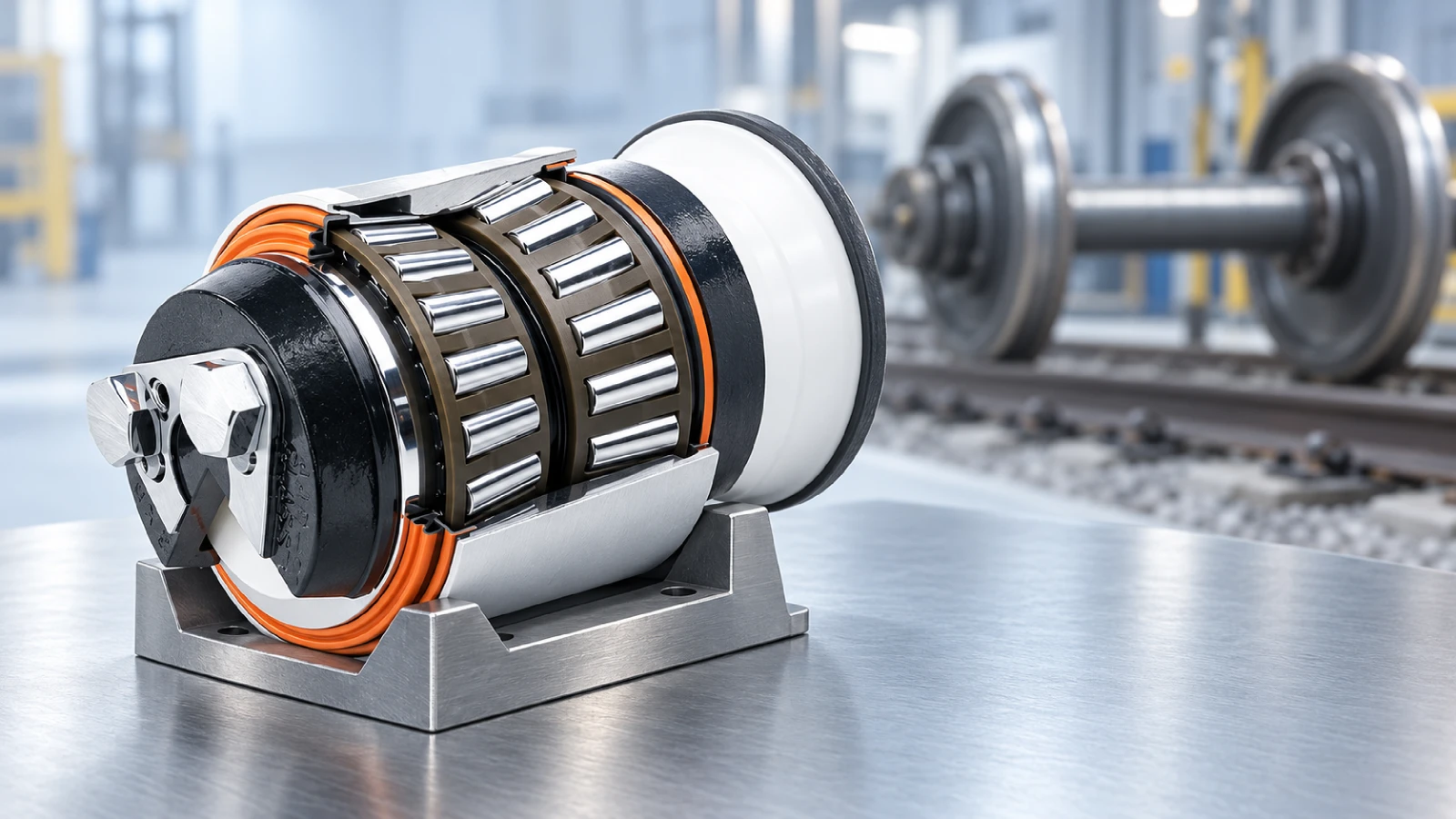
AP and AP-2 are self-contained, pre-lubricated tapered roller bearing assemblies intended for rail journal applications. A journal bearing supports the wheelset axle and handles combined loads under repeated track events. The complete assembly can include cones, cup, spacer, seals and backing or other mounting components. A marking on one component is not necessarily the orderable designation for the entire assembly.
Timken’s rail market overview describes AP-2 development and rail applications. Its published service-limit chart gives component examples in specific columns. Class D (5½ × 10) AP includes roller assembly HM127446 and outer ring HM127415XD. Class F (6½ × 12) AP lists HM133444 and HM133416XD. These component identifiers do not establish a complete replacement assembly or interchange approval. Verify class, assembly configuration, seal and service revision in the relevant Timken passenger-car service chart.
An assembly-level ordering example shows what a component number omits. Timken’s AP Bearings for Industrial Applications catalog identifies Class D HM127446-90012 as an AP bearing assembly with a pressed-on shrouded backing ring. It lists K85521-90011 as a separate axle end cap assembly. This industrial catalog example explains order scope; it does not certify the configuration for a passenger car, wheelset, rail operator or service revision. Request the approved full assembly number and mounting parts for the actual fleet.
How Do Motor and Gearbox Positions Differ?
Traction motor and gearbox positions may use other bearing constructions and lubrication systems. Never transfer an axle-journal AP designation to a motor simply because the bore appears similar. Identify vehicle type, assembly number, axle or drive location and the applicable maintenance document first.
| Position | Information to identify | Boundary of comparison |
|---|---|---|
| Axle journal | AP or AP-2 class, full assembly, seals and mounting | Match the approved wheelset arrangement |
| Traction motor | Motor bearing location and maker’s drawing | Review electrical, speed and thermal conditions |
| Gearbox | Shaft position, load path and lubricant | Review gear loads, fits and oil delivery |
How Do Load, Speed, Shock and Duty Cycle Shape Selection?
Rail axle bearings see radial vehicle load and axial forces from curves and track geometry. Impact at joints or irregularities adds transient loading; mileage, starts, braking and operating speed influence fatigue and heat. A static rating alone does not tell whether a candidate survives the actual service profile. Ask engineering for axle load, maximum and normal speeds, route conditions and required inspection interval.
The bearing arrangement determines how forces travel through rollers, rings, shoulders and end hardware. AP and AP-2 are integrated units with defined geometry and setting. Matching the outside envelope does not recreate their internal load distribution or approved mounting. A modified cage, seal or lubricant can change thermal behavior. Where a U.S. rail operator is scheduling a wheelset change, the maintenance team should record the required standard, equipment drawing and authorized repair procedure before ordering.
A rail service substitution needs the operator’s technical and regulatory acceptance. HSN may discuss the feasibility of identifying a number or comparing a drawing, but an alternative is not qualified for rail service merely because its dimensions agree. Keep any performance claims tied to the exact proposed item and available evidence.
Why Do Sealing, Lubrication and Contamination Matter?
Timken describes AP and AP-2 as sealed and pre-lubricated assemblies. The supplied seal design and lubricant are parts of the service system. Contamination from water, grit or damaged seals can accelerate raceway distress; lubricant loss or incompatible grease can raise friction and temperature. The housing, axle surface and protective handling affect whether a new bearing stays clean before installation.
Use the manufacturer’s applicable handling and installation/removal guidance for the exact assembly. Do not add grease or disassemble a sealed unit on the assumption that it is a conventional shop bearing. Record seal type and damage pattern during removal. Ask whether the observed failure followed water ingress, mounting damage, electrical effects or an abnormal operating condition; replacing only the bearing may not resolve the cause.
In a gearbox or traction motor, lubrication may instead come from oil circulation, splash or another system. Obtain the position-specific maintenance instructions. Neither an AP grease specification nor an axle seal concept can simply be copied to those positions.
Which Fit, Clearance and Mounting Checks Are Required?
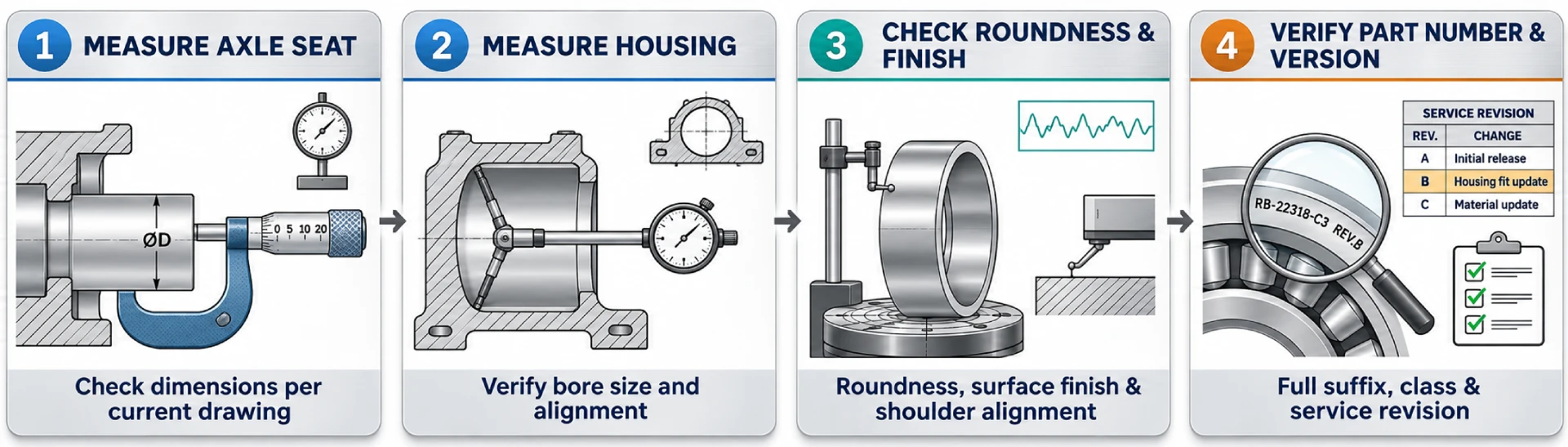
Measure the axle seat or shaft and housing against the current drawing, including roundness, surface finish and shoulder geometry. Verify the bearing class, press fit, backing ring, end cap and fastener arrangement. Correct handling and pressing tools protect raceways and seals. The installed axial condition must follow the assembly’s prescribed method; a technician should not apply a generic tapered bearing adjustment to an integrated unit.
For motor or gearbox bearings, review internal clearance and thermal fits as appropriate to that specific construction. A loose fit may permit ring creep; an overly tight fit may reduce operating clearance. Inspect seats for fretting and verify alignment and lubricant delivery before assigning a failure to the bearing alone. Any dimensional deviation should be escalated under the operator’s maintenance process.
A part-number comparison should include the entire suffix and service revision. Timken’s Class D and Class F component examples show why a class label is useful, but still incomplete. Seals, spacer, cage and accessory configurations can differ within a class. An RFQ based only on “Class F bearing” leaves critical details unresolved.
Which Bearing and Service Records Support Replacement Review?
Send the full assembly number, all readable ring and component markings, class, vehicle and wheelset identification, position, and photographs before and after removal. Add mileage, installation date, last service and observed damage, along with load and speed conditions where available. State quantity, required date and whether the inquiry concerns a new unit, an approved reconditioning route or a technical feasibility review.
Request the documents required by the operator: drawing and revision, batch and material traceability, inspection results, lubricant and seal identification, and the applicable rail acceptance record. Distinguish a service-limit chart from a parts interchange approval. Timken’s published chart informs inspection of its specified components; it does not authorize an independently sourced assembly for a fleet.
HSN can help screen an exact hard-to-find reference and organize a dimensional or documentation review. For any proposed replacement, the customer must define the specification, validation tests and approval authority before service use. This keeps procurement aligned with the actual wheelset or drive position and its maintenance obligations.
FAQ
Are AP and AP-2 journal assemblies the same item?
No. Confirm the exact assembly, class, seal configuration and service documentation.
Which records distinguish a new unit from reconditioning?
Send the full assembly number, service history, applicable chart and the operator’s acceptance requirements.
What should a U.S. rail maintenance RFQ include?
Include wheelset position, full number, class, photos, service records, quantity and deadline.
Can HSN approve an alternative rail bearing?
HSN can support technical inquiry; the operator’s engineering and approval process governs use.
Remarks
For detailed models beyond those listed above, or for other bearing types, please contact HSN. Send the complete model, photographs, dimensions, quantity, and working conditions so the inquiry starts with the right information.
This article is based on independent analysis of publicly available technical information and industry understanding, and aims to provide knowledge sharing. All brand names and trademarks mentioned in this article belong to their respective owners. HSN Bearing Group is an independent bearing supplier and technical service provider.
Tel: +86 156 6578 7336 Email: service@hsnindustrial.com Website: www.rollingparts.com www.hsnbearing.com
Need Help Identifying a Timken Rail Bearing?
Contact HSN to confirm a hard-to-find model or discuss a replacement after technical review.