

Why Needle Thrust Bearing Selection Needs Raceway and Model Checks?

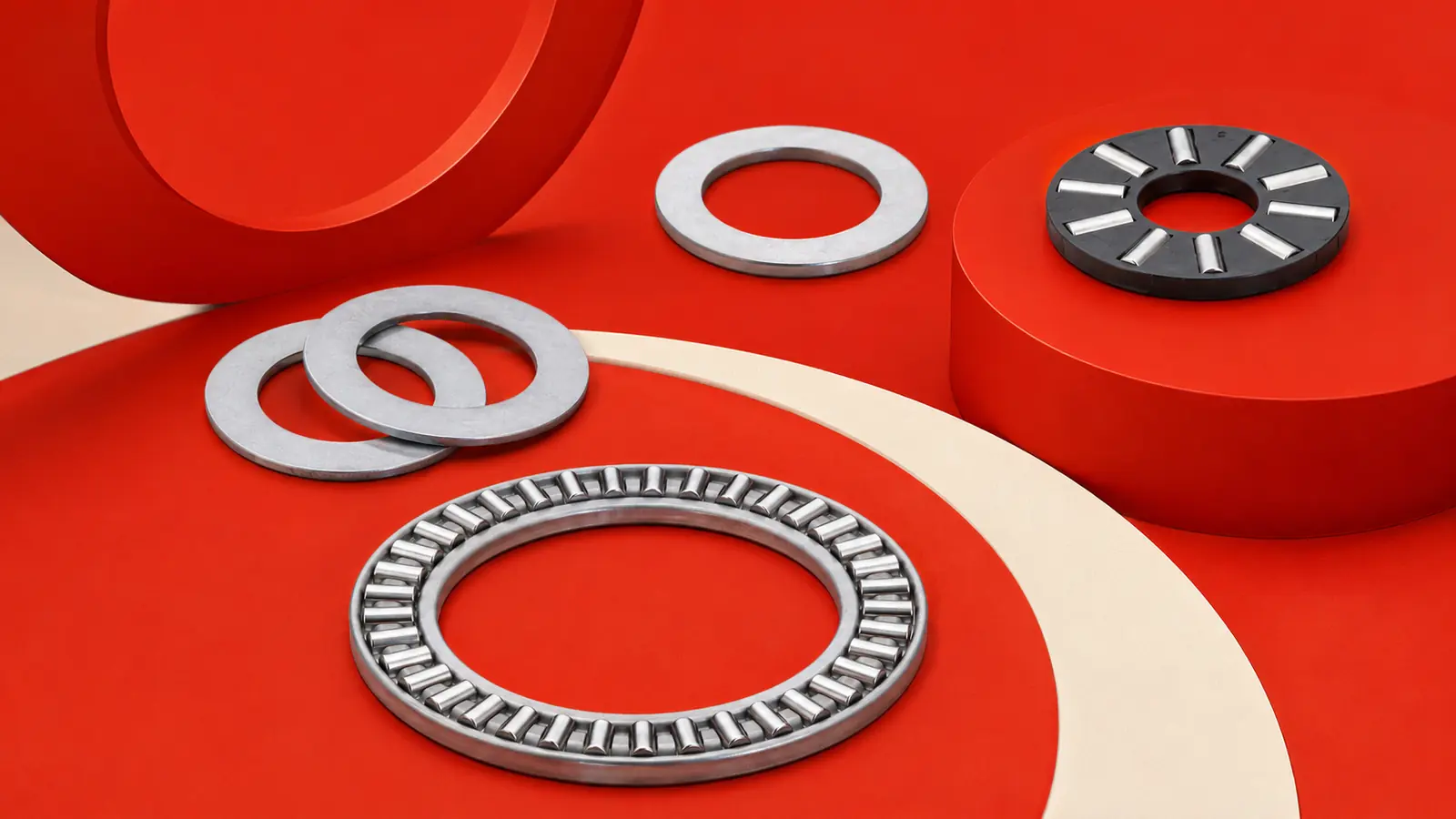
A needle thrust bearing supports axial load within a very small axial space. It uses long, small-diameter rollers arranged radially in a cage. This structure provides high axial stiffness, but it depends heavily on flat, hard and accurately aligned raceways.
Buyers should not select the assembly by bore size alone. The cage design, roller set, washers, load direction, shaft guidance and lubrication method all affect suitability. The complete designation must therefore be checked before ordering.
Table of contents
- What Defines the Structure of a Needle Thrust Bearing?
- How Do AXK, AXW and Bearing Washer Designs Differ?
- Where Are Needle Thrust Bearings Commonly Used?
- What Raceway and Operating Details Must Buyers Confirm?
- What Should Buyers Know About Installation and Removal?
- Which Brand Series and Complete Models Should Buyers Know?
- How Do Buyers Read a Needle Thrust Bearing Code?
- How Can HSN Support Needle Thrust Bearing Orders?
- FAQ
What Defines the Structure of a Needle Thrust Bearing?
The basic component is a thrust needle roller and cage assembly. The cage separates, guides and retains the rollers, while the rollers carry load between two flat raceways. Unlike a radial needle bearing, this design is intended mainly for axial force.
Most standard assemblies are single direction. They support axial load acting in one direction, so the surrounding parts must locate the shaft correctly. A double-direction arrangement can be created with two assemblies, suitable washers and an intermediate washer designed for the required centring method.
The adjacent shaft shoulder and housing face may serve as raceways when their hardness, surface finish, flatness and geometry meet the bearing requirements. Otherwise, separate washers are necessary.
How Do AXK, AXW and Bearing Washer Designs Differ?
AXK-series products are needle roller and cage thrust assemblies. They provide the most compact arrangement when the machine faces can act as raceways. Where this is not possible, AXK assemblies can be combined with thin or precision-machined washers.
AXW-series products combine a thrust needle assembly with a washer that has a centring spigot. The spigot helps locate the housing washer and can simplify assembly. However, its outside geometry must match the surrounding component.
Common washer forms include:
- AS thin thrust washers for compact arrangements
- LS raceway washers with a ground raceway
- WS shaft washers with a ground bore
- GS housing washers with a ground outside diameter
Washers are often ordered separately. Therefore, a quotation for an AXK assembly should not be assumed to include both raceways.
Where Are Needle Thrust Bearings Commonly Used?
Needle thrust roller bearings suit mechanisms that need axial support but have limited space. Typical positions include transmissions, gear pumps, compressors, steering systems, machine tools, indexing mechanisms and compact gear units. Each position needs stable axial guidance and suitable raceways.
These products do not replace a radial bearing. If a shaft carries both radial and axial loads, the arrangement normally needs a separate radial bearing or a combined bearing design. Load direction, shaft deflection and housing stiffness should be reviewed as a system.



What Raceway and Operating Details Must Buyers Confirm?
Start with axial load magnitude, direction and duty cycle. Then check speed, shock, temperature and required life. A compact bearing can carry substantial axial load, but poor raceway geometry can concentrate stress near the roller ends.
Before selection, confirm:
- Shaft and housing raceway hardness and surface finish
- Raceway flatness, runout and perpendicularity
- Guidance method for the cage assembly
- Washer type and total installed height
- Lubricant type, supply path and relubrication access
- Operating temperature and cage material
- Required internal location for single- or double-direction load
At higher speeds, stable radial guidance becomes more important. Lubricant must reach the needle rollers without being blocked by shoulders or washers. Excessive grease can also increase heat in compact arrangements.
What Should Buyers Know About Installation and Removal?
Keep the assembly and washers clean because small particles can mark the thin raceways. Check that the supporting faces are free from burrs and are perpendicular to the shaft axis. Install the cage in the correct direction when the design has a defined guiding side.
Apply assembly force to the fitted component, not through the rollers. When separate washers are used, verify their shaft or housing location before final tightening. Rotate the arrangement by hand and check for uneven resistance.
During removal, support thin washers so they do not bend. If raceways show scoring, edge loading or heat discoloration, inspect the mating faces and lubrication system before fitting a new bearing. Replacing only the cage assembly may not correct a damaged raceway.
Which Brand Series and Complete Models Should Buyers Know?
Several brands use similar AXK terminology, but spacing, suffixes and dimensional scope can differ.
| Brand | Main thrust needle range | Complete model example |
|---|---|---|
| SKF | AXK cage assemblies; AXW centred bearings; AS, LS, WS and GS washers | AXK 2035; AXW 20 |
| Schaeffler | AXK axial needle roller and cage assemblies | AXK2035-A/0-10 |
| NTN | AXK thrust needle roller and cage assemblies | AXK1102 |
SKF AXK 2035 is a cage assembly whose numerical section identifies its bore and outside-diameter group. AXW 20 includes a centring feature and belongs to a different construction.
Schaeffler adds production and tolerance-related code sections to AXK2035-A/0-10. NTN AXK1102 is a metric thrust needle roller and cage assembly with a 15 mm bore, 28 mm outside diameter, and 2 mm width.
These examples should be compared by dimensions, washer arrangement, cage design and operating limits. A shared AXK prefix does not prove direct interchangeability.
How Do Buyers Read a Needle Thrust Bearing Code?
The SKF examples show why every code section matters.
| Code | Code section | Meaning |
|---|---|---|
| AXK | Product prefix | Needle roller and cage thrust assembly |
| 20 | First size section | NNominal bore group in AXK 2035 |
| 35 | Second size section | Outside-diameter group in AXK 2035 |
| AXW | Alternative prefix | Needle thrust bearing with a centring spigot |
| 20 | AXW size code | Identifies the nominal bore group |
| TN | Optional suffix | Glass-fibre-reinforced polyamide cage on applicable SKF sizes |
| AS / LS | Washer prefixes | Thin thrust washer / ground raceway washer |
| WS / GS | Washer prefixes | Shaft washer / housing washer |
The digits do not state every tolerance, height or operating limit. Buyers should retain spaces, hyphens and suffixes in the inquiry. They should also state whether washers are required.
How Can HSN Support Needle Thrust Bearing Orders?
HSN Bearing Group supports model confirmation, sourcing, inspection, and custom supply discussions. Buyers should provide the complete reference, quantity, and mounting space. HSN can review the cage-and-roller assembly, required washers, dimensions, installed height, and raceway condition. Axial load direction, speed, lubrication, and working conditions also require confirmation. Availability is checked for the exact requested component.
For old or difficult references, HSN can review drawings, samples, surrounding parts, and application data. Replacement supply can follow technical confirmation. Before shipment, checks may cover dimensions, hardness, surface condition, appearance, and assembly clearance. Similar dimensions do not prove interchangeability. Washer arrangement, raceway quality, thickness, and internal construction must also match.
FAQ
Does a needle thrust assembly need bearing washers?
Use matching washers when adjacent surfaces lack the required hardness, finish, flatness or raceway accuracy.
Can a needle thrust bearing carry radial load?
It is designed mainly for axial load. A separate bearing or guidance system is normally needed for radial load.
Why does washer thickness matter?
It affects installed height and axial position, so the washer code and dimensions must match the assembly.
What data is needed before ordering?
Provide shaft and housing sizes, axial load, speed, raceway condition, lubrication and required washer arrangement.
Remarks
For detailed needle thrust bearing models not listed above, please contact HSN for model confirmation and supply discussion. When checking needle thrust bearing references, you can also send the complete model number, photos, dimensions, quantity, and working conditions for review.
This article is based on independent analysis of publicly available technical information and industry understanding for knowledge sharing. All brand names and trademarks mentioned belong to their respective owners. HSN Bearing Group is an independent bearing supplier and technical service provider.
Tel: +86 156 6578 7336 Email: service@hsnindustrial.com Website: www.rollingparts.com www.hsnbearing.com
Need Help Confirming a Needle Thrust Bearing?
If you urgently need a hard-to-find needle thrust bearing from stock in China, contact HSN. We can also discuss an alternative solution after technical confirmation.