

Why Pillow Block Bearings Need Housing and Locking Checks?

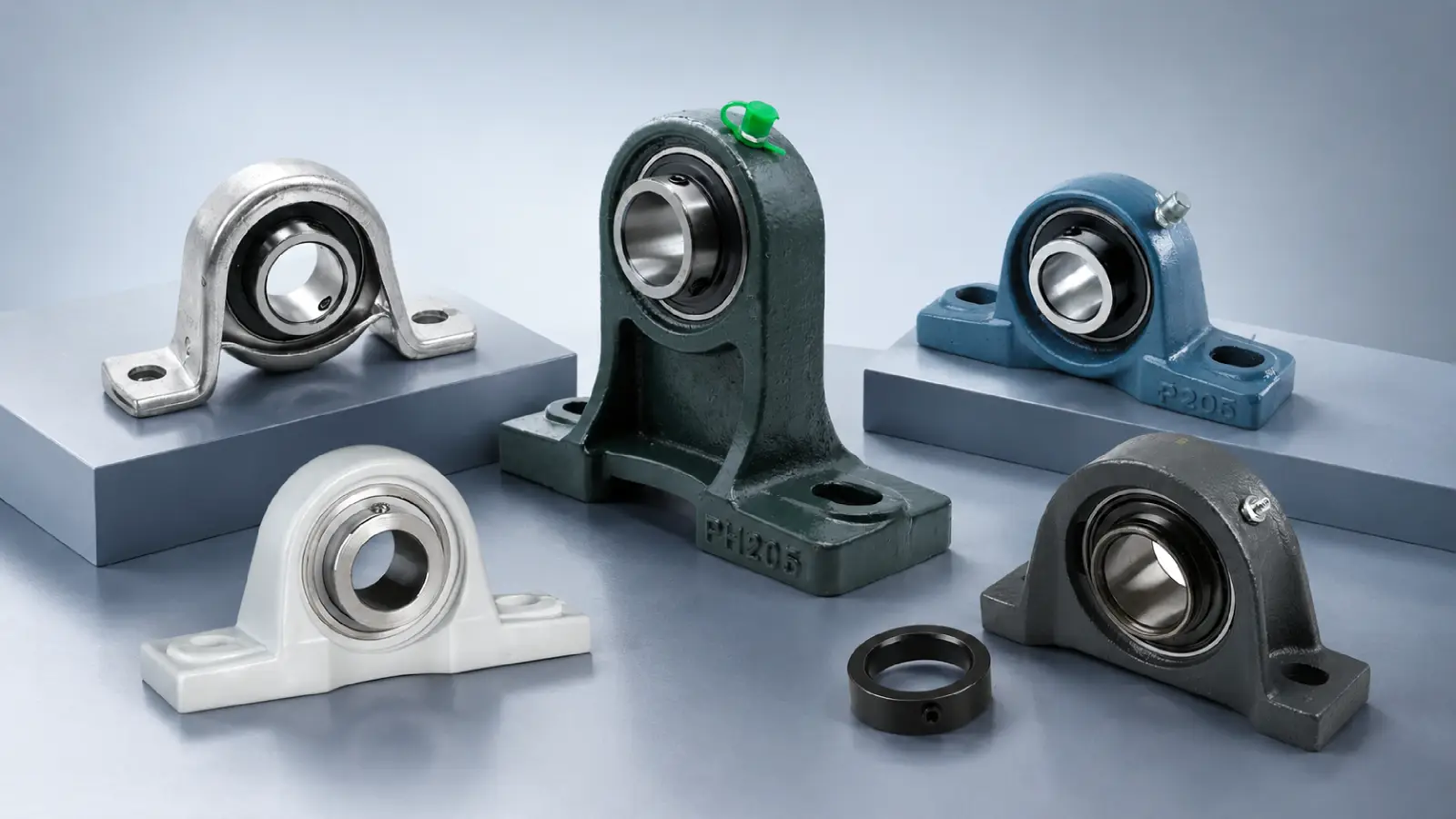
Pillow block bearings are ready-to-mount units that combine a rolling bearing insert with a pedestal housing. The housing bolts to a support surface, while the insert carries the shaft. This simple format reduces assembly work, but the complete unit still has several design variables.
These variables are not arbitrary—they directly affect the bearing’s fit, alignment, and load transfer. Buyers must therefore confirm the housing material, bolt pattern, shaft size, locking method, seals, lubrication, and load direction. Similarly, a flange unit is a different housing form from a pillow block and must be ordered with its own part number, not a pillow block code. Likewise, matching a 205 size across brands does not prove that every dimension or suffix is equivalent.
Table of contents
- What Are the Main Pillow Block Bearing Features?
- Which Pillow Block Bearing Types Are Available?
- Where Are Pillow Block Bearings Commonly Used?
- What Installation and Removal Practices Matter?
- Which Brands, Series, and Models Should Buyers Know?
- How Are Pillow Block Bearing Codes Read?
- What Must Buyers Confirm Before Ordering?
- How Can HSN Support Pillow Block Bearing Orders?
- FAQ
What Are the Main Pillow Block Bearing Features?
A typical ball-bearing unit uses an insert with a spherical outside surface seated in a matching housing bore. This interface permits limited static alignment during mounting. It does not correct a bent shaft, moving foundation, or large operating misalignment.
The extended inner ring locks to the shaft, and seals retain lubricant while limiting contamination. Cast iron gives a rigid two-bolt base for general machinery. Pressed steel, composite, stainless, and special-temperature versions address different mass, corrosion, washdown, or heat requirements. These executions require their own complete codes.
Which Pillow Block Bearing Types Are Available?
Classification should begin with the bearing type and shaft-locking system, not only the housing outline. Common mounted ball units use the following arrangements:
| Unit type | How it locks | Main selection point |
|---|---|---|
| Set-screw unit | Two screws in the extended inner ring | Shaft tolerance, screw torque, and reversing duty |
| Eccentric-collar unit | Collar rotated and secured on an eccentric extension | Rotation direction and collar installation |
| Adapter-sleeve unit | Tapered bore insert tightened on a sleeve | Sleeve, locknut, clearance, and shaft condition |
| Pressed-steel unit | Insert retained in a light two-piece housing | Load, base stiffness, and environmental limits |
| Roller-bearing pillow block | Roller bearing with separate locking and housing system | Higher load system; do not use ball-unit codes |
Where Are Pillow Block Bearings Commonly Used?
Pillow block bearings are used on conveyors, fans, blowers, agricultural machines, packaging lines, textile equipment, material-handling systems, food-processing equipment, and general transmission shafts. Their bolted base and preassembled insert make shaft support straightforward where equipment has an accessible mounting surface.
However, the application must define radial load, occasional axial load, shock, speed, shaft direction, contamination, washdown, and temperature. Long conveyor shafts also need a clear fixed-and-floating arrangement for thermal expansion. A standard cast-iron unit may suit dry industrial service, while wet, corrosive, dusty, or hot positions need different housing, seal, grease, and cover choices.





What Installation and Removal Practices Matter?
Use a clean, straight shaft with the specified diameter and surface condition. Place both housings on a flat support, align the shaft without forcing the units, and tighten base bolts evenly with washers. Then apply the locking device in the manufacturer’s sequence and torque range. Do not use the insert’s self-aligning seat to compensate for poor base geometry.
During removal, release the set screws, eccentric collar, or adapter assembly before pulling the unit. Protect the shaft and housing bore from hammer damage. Record grease condition, seal wear, fretting, base cracks, and shaft marks because they help identify the cause of failure before a new unit is installed.
Which Brands, Series, and Models Should Buyers Know?
SKF, Timken, NTN, and Schaeffler supply mounted units under different designation systems. The examples below are complete brand references, not automatic cross-brand substitutes.
| Brand | Series or execution | Complete model example |
|---|---|---|
| SKF | Cast-iron pillow unit, set-screw locking | SY 25 TF |
| Timken | U Series pillow unit, eccentric locking collar | UELP205 |
| NTN | Cast-housing pillow unit, set-screw locking, inch bore | UCP205-100D1 |
| Schaeffler | Corrosion-resistant pillow unit for food-industry service | RASE25-TV-VA-FD |
A brand may offer several pillow block bearing types with the same nominal shaft size. Housing height, bolt spacing, base length, seal design, grease, and permissible speed can still differ. Always compare the complete product data and mounting drawing..
How Are Pillow Block Bearing Codes Read?
In SKF SY 25 TF, SY identifies the pillow-unit family, 25 identifies the metric shaft diameter, and TF identifies a set-screw-locked insert execution.
Timken UELP205 uses UEL for the eccentric-collar insert family, P for the pillow housing, and 205 for the metric size group.
NTN UCP205-100D1 combines a UCP set-screw pillow unit with a -100 inch-bore code and D1 execution suffix.
Schaeffler RASE25-TV-VA-FD includes a 25 mm bore plus material and application suffixes.
Because suffix meanings are brand-specific, never remove them when requesting a quote.
What Must Buyers Confirm Before Ordering?
Send the full unit code and identify whether the request is for a complete unit, insert only, or housing only. Also confirm these points:
- Metric or inch shaft diameter, tolerance, rotation direction, and surface condition
- Housing center height, overall length, bolt spacing, bolt size, and base material
- Set screw, eccentric collar, adapter sleeve, or other shaft-locking method
- Fixed or expansion position, radial and axial loads, speed, and duty cycle
- Seal, grease, relubrication, end cover, temperature, washdown, and contamination
- Quantity, photos, drawing, existing brand, and inspection requirements
How Can HSN Support Pillow Block Bearing Orders?
HSN Bearing Group supports model confirmation, sourcing, inspection, and replacement discussions. Buyers should provide the complete unit reference, insert and housing numbers, shaft size, mounting dimensions, quantity, application, and working conditions.
Based on this information, HSN reviews key parameters—including locking device, housing material, seals, grease, bolt pattern, center height, loads, speed, and environment. For older or difficult units, HSN can compare photos, samples, and controlled drawings before discussing an alternative or custom solution.
Once a solution is agreed, physical checks may cover dimensions, hardness, clearance, material, appearance, and rotation. However, similar UCP, SY, or RASE size references do not prove interchangeability because brand geometry and execution suffixes can differ.
FAQ
Is a pillow block bearing a complete unit?
Usually yes. Confirm whether the quote includes the insert, housing, seals, locking parts, and grease fitting.
Can a flange unit replace a pillow block?
Not from the bearing size alone. Their mounting faces, bolt patterns, center heights, and load paths differ.
Does a 205 code always mean a 25 mm shaft?
Metric 205 units often use 25 mm, but inch suffixes can change the bore. Check the complete brand code.
Can the housing correct shaft misalignment?
It allows limited static alignment. It cannot correct bent shafts, poor foundations, or large running movement.
Remarks
For pillow block bearing models not listed above, contact HSN for confirmation. Send the complete model, photos, dimensions, quantity, application, and working conditions.
This article is based on independent analysis of publicly available technical information and industry understanding for knowledge sharing. All brand names and trademarks belong to their respective owners. HSN Bearing Group is an independent bearing supplier and technical service provider.
Tel: +86 156 6578 7336 Email: service@hsnindustrial.com Website: www.rollingparts.com www.hsnbearing.com
Need Help Finding Pillow Block Bearings?
Contact HSN to confirm a hard-to-find model or discuss a replacement after technical review.