

Why Precision Angular Contact Bearings Need Full-Code Checks?

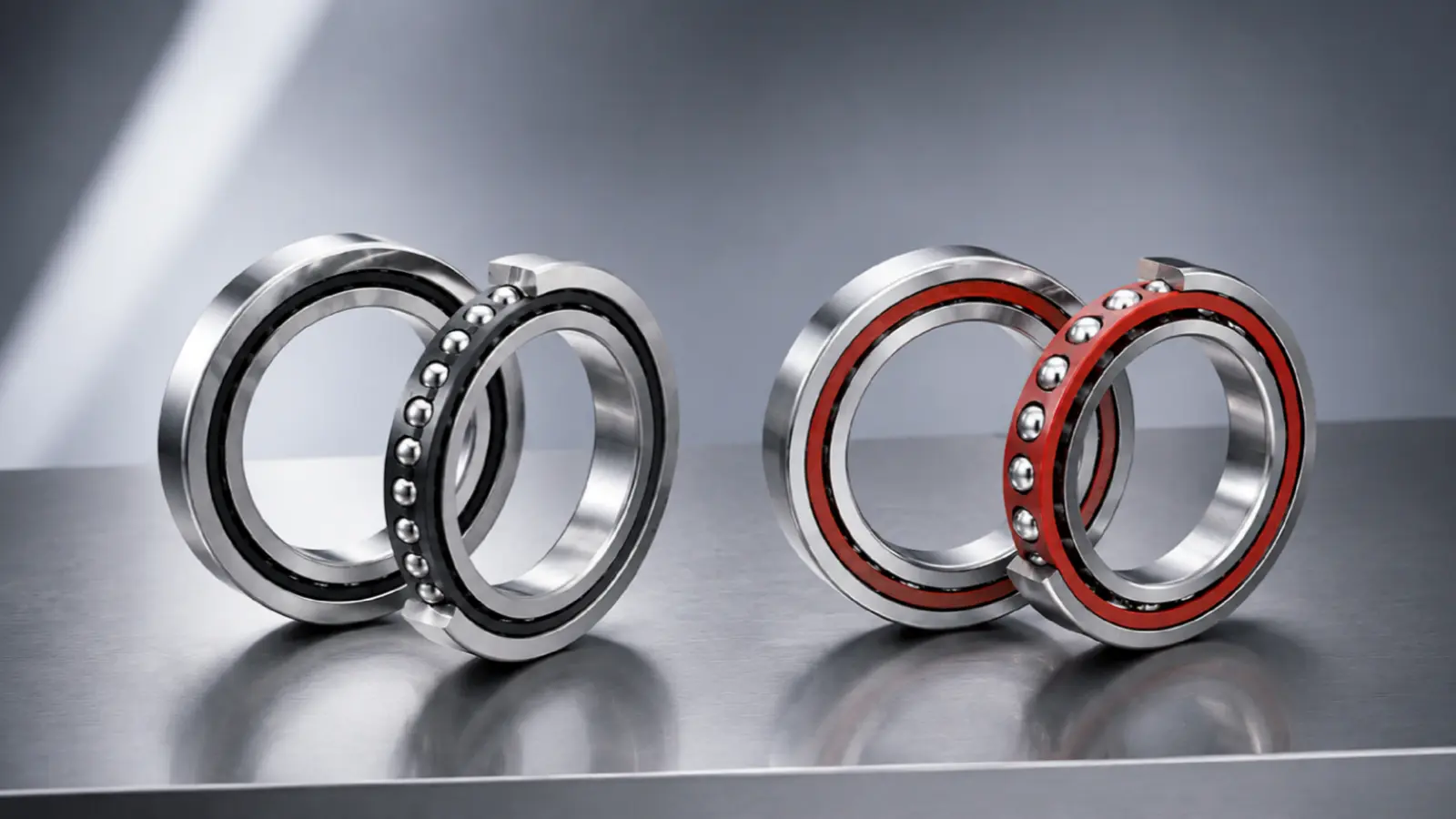
Precision angular contact bearings carry combined radial and axial loads through an offset contact line. Their geometry supports high running accuracy and speed, so they are widely used in machine-tool spindles and other precision shafts. However, a single bearing normally carries axial load mainly in one direction.
Designers use pairs or sets to control axial movement in both directions, increase stiffness, and resist moment load. Contact angle, preload, accuracy class, cage, seals, and lubrication all affect the result. Therefore, buyers must preserve the complete model and matching information instead of ordering from the basic 7010 size alone.
Table of contents
- How Does Contact Angle Affect Bearing Performance?
- Which Designs and Arrangements Are Available?
- Where Are Precision Angular Contact Bearings Used?
- What Installation and Removal Details Matter?
- Which Brands, Series, and Models Should Buyers Know?
- What Must Buyers Confirm Before Ordering?
- How Can HSN Support Precision Bearing Orders?
- FAQ
How Does Contact Angle Affect Bearing Performance?
The contact angle is measured between the load line through a ball and a plane perpendicular to the bearing axis. A smaller angle generally supports higher speed, while a larger angle increases axial capacity and stiffness. Engineers should select the angle from the actual radial load, axial load, speed, lubrication, and spindle arrangement.
Precision bearings also use tighter dimensional and running tolerances than general-purpose units. These tolerances only provide value when the shaft seats, housing bores, spacers, shoulders, clamping, and temperature control are equally accurate. A precision label cannot compensate for poor surrounding geometry.
Which Designs and Arrangements Are Available?
Single bearings can be supplied alone, universally matchable, or as factory-matched sets. The product ranges include steel-ball, hybrid ceramic-ball, open, sealed, high-capacity, and high-speed executions. Each brand expresses these features through its own suffix system.
| Arrangement | Load and stiffness behavior | Main confirmation |
|---|---|---|
| Back-to-back pair | Supports axial load in both directions and resists moment load | Orientation marks, preload, spacer widths, and clamp force |
| Face-to-face pair | Supports axial load in both directions with a narrower spread | Alignment sensitivity, preload, and shoulder geometry |
| Tandem pair | Shares higher axial load in one direction | Equal load sharing and opposing locating bearing |
| Universal set | Ground for a stated preload when mounted in a defined arrangement | Set quantity, preload class, sequence, and matching marks |
| Hybrid or sealed execution | Targets speed, friction, contamination, or grease retention | Ball material, seal type, lubricant, and temperature |
Where Are Precision Angular Contact Bearings Used?
Precision angular contact bearings are used in machining-center spindles, grinding spindles, lathes, high-speed routers, precision motors, robotic axes, measuring equipment, and multi-spindle drilling heads. Their contact geometry helps combine speed, axial location, stiffness, and running accuracy in a compact bearing arrangement.
The application must still define cutting load, tool overhang, acceleration, maximum and continuous speed, cooling, lubrication, and required runout. Spindle duty may favor a high-speed small-angle design, while heavier axial work may require a different contact angle or tandem support. Designers must also review thermal growth and housing stiffness with the complete bearing set.




What Installation and Removal Details Matter?
Handle precision bearings in a clean area and keep them in protective packaging until assembly. Check shaft and housing geometry, shoulder squareness, spacer parallelism, and fit before mounting. Follow the orientation and matching marks on universal pairs or sets. Never mix rings or bearings from matched groups.
Apply mounting force only to the ring with the interference fit, and use controlled heating when the approved procedure requires it. After clamping, verify running torque and axial behavior. A staged run-in is important for grease-lubricated spindles because excessive grease or rapid acceleration can produce heat. Record the original set arrangement before removal.
Which Brands, Series, and Models Should Buyers Know?
FAG, SKF, and NTN use different suffix systems for spindle and high-precision angular contact bearings. These verified examples share 50×80×16 mm boundary dimensions. However, this dimensional comparison does not treat the three models as interchangeable.
| Brand | Series or execution | Complete model example |
|---|---|---|
| FAG | B70 spindle bearing, 25 degree high-capacity design, universal light preload | B7010-E-T-P4S-UL |
| SKF | 70 series super-precision high-capacity single-row bearing | 7010 ACD/P4A |
| NTN | Machline high-precision single-row bearing, 15 degree contact angle | 7010CVUJ74 |
The equal bore, outside diameter, and width only establish boundary size. Contact angle, internal design, preload, cage, precision, permissible speed, and matching method still require separate review.
In each example, 70 identifies the dimension series and bore code 10 corresponds to a 50 mm bore. In FAG B7010-E-T-P4S-UL, B identifies a spindle-bearing family and E identifies the 25 degree design. T belongs to the cage execution, P4S identifies restricted precision tolerances, and UL identifies universal matching with light preload.
SKF ACD identifies its high-capacity angular contact design, while P4A identifies the super-precision execution. NTN 7010CVUJ74 is a complete Machline code associated with a phenolic cage, ISO Class 4 precision, 15 degree contact angle, and light preload. Buyers must confirm these properties from the exact brand code instead of transferring suffix meanings between manufacturers.
What Must Buyers Confirm Before Ordering?
Send the complete model from every ring or package and identify whether the order requires singles, pairs, or matched sets. Also confirm:
- Bearing quantity per set, DB, DF, DT, or another arrangement, and orientation
- Contact angle, steel or ceramic balls, cage, open or sealed construction
- Precision class, universal matching, preload class, and spacer requirements
- Radial and axial loads, continuous and peak speed, stiffness, and runout target
- Grease or oil-air lubrication, cooling, temperature, shaft fit, and housing fit
- Photos, spindle drawing, application, quantity, and inspection requirements
How Can HSN Support Precision Bearing Orders?
HSN Bearing Group supports model confirmation, sourcing, inspection, and replacement discussions for precision angular contact bearings. Buyers should provide the complete model, set arrangement, preload, precision class, quantity, spindle drawing, loads, speed, lubrication, cooling, and working conditions. HSN can then review dimensions, contact angle, cage, ball material, seals, matching marks, fits, and application requirements.
For difficult references, HSN can compare photos, samples, and controlled drawings before discussing an alternative. Agreed checks may cover dimensions, hardness, appearance, rotational accuracy, and clearance- or preload-related data. Buyers may also request vibration and noise checks when relevant. However, matching 7010 dimensions do not prove equivalent speed, preload, precision, or set behavior.
FAQ
Can one angular contact bearing carry both directions?
A single row mainly carries axial load in one direction. Pairs or sets control both directions.
Does P4 mean the same for every brand?
No. Precision designations and suffix combinations are brand-specific. Keep the full reference.
Can bearings from different sets be mixed?
Do not mix matched bearings without technical approval. Preload, width matching, and orientation can be affected.
Are all 7010 precision bearings interchangeable?
No. Compare contact angle, preload, cage, ball material, accuracy, lubrication, and set arrangement.
Remarks
For precision angular contact bearing models not listed above, contact HSN for confirmation. Send the complete code, set details, drawing, quantity, application, and working conditions.
This article is based on independent analysis of publicly available technical information and industry understanding for knowledge sharing. All brand names and trademarks belong to their respective owners. HSN Bearing Group is an independent bearing supplier and technical service provider.
Tel: +86 156 6578 7336 Email: service@hsnindustrial.com Website: www.rollingparts.com www.hsnbearing.com
Need Help Finding Precision Angular Contact Bearings?
Contact HSN to confirm a hard-to-find model or discuss a replacement after technical review. Send the full code, set arrangement, drawing, quantity, application, and working conditions.