

Why PTFE Bushings Need Material, Fit and Model Checks?

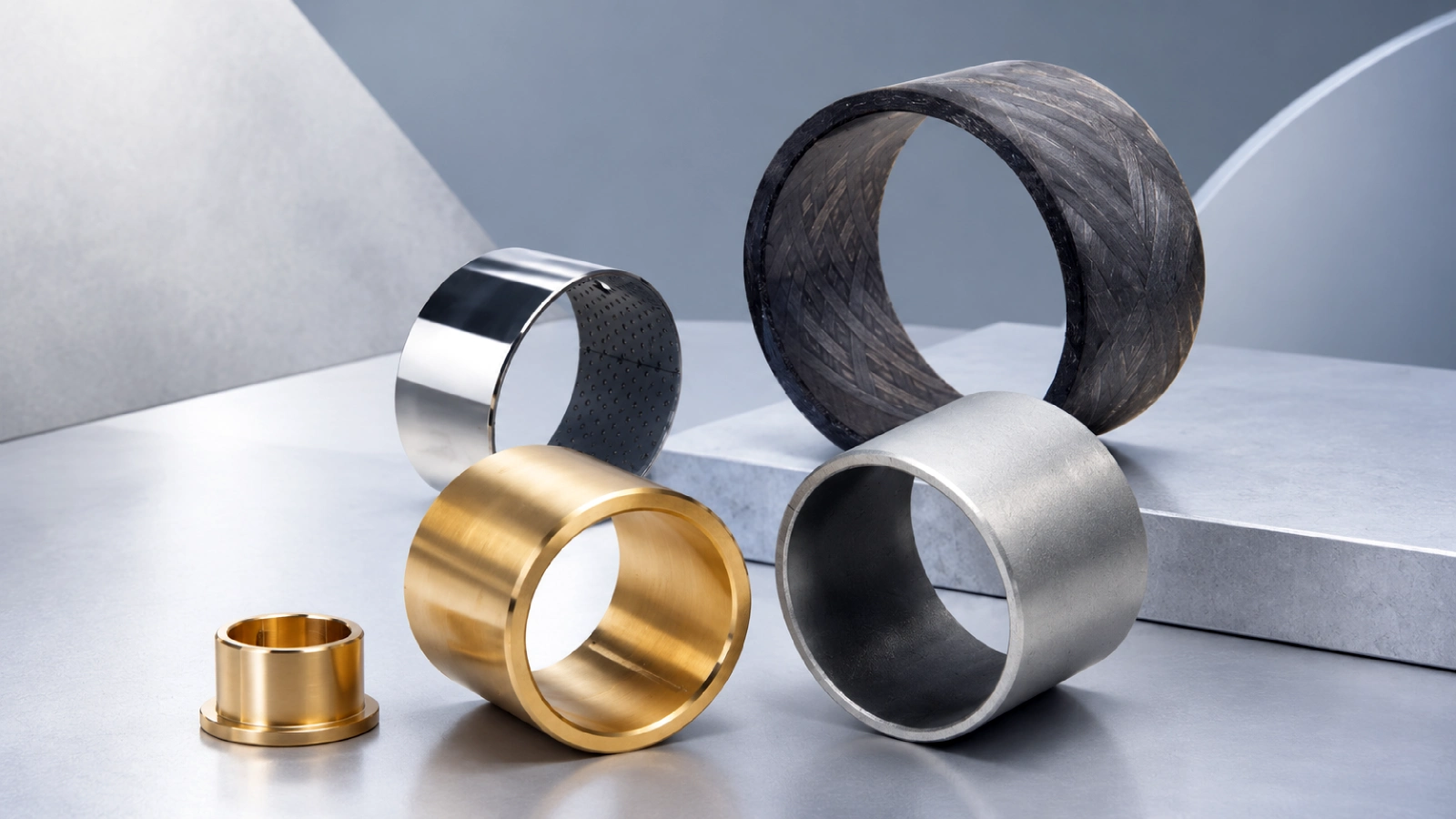
PTFE bushings are plain bearings that use polytetrafluoroethylene in the sliding layer or polymer matrix. Buyers also search for a teflon bushing, but PTFE is the useful generic material description. The product may be a steel-backed composite, a polymer bushing containing PTFE, or another engineered sliding construction.
These variations directly affect load capacity, temperature limits, fit tolerance, and lubrication requirements—and ordering from size alone risks receiving a product unsuitable for the actual sliding conditions. Therefore, buyers should identify the backing, sliding layer, dimensions, motion, and mating surfaces before ordering. In SKF composite codes, the letters define product form and material family, while grouped numbers represent principal dimensions.
Table of contents
- How Are PTFE Composite Bushings Constructed?
- Which PTFE Bushing Forms Are Available?
- Where Are PTFE Bushings Commonly Used?
- What Installation and Removal Practices Matter?
- Which SKF PTFE Series and Models Should Buyers Know?
- What Must Buyers Confirm Before Ordering?
- How Can HSN Support PTFE Bushing Orders?
- FAQ
How Are PTFE Composite Bushings Constructed?
A common PTFE composite bushing has a steel backing, a porous sintered bronze intermediate layer, and a PTFE-based sliding layer containing solid-lubricant additives. The backing provides mechanical strength, the bronze layer bonds and spreads heat, and the PTFE surface reduces friction during dry sliding.
A PTFE-filled polymer bushing uses a different body material and is not the same as a steel-backed composite. The two types can have different wall thickness, press fit, temperature range, and load capability. Color or a general PTFE label cannot confirm the construction.
Which PTFE Bushing Forms Are Available?
Product form determines whether the sliding element carries radial load, locates axial movement, or lines a custom surface. Therefore, buyers should identify the required load direction before comparing dimensions. SKF PTFE composite family illustrates several common forms.
| Form | Main load function | Ordering check |
|---|---|---|
| Straight bushing | Radial support for rotation or oscillation | Bore, outside diameter, width, butt joint, and installed clearance |
| Flanged bushing | Radial support plus axial location in one direction | Flange diameter, flange thickness, shoulder, and alignment |
| Thrust washer | Space-saving axial sliding support | Bore, outside diameter, thickness, anti-rotation, and backing surface |
| Composite strip | Custom wear surface or formed sliding element | Material direction, final shape, edge finish, and retention |
| PTFE-filled polymer bushing | Dry sliding where the specified polymer grade supports the load and environment | Polymer grade, fillers, wall thickness, fit, temperature, and any electrical requirements |
A PTFE-filled polymer bushing should not automatically be described as electrically insulating. Fillers, additives, moisture, temperature, and the complete material formulation can affect electrical behavior. Consequently, applications that require electrical isolation need a documented material rating and a review of the complete assembly.
Where Are PTFE Bushings Commonly Used?
PTFE bushings are used in automotive linkages, material-handling equipment, textile machinery, appliances, packaging mechanisms, agricultural controls, hinges, pivots, and slow oscillating joints. Their low-friction sliding layer is useful where regular relubrication is difficult, space is limited, or clean operation is preferred.
However, performance depends on pressure, sliding velocity, temperature, shaft finish, alignment, and contamination acting together. Oscillation can concentrate wear over a short arc, while soft or rough shafts damage the transfer film. Buyers should provide the load direction, motion angle, cycle rate, shaft material, housing material, temperature, environment, and whether dry or fluid-assisted operation is planned.




What Installation and Removal Practices Matter?
First, prepare a clean housing bore and a smooth shaft without burrs. A 10- to 15-degree lead-in chamfer helps the bushing enter the housing and protects the sliding layer. Next, use a shouldered mandrel or press tool that supports the bushing end evenly. Do not hammer the thin edge or scrape the PTFE surface.
After press fitting, the bushing reaches its intended bore and clearance. Therefore, inspect the housing, bushing, and shaft as one system, and avoid uncontrolled reaming of the sliding layer. For removal, use an aligned extraction tool or supported press method. Finally, record edge loading, scoring, joint position, and backing corrosion before discarding the old part.
Which SKF PTFE Series and Models Should Buyers Know?
SKF supplies related PTFE composite plain-bearing forms under PCM designations. Meanwhile, the additional letters distinguish straight bushings, flanged bushings, thrust washers, and strip material. The following complete examples show how product form changes the designation.
| SKF series | Product form | Complete model example |
|---|---|---|
| PCM .. E | Metric straight PTFE composite bushing | PCM 202315 E |
| PCMF .. E | Metric flanged PTFE composite bushing | PCMF 202315 E |
| PCMW .. E | Metric PTFE composite thrust washer | PCMW 223801.5 E |
| PCMS .. E | PTFE composite strip | PCMS 1005002.0 E |
However, these examples belong to one brand system. Another manufacturer may use a different backing, sliding-layer thickness, tolerance, or material suffix for a visually similar product. Therefore, direct replacement requires both dimensional and application confirmation.
For PCM 202315 E, P means plain bearing, C means composite material, and M means metric size. The grouped number 202315 gives 20 mm bore, 23 mm outside diameter, and 15 mm width. Suffix E identifies the PTFE composite sliding material with molybdenum disulphide.
Adding F creates the flanged PCMF form. In addition, W identifies a thrust-washer code. In PCMW 223801.5 E, 22 gives the bore, 38 gives the outside diameter, and 01.5 gives the 1.5 mm thickness. Meanwhile, PCMS identifies strip material, and its number describes width, length, and thickness. Therefore, buyers should preserve every decimal point and suffix exactly as published.
What Must Buyers Confirm Before Ordering?
A complete inquiry should identify both the bushing and the mating components. Provide these details:
- Complete model, dimensions, quantity, and straight, flanged, washer, or strip form
- Steel-backed composite, PTFE-filled polymer, or other sliding-layer construction
- Housing bore, shaft diameter, tolerances, chamfers, surface finish, and hardness
- Radial or axial load, static pressure, sliding speed, oscillation angle, and duty cycle
- Dry, grease, oil, water, or process-fluid exposure plus temperature and contamination
- Photos, drawing, application, anti-rotation method, and inspection requirements
How Can HSN Support PTFE Bushing Orders?
HSN Bearing Group supports model confirmation, sourcing, inspection, and custom supply discussions for ptfe bushings. Buyers should provide the complete code, drawing, sample photos, dimensions, quantity, material construction, application, and working conditions. HSN can then review the backing, sliding layer, product form, fit tolerance, shaft finish, load, motion, temperature, lubrication, contamination, and installation method.
For non-standard or difficult parts, HSN can evaluate samples and controlled drawings before discussing production or a replacement option. Agreed checks may cover dimensions, wall thickness, material, flange geometry, surface condition, and assembly fit. However, matching nominal dimensions do not prove equivalent clearance or performance because the layer system, tolerances, and mating surfaces can differ.
FAQ
Can PTFE bushings run without grease?
Many PTFE composite types are designed for dry running. Confirm the exact material and application conditions.
Is every white polymer bushing PTFE?
No. Color does not identify the polymer, filler, backing, load capability, or temperature range.
Can a PTFE bushing be reamed after fitting?
Avoid uncontrolled machining of the sliding layer. Confirm the permitted calibration or finishing method.
Does PCM 202315 E show the dimensions?
Yes. In the SKF code, it identifies 20 mm bore, 23 mm outside diameter, and 15 mm width.
Remarks
For ptfe bushing models not listed above, contact HSN for confirmation. Send the complete model, photos, dimensions, quantity, application, and working conditions.
This article is based on independent analysis of publicly available technical information and industry understanding for knowledge sharing. All brand names and trademarks belong to their respective owners. HSN Bearing Group is an independent bearing supplier and technical service provider.
Tel: +86 156 6578 7336 Email: service@hsnindustrial.com Website: www.rollingparts.com www.hsnbearing.com
Need Help Finding PTFE Bushings?
Contact HSN to confirm a hard-to-find model or discuss a replacement after technical review.