

Why Kaydon Bearings Need Type, Load and Model Checks?

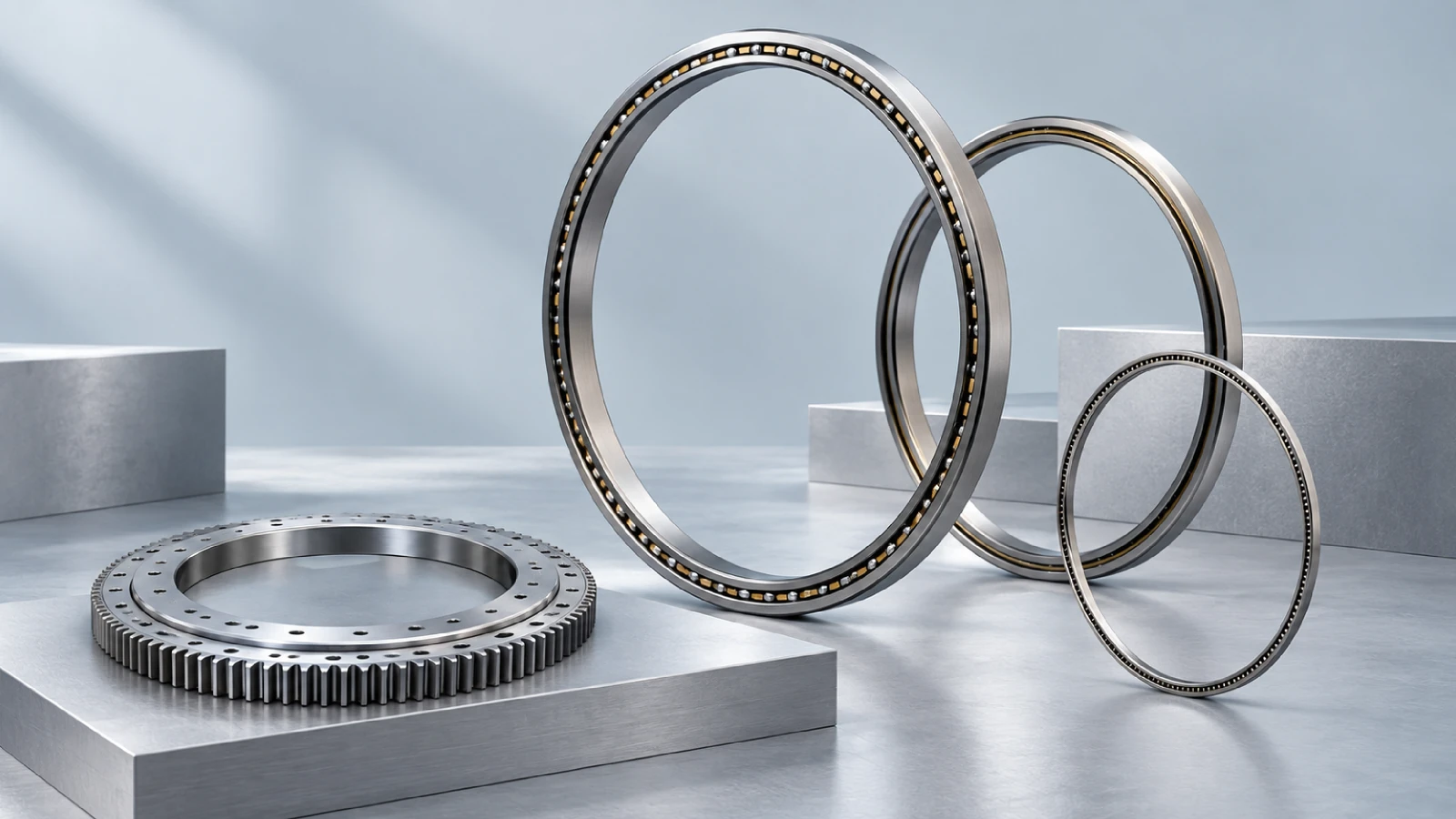
A search for kaydon bearings can refer to several product groups with very different structures. A buyer may need a Reali-Slim thin-section bearing for compact precision motion, a turntable bearing, or a large slewing ring for combined loads. The brand name and bore size do not identify the complete requirement.
Before sourcing, buyers should confirm the bearing type, full designation, load direction, internal fit, mounting arrangement, accuracy, sealing, lubrication, and operating environment. These checks are also necessary before any alternative supply option can be reviewed.
Table of contents
What Is Kaydon and Which Bearing Markets Does It Serve?
Kaydon began in 1941 and is now an SKF Group brand. Its bearing portfolio is associated mainly with thin-section ball bearings, slewing ring bearings, turntable solutions, and application-specific designs. These products serve applications where space, weight, stiffness, positioning accuracy, or a large rotating diameter affects the machine design.
Typical markets include aerospace, robotics, semiconductor equipment, medical systems, industrial machinery, machine tools, heavy equipment, mining, oil and gas, radar, solar power, and wind energy. However, the operating priorities differ sharply. A robotic joint may emphasize compact size and low torque, while a crane or excavator position may require a slewing bearing that supports thrust, radial, and moment loads.
Therefore, buyers should identify the machine position before comparing part numbers. The same Kaydon name can appear on products intended for precision instruments, intermittent turntables, or heavy-duty rotating structures.






Which Kaydon Thin-Section Bearing Types Should Buyers Know?
Reali-Slim bearings use a constant cross-section within each series as the bore diameter increases. The three basic contact arrangements are Type C radial contact, Type A angular contact, and Type X four-point contact.
- Type C is primarily a radial-contact design. Any axial load capability depends on clearance, fit, speed, and application conditions.
- Type A provides angular contact and unidirectional thrust capacity. Opposed arrangements are commonly considered when reversing thrust or moment support is required.
- Type X uses four-point contact geometry to support radial, axial, and moment loads in one bearing arrangement. It should not automatically be paired with another Type X bearing without an application review.
A complete Reali-Slim code carries more information than the series and bore alone. The following example shows why every position matters.
| Code | Code section | Meaning |
|---|---|---|
| K | Material and closure | AISI 52100 bearing steel; open construction without seals or shields |
| G | Series and cross-section | Reali-Slim G Series with a 1.000 × 1.000-inch cross-section |
| 120 | Bore size | Nominal 12.000-inch bore |
| X | Contact type | Four-point contact bearing |
| P | Separator | One-piece formed snap-over separator for Type C or Type X |
| 0 | Precision class | Kaydon Precision Class 1, corresponding to ABEC 1F |
| L | Internal fit | 0.0000–0.0010-inch diametral preload in the unmounted bearing |
The complete KG120XP0L designation is important because each position defines a different part of the bearing configuration. Buyers should preserve every character and confirm any additional seal, coating, lubricant, or special drawing requirement before ordering.
Which Kaydon Slewing Bearing Designs Should Buyers Compare?
Kaydon slewing products include ball and roller designs for different combinations of capacity, stiffness, rotation, and positioning. Series letters identify a family, but they do not replace load calculations or drawing checks.
| Design group | Series examples | Main comparison point |
|---|---|---|
| Four-point contact ball | RK, HS, HT, MT, KH, XT | Envelope, gear option, stiffness, precision, and combined-load requirement |
| Eight-point contact ball | DT | Two ball rows, load sharing, stiffness, and mounting accuracy |
| Cross roller | XR | Moment stiffness, dynamic capacity, speed, and lubrication |
| Three-row roller | TR | High thrust, radial and moment loads in large rotating equipment |
For example, RK and HS are both four-point contact families, but their sections and capacity ranges differ. KH is associated with precise positioning, while HT and XT address larger or heavier-duty requirements. A shared outside diameter does not make these series interchangeable.
Buyers should also confirm whether the bearing is non-geared, internally geared, or externally geared. Gear module or diametral pitch, tooth count, backlash requirement, mounting-hole pattern, seals, and lubrication provisions can determine whether a slewing ring fits the existing assembly.
How Should Buyers Confirm Load, Mounting and Model Details?
Selection starts with the actual load case. Record axial load, radial load, overturning moment, shock, duty cycle, rotation angle, speed, acceleration, and emergency conditions. For oscillating motion, the movement range and reversal frequency also matter because lubrication distribution can differ from continuous rotation.
Mounting structure is equally important. Ring stiffness, support flatness, bolt grade, bolt pattern, pilot dimensions, gear alignment, and installation sequence affect load distribution. Thin-section bearings also require suitable shaft and housing fits because ring deformation can change clearance, torque, and running accuracy.
The environment determines additional options. Dust, moisture, corrosion, vacuum, cleanroom requirements, temperature, and washdown exposure can influence material, coating, seals, separator, and lubricant selection. As a result, a dimensional match alone cannot confirm application suitability.
What Should Buyers Provide for an Alternative Inquiry?
An effective inquiry should allow the supplier to separate identification from engineering review. Provide:
- Complete Kaydon model and all suffixes
- Photos of markings and the installed bearing
- Bearing drawing or measured dimensions
- Contact type, gear arrangement, and mounting-hole pattern
- Axial, radial, and moment loads
- Speed, rotation angle, duty cycle, and required life
- Accuracy, clearance, preload, and running-torque requirements
- Material, coating, seal, separator, and lubricant details
- Application, environment, quantity, and delivery requirement
- Required inspection records or acceptance criteria
HSN can compare the reference with drawings, samples, dimensions, and working conditions. Before shipment, key checks can include dimensional tolerance, hardness, and clearance where relevant. Material verification, rotation accuracy, vibration, noise, or flaw detection can be discussed according to the bearing construction and customer requirements. No direct interchange should be assumed before the technical review is complete.
FAQ
Can Type C, Type A and Type X bearings interchange?
No. Their contact geometries and load capacities differ. Confirm the full code, mounting, clearance or preload, speed and accuracy.
Does a Kaydon bore size identify the full bearing?
No. The code may also define material, cross-section, contact type, separator, precision and internal fit.
Can outside diameter identify a slewing bearing?
No. Also confirm loads, gear arrangement, bolt pattern, pilot dimensions, raceway design, sealing, lubrication and support structure.
What helps HSN review a Kaydon bearing alternative?
Send the full model, photos, drawing, dimensions, load data, mounting details, application, quantity and inspection needs.
Remarks
For detailed Kaydon bearing models not listed above, please contact HSN for model confirmation and supply discussion. For other bearing types, send the complete model, photos, dimensions, quantity, application, and working conditions.
This article is based on independent analysis of publicly available technical information and industry understanding and is intended for knowledge sharing. All brand names and trademarks belong to their respective owners. HSN Bearing Group is an independent bearing supplier and technical service provider.
Tel: +86 156 6578 7336 Email: service@hsnindustrial.com Website: www.rollingparts.com www.hsnbearing.com
Need Help Confirming a Kaydon Bearing Model?
Contact HSN to confirm a hard-to-find model or discuss a replacement after technical review.