

Why Thomson Linear Bearings Need System and Application Checks

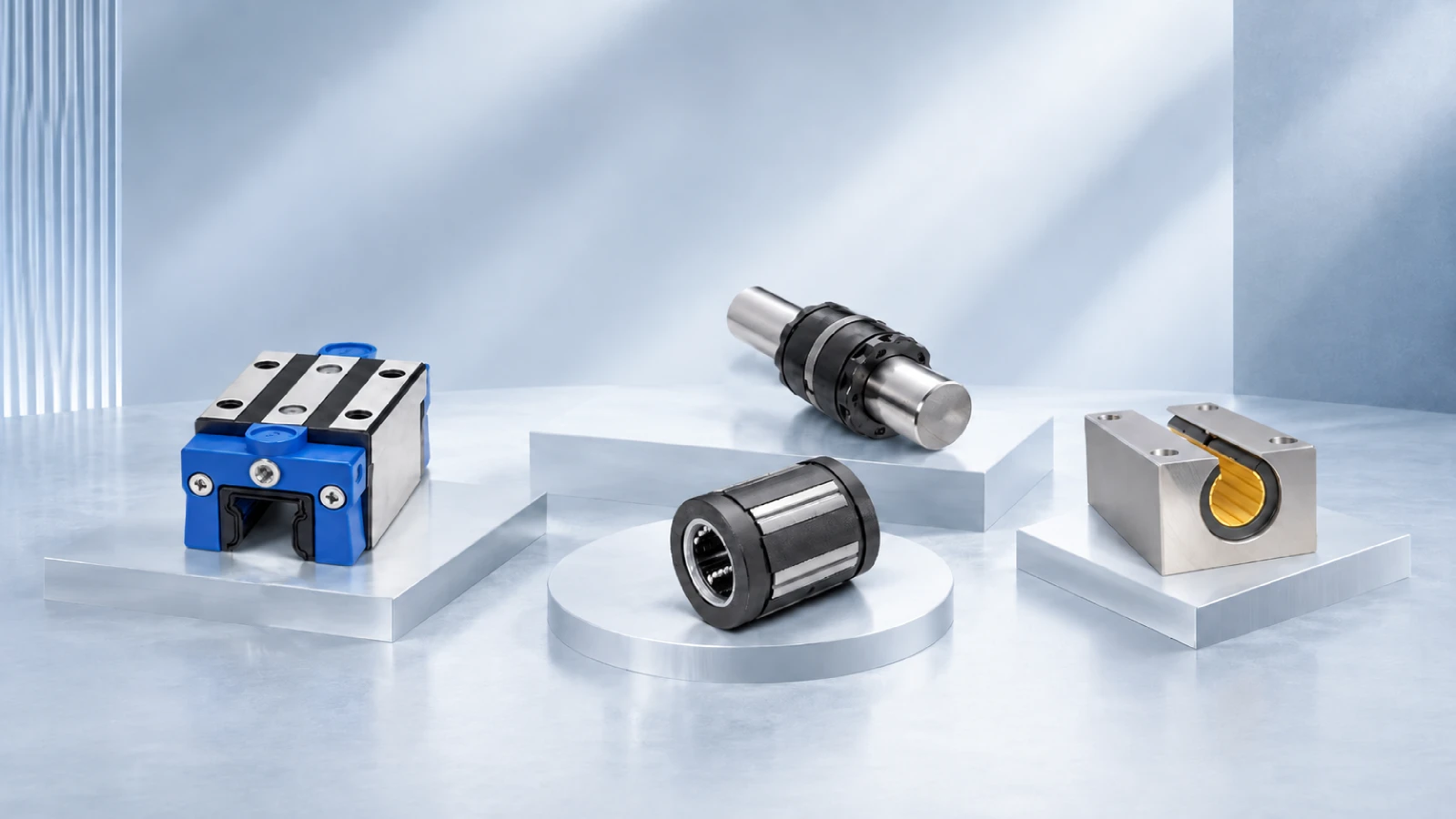
Thomson linear bearings include several technologies for guiding straight-line motion. Buyers may be looking for a ball bushing on a round shaft, a polymer bushing, a mounted pillow-block unit, or a carriage running on a profile rail. These products have different mounting and performance requirements.
Consequently, a bearing number should be reviewed with the shaft, housing, or rail that supports it. Nominal size alone cannot confirm fit, clearance, load capacity, rigidity, travel accuracy, or environmental suitability. The complete system must also be checked before an alternative supply option is discussed.
Table of contents
What Is Thomson and How Is Its Linear Motion Portfolio Organized?
Thomson is a motion technology manufacturer with decades of experience in mechanical linear motion. Its portfolio covers linear bearings and guides, ball screws, lead screws, actuators, profile rail systems, round-rail components, and complete linear motion systems.
This range serves applications with different priorities. Packaging equipment may require fast travel and environmental protection. Machine tools and measuring systems can emphasize stiffness and accuracy, while medical equipment may need quiet, smooth motion.
First identify the system architecture. A round-rail bearing runs on a cylindrical shaft, while a profile rail carriage uses a matching profiled rail. A complete linear unit may also include a drive and protection components.
Which Thomson Linear Bearing Types Should Buyers Know?
Thomson offers both round-rail and profile-rail products. The following examples show how model structure helps identify the required configuration.
| Product type | Model example | System detail to confirm |
|---|---|---|
| Closed polymer bushing | PLM20 | 20 mm shaft, housing bore, retention, load, and shaft condition |
| Open polymer bushing | PLM20OPN | 20 mm supported shaft, opening orientation, load direction, and housing |
| Polymer bushing pillow block | PLBM20 | 20 mm shaft, block mounting dimensions, alignment, and support spacing |
| 500 Series profile rail system | 511P25A1 + 521P25A | Carriage style, size, accuracy, preload, rail style, and rail length |
| Other profile rail families | 400 Series, 500 Series Ball, 500 Series Roller, and MicroGuide | Rolling element, rigidity, accuracy, envelope, and environment |
The polymer codes provide a clear example. PLM20 is a closed bushing for a 20 mm shaft, while PLM20OPN is the open version. PLBM20 uses a pillow-block format. Their housing and support requirements differ.
The profile rail example shows why both components matter. 511P25A1 identifies a 500 Series carriage configuration, while 521P25A is the corresponding rail reference. The carriage code alone does not define rail length or hole layout.
Why Do Shaft, Housing and Bearing Designs Need System Checks?
In a round-rail system, the shaft forms part of the bearing arrangement. First, inspect its diameter, tolerance, hardness, surface finish, straightness, support spacing, and resistance to corrosion or contamination. A worn or undersized shaft can increase clearance and reduce guidance accuracy even when the new bearing has the correct nominal size.
Next, confirm the housing bore, tolerance, alignment, retention method, and structural support. An open bearing such as PLM20OPN needs a housing opening and a compatible supported-shaft arrangement. The opening must face the correct direction for both the shaft support and the applied load.
By contrast, profile rails require checks of base flatness, rail parallelism, fastening sequence, carriage spacing, and structural rigidity. These factors influence load distribution and running quality. Preload can improve rigidity, but it also reduces the allowable installation error. Therefore, select only enough preload to meet the deflection requirement.
Finally, evaluate radial load, moment load, acceleration, stroke, speed, duty cycle, lubrication, temperature, and contamination for the complete system. These checks separate a dimensionally similar component from one that can meet the application requirements.
Where Are Thomson Linear Bearings Commonly Applied?
Thomson linear motion products are used in packaging, printing, dispensing, factory automation, machining, test and measurement equipment, medical devices, lifting systems, and laboratory automation.
Priorities change by application. Packaging systems may combine long travel, rapid reversals, and protective covers. Measuring equipment can require accuracy and smoothness. Food-processing positions may need protection against moisture, while medical systems often prioritize low noise and controlled lubrication.
Buyers should describe the actual axis. Moving load, center of gravity, number of shafts or rails, travel, orientation, cycle rate, and environment determine which arrangement should be reviewed.






What Should Buyers Confirm Before Requesting Supply Support?
A complete inquiry allows the supplier to separate standard replacement needs from applications that require additional engineering review. Provide:
- Complete Thomson bearing, block, carriage, and rail codes
- Photos of markings and the installed assembly
- Shaft diameter, material, hardness, finish, and support method
- Housing bore, mounting dimensions, and retention method
- Rail length, hole pitch, end distances, and number of carriages
- Radial load, moment load, speed, acceleration, stroke, and duty cycle
- Required clearance, preload, accuracy, and running resistance
- Lubrication, seals, covers, and corrosion protection
- Temperature, dust, moisture, washdown, chips, or chemical exposure
- Quantity, requested delivery date, and inspection requirements
HSN can review the original reference together with dimensions, drawings, photos, samples, and working conditions. If the initial comparison supports an alternative, HSN then checks shaft or rail compatibility, housing fit, structure, material, load direction, and inspection criteria. The pre-shipment quality plan can include dimensional tolerance, hardness, and clearance checks where these items apply to the product.
FAQ
Are PLM20 and PLM20OPN the same bearing?
No. PLM20 is closed, while PLM20OPN is open. Their housing openings and shaft-support arrangements require separate checks.
Can a Thomson carriage be ordered without rail details?
Start with the carriage code, but also confirm the matching rail series, size, accuracy, length, hole layout and installed arrangement.
Why should an old shaft be inspected before replacement?
Wear, corrosion, incorrect diameter, poor finish or loss of straightness can increase clearance and reduce running accuracy.
What does HSN need for an alternative review?
Send the full code, shaft or rail data, housing dimensions, load, speed, stroke, environment, quantity and inspection needs.
Remarks
For detailed Thomson bearing models not listed above, please contact HSN for model confirmation and supply discussion. For other bearing types, send the complete model, photos, dimensions, quantity, application, and working conditions.
This article is based on independent analysis of publicly available technical information and industry understanding and is intended for knowledge sharing. All brand names and trademarks belong to their respective owners. HSN Bearing Group is an independent bearing supplier and technical service provider.
Tel: +86 156 6578 7336 Email: service@hsnindustrial.com Website: www.rollingparts.com www.hsnbearing.com
Need Help Confirming a Thomson Linear Bearing?
Contact HSN to confirm a hard-to-find model or discuss a replacement after technical review. For U.S. orders, also provide the delivery destination and required shipping terms if you need a freight-inclusive quotation.