

Why Drawn Cup Needle Roller Bearing Selection Needs Code Checks?

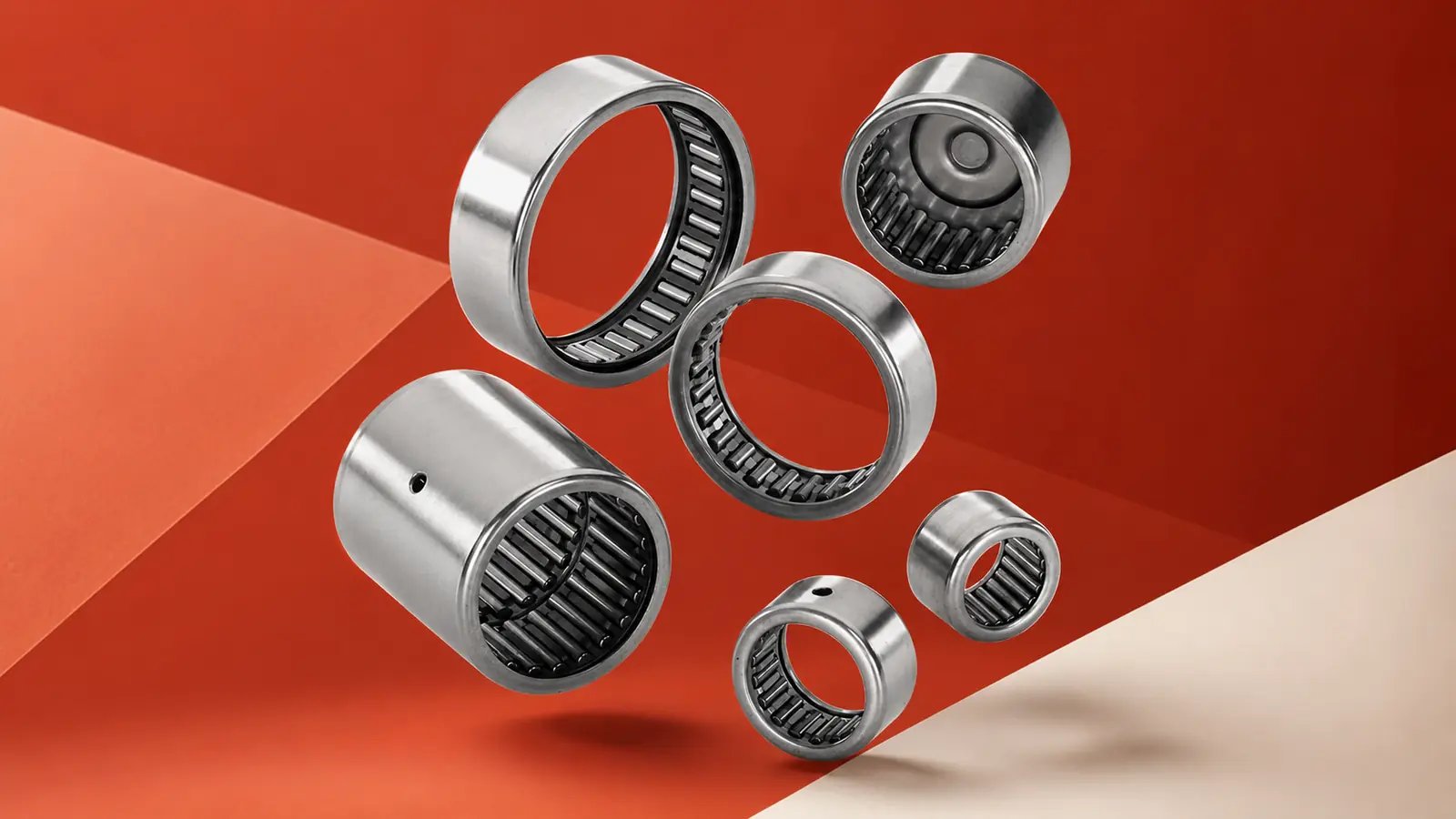
A drawn cup needle roller bearing combines a thin, deep-drawn outer ring with needle rollers and either a cage or a full roller complement. Its small radial section makes it useful where a machined outer ring would consume too much space. The bearing normally carries radial load and often runs directly on a hardened shaft.
Despite its simple appearance, the design depends strongly on the housing and shaft. Open, closed, sealed, caged, and full-complement versions serve different positions. Moreover, the housing fit shapes the thin outer ring and affects the final operating clearance. Buyers should therefore check the complete code and surrounding components before ordering.
Table of contents
- What Defines a Drawn Cup Needle Roller Bearing?
- Which Open, Closed, Caged, and Full-Complement Types Exist?
- Where Are Drawn Cup Needle Bearings Used?
- What Shaft, Housing, and Load Details Must Buyers Confirm?
- What Should Buyers Check During Installation and Removal?
- Which Brand Series and Complete Models Should Buyers Know?
- How Do Buyers Read a Drawn Cup Needle Bearing Code?
- How Can HSN Support Drawn Cup Needle Bearing Orders?
- FAQ
What Defines a Drawn Cup Needle Roller Bearing?
The drawn cup acts as both outer ring and outer raceway. Because it is thin, the ring can be slightly out of round before installation. A correctly made housing bore brings it to its intended shape after press fitting. Measuring only the unmounted outside diameter does not provide a reliable acceptance check.
Most versions do not contain an inner ring. In that arrangement, the shaft serves as the inner raceway and needs suitable hardness, surface finish, geometry, and diameter tolerance. If the shaft cannot provide an adequate raceway, the design can use a separate inner ring.
These bearings primarily support radial loads. A closed end can help protect a shaft-end position, but it does not turn the bearing into a general thrust bearing.
Which Open, Closed, Caged, and Full-Complement Types Exist?
The main structural groups solve different space, speed, load, and sealing problems:
| Type | Typical series | Practical selection point |
|---|---|---|
| Caged, open ends | HK | Compact radial support with access through both ends |
| Caged, closed end | BK | Shaft-end arrangement where one end must be closed |
| Sealed caged | HK..RS, HK..2RS, BK..RS | Lubricant retention and contaminant exclusion |
| Full complement, open | DL or HN, depending on brand | Higher radial load at more moderate speed |
| Full complement, closed | DLF | Closed shaft-end position with a full roller complement |
Some wide versions use two adjacent roller-and-cage assemblies. Lubrication holes can also appear as a standard feature or suffix. Buyers should check whether the supplied code includes the required seal, hole, or inner ring.
Where Are Drawn Cup Needle Bearings Used?
Drawn cup needle roller bearings are commonly used in automotive, industrial machinery, power tools, printing equipment, material handling, and compact drive systems. Typical positions include gear units, pumps, transmissions, electric tools, conveyor drives, and other mechanisms where radial installation space is limited.
Open types are suitable for through-shaft arrangements, while closed types are often used at shaft ends. Selection should also consider lubrication, contamination, oscillating or rotating motion, and whether the shaft or housing serves as the bearing raceway. Therefore, the mounting position and surrounding components are as important as the nominal bearing size.




What Shaft, Housing, and Load Details Must Buyers Confirm?
Confirm the radial load, speed, duty cycle, shock, lubrication, operating temperature, and contamination level. Then check the geometry that determines the final raceway:
- Shaft diameter, hardness, surface finish, and roundness
- Whether the shaft runs directly under the rollers
- Inner-ring reference when a separate raceway is required
- Housing-bore diameter, tolerance, roundness, and material
- Housing-wall thickness and local stiffness
- Available width and shaft-end clearance
- Seal count, seal direction, and lubrication-hole requirement
A housing with uneven wall thickness or local defects can deform the bearing. Likewise, a soft or rough shaft can damage the roller contact surface. Resolve these details before comparing brands.
What Should Buyers Check During Installation and Removal?
Use a press and a correctly sized mandrel to apply uniform force. For many needle-bush designs, the force belongs on the marked face. Do not strike the cup or transmit installation force through the rollers. The mandrel should keep the bearing square to the bore and stop at the planned mounting depth.
For a closed-end bearing, present the open end to the housing bore whenever the design requires it. Avoid pressing on the inside of a BK closed end. Also keep housing shoulders, covers, and spacers away from the thin cup edge unless the drawing provides suitable clearance.
Chamfer the shaft end and lubricate the seal-running surface before insertion. After assembly, verify smooth rotation and the required radial clearance. During removal, avoid scoring the housing bore. Do not reuse a removed cup when inspection finds distortion or damage.
Which Brand Series and Complete Models Should Buyers Know?
The following examples show common international series. Similar codes can share a dimensional convention, but materials, cage designs, seals, tolerances, and load ratings can still differ.
| Brand | Series examples | Complete model example |
|---|---|---|
| Nadella | HK open; BK closed; HK..RS and HK..2RS sealed; DL/DLF full complement | HK2016.2RS |
| SKF | HK open; BK closed; HK..RS and HK..2RS sealed; HN full complement | HK 2016.2RS |
| NTN | HK and HMK drawn cup series | HK2016 |
Nadella also lists models such as DL 20 16 and DLF 20 16 for open and closed full-complement designs.
Preserve the spaces and punctuation in each reference. Before treating one brand as an alternative, compare the mounted internal diameter, cup width, seal arrangement, load data, and installation requirements.
How Do Buyers Read a Drawn Cup Needle Bearing Code?
Nadella model HK2016.2RS shows how a compact code can describe construction and size.
| Code | Code section | Meaning |
|---|---|---|
| HK | Series prefix | Caged needle bush with open ends |
| 20 | Bore section | 20 mm nominal roller-complement bore |
| 16 | Width section | 16 mm nominal bearing width |
| 2RS | Seal suffix | Integral seal on both sides |
The code does not state every performance detail. Buyers still need the manufacturer, full reference, and current technical data. A missing suffix can change the sealing and lubrication arrangement.
How Can HSN Support Drawn Cup Needle Bearing Orders?
HSN Bearing Group supports model confirmation, sourcing, inspection, and custom supply discussions. Buyers should provide the full reference, quantity, and application conditions. HSN can review open or closed-end construction, seals, inner-ring needs, dimensions, and mounting direction. Shaft raceway, housing bore, fits, load, speed, and lubrication also matter.
For old or difficult models, HSN can review drawings, samples, and surrounding geometry. Replacement supply can follow technical confirmation. Before shipment, checks may cover dimensions, hardness, surface condition, appearance, and other agreed items. The cup takes its final geometry from the installed housing. Therefore, housing accuracy and inspection methods must also be considered. Similar base codes do not prove compatibility.
FAQ
Does the shaft act as the inner race?
Often yes when no inner ring is used. Its hardness, finish, diameter and tolerance must meet raceway requirements.
Why does housing bore accuracy matter?
The thin cup conforms to the housing, so bore size, roundness and rigidity affect clearance and alignment.
Can open and closed-end cups be exchanged?
Not automatically. End space, shaft position, lubrication access and mounting direction must be reviewed.
How should the cup be pressed into its housing?
Use the specified mandrel and press it evenly in the correct direction. Avoid direct blows and cup distortion.
Remarks
For detailed drawn cup needle roller bearing models not listed above, please contact HSN for model confirmation and supply discussion. When checking drawn cup needle roller bearing references, you can also send the complete model number, photos, dimensions, quantity, and working conditions for review.
This article is based on independent analysis of publicly available technical information and industry understanding for knowledge sharing. All brand names and trademarks mentioned belong to their respective owners. HSN Bearing Group is an independent bearing supplier and technical service provider.
Tel: +86 156 6578 7336 Email: service@hsnindustrial.com Website: www.rollingparts.com www.hsnbearing.com
Need Help Finding a Drawn Cup Needle Bearing?
Contact HSN with the complete model, shaft and housing dimensions, seal requirement, quantity, application and inspection needs for technical confirmation.